



A model in project management is a way of looking at the world. It’s a simplified version of how things work, used to give you a general overview and a direction to follow for your own work.
Think of models as shortcuts: approaches that present a way of thinking that’s tried-and-tested and is 99% likely to be applicable to your organization. They give you a framework for how to respond to a situation or deal with a project scenario.
Project management models in the PMBOK® Guide
The
The Eighth Edition no longer references models as a particular ‘thing’. Instead, they are broadly covered by the Tools and Techniques section, and some models, like Tuckman for team development, are dotted throughout the book in the place where you would most likely use them.
Some models mentioned in the
Essential read

We earn a commission if you click this link and make a purchase, at no additional cost to you #ad
The models mentioned in the PMBOK Guide are not supposed to represent an exhaustive list of every model in the world that might be relevant to your project, nor are they framed as recommendations.
Instead, like so much in project management, they are part of your toolbox and you’re supposed to be able to pick and choose what is going to be the most useful depending on the specifics of your situation.
Good project management comes down to tailoring, and this is another example of where you are expected to be able to make the right choice.

What are management models?
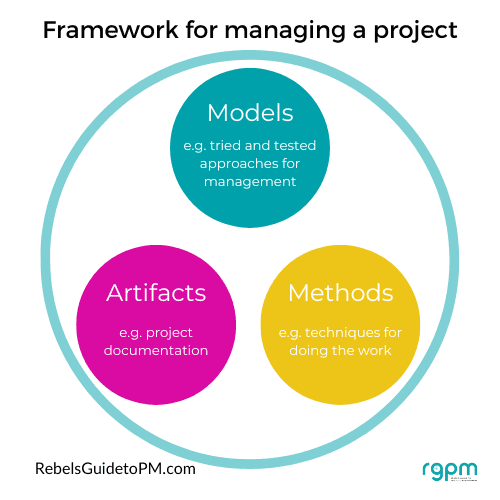
It can get quite confusing talking about methods, models and artifacts. PM models sit alongside methods and artifacts as part of the framework for managing a project. Let’s think of them like this:
- Model: A way of thinking about a particular management situation.
- Method: A way of working that achieves some kind of result, or delivers something.
- Artifact: A document, template or other thing produced by the project.
And while we’re on the subject of definitions, let’s talk about methodologies too.
- Methodology: A collection of ideas, processes, procedures and best practices.
So, methodology vs model: A methodology is a specific way of doing something (in project management, this would be your in-house way of managing projects) whereas a model is an industry-recognized way of thinking about a problem.
Models help you frame your thinking and benefit from best practice wisdom.
During your project, you’ll have to select the right artifacts to create, the right methods to use as part of your methodology and pick the most appropriate models to shape your actions.
Models help you tailor your project management approach to best fit your project’s needs.
Sound difficult? Getting the combination right is probably easier than you think, especially if you’ve had a bit of project management experience already.
How useful are models?
Management models reflect a pretty simplistic view of the world.
They are designed to explain how something works in theory, and you’ll have to decide how to best adapt the approach to make it work in practice.
Models don’t care whether you are using
A model is more of a core principle; something that helps you shape behavior and address a need at a single point in time or across your entire project.
Categories of models
There are a selection of commonly used models that feature as part of the life of a project manager. The project management models most likely to come up in your Project Management Professional (
- Situational leadership (Blanchard)
- Communication models like the Gulf of Execution and the Gulf of Evaluation
- Motivation (Herzberg’s work on hygiene and motivational factors and the hierarchy of needs, and Pink’s work on intrinsic and extrinsic motivation)
Change management (there are many: Satir, ADKAR, Bridges’s Transition Model, Kotter’s 8 steps)- Complexity (Cynefin and the Stacey Matrix)
- Conflict (notably the Thomas-Kilmann model)
- Project team development models (like Tuckman and Drexler/Sibbet)
- Negotiating (like Covey’s Think Win-Win)
- Planning (Boehm)
- Stakeholder salience (Mitchell, Agle and Wood – this is a good one for stakeholder engagement)
Some of these are proprietary models like ADKAR (from Prosci) and Situational Leadership (which I learned as a graduate trainee and has shaped how I manage my interactions with people at various levels in the organization – also extremely useful for delegating).
How to use the project management models
Some models have several ways that you can use them. For example, models of project complexity might be useful at portfolio, program and project level, as well as for explaining to individual sponsors why you need extra resources or budget to deal with complexity factors.
Some categories of model might have several options inside them. For example, there are several models for team development, but the one you and your team decide on using is the ever-popular Tuckman (he of Forming, Storming, Norming, Performing, Adjourning fame).
Some models are going to be most appropriate for different project performance domains. For example, you’d use conflict models (like Thomas-Kilmann) in the team performance domain.
Example: Using ADKAR
Let’s say you are delivering a project that has an element of process change and that means 10 users are going to have to do their work differently.
You could use the ADKAR model of
ADKAR is the Prosci model for delivering change based on best practice. It stands for:
- Awareness of the need for change
- Desire to support the change
- Knowledge of how to change
- Ability to demonstrate skills and behaviors
- Reinforcement to make the change stick.
You can see how that broad model doesn’t tell you what to do or how to do it, but it gives you a starting point for thinking about the change that your project is delivering and how you could help people through the change to improve the project’s outcomes.
Your role as the project manager is to take the ADKAR model for
For example, for the Awareness step, you’d think about whether people knew that the change was coming, why it was coming and how much they understood about the new process and why the project was being delivered at all.
When you know the answer to those questions, you can plan specific
Your next steps
The project management principles apply regardless of what model you use (or none, if you are making things up totally from scratch, which is your right).
I’d suggest checking those out next to round out how you want to manage your project or to continue your study prep.
Recommended
The PMP PrepCast Elite PLUS
This complete self-directed PMP Exam course is our top pick. The Elite PLUS bundle includes the PMP training course, the PMP Exam Simulator, The Formula Guide, and The StudyCoach Guidebook, giving students a PMP Study Plan to follow.

We’re pleased to be affiliates for The Project Management PrepCast #ad
Frequently Asked Questions
What is a model?
A model is a simplified view of reality that helps explain how something works. Models are designed to give you an understanding of the big concepts that underpin certain actions, behaviors or approaches.
When do you use project management models?
Use project management models at appropriate points in the project to inform your actions and give you a direction. Different models will be useful at different steps in the project. There’s a model for nearly everything in business, so consider what problem you are trying to solve and then pick the most appropriate management model to look at.