
Solega Co. Done For Your E-Commerce solutions.
  • Home
  • E-commerce
  • Start Ups
  • Project Management
  • Artificial Intelligence
  • Investment
  • More
    • Cryptocurrency
    • Finance
    • Real Estate
    • Travel
No Result
View All Result
  • Home
  • E-commerce
  • Start Ups
  • Project Management
  • Artificial Intelligence
  • Investment
  • More
    • Cryptocurrency
    • Finance
    • Real Estate
    • Travel
No Result
View All Result
No Result
View All Result
Home Artificial Intelligence

Teaching AI to See the World More Like Humans Do

Solega Team by Solega Team
January 26, 2026
in Artificial Intelligence
Reading Time: 2 mins read
0
Teaching AI to See the World More Like Humans Do
0
SHARES
0
VIEWS
Share on FacebookShare on Twitter


New research shows that reorganizing a model’s visual representations can make it more helpful, robust and reliable

“Visual” artificial intelligence (AI) is everywhere. We use it to sort our photos, identify unknown flowers and steer our cars. But these powerful systems do not always “see” the world as we do, and they sometimes behave in surprising ways. For example, an AI system that can identify hundreds of car manufacturers and models might still fail to capture the commonalities between a car and an airplane, i.e. both are large vehicles made primarily of metal.

To better understand these differences, today we’re publishing a new paper in Nature analyzing the important ways AI systems organize the visual world differently from humans. We present a method for better aligning these systems with human knowledge, and show that addressing these discrepancies improves their robustness and ability to generalize.

This work is a step towards building more intuitive and trustworthy AI systems.

Why AI struggles with the “odd one out”

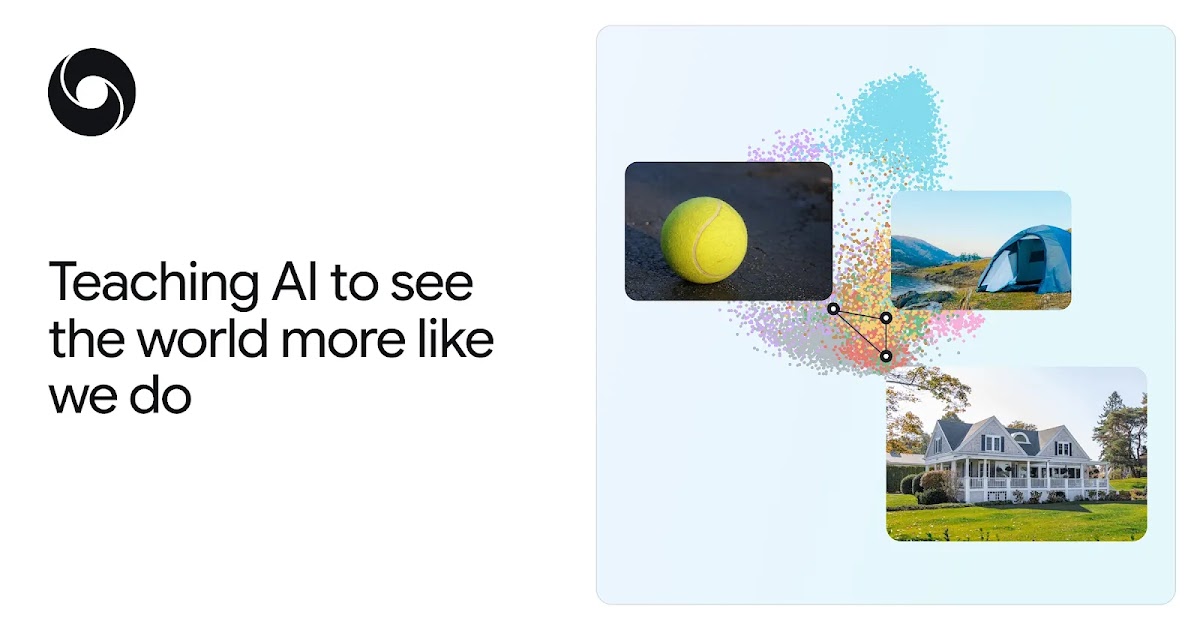
When you see a cat, your brain creates a mental representation that captures everything about the cat, from basic concepts like its color and furriness to high-level concepts like its “cat-ness.” AI vision models also produce representations, by mapping images to points in a high-dimensional space where similar items (like two sheep) are placed close together, and different ones (a sheep and a cake) are far apart.

To understand the differences in how human and model representations are organized, we used the classic “odd-one-out” task from cognitive science, asking both humans and models to pick which of three given images does not fit in with the others. This test reveals which two items they “see” as most similar.

Sometimes, everyone agrees. Given a tapir, a sheep, and a birthday cake, both humans and models reliably pick the cake as the odd one out. Other times, the right answer is unclear, and people and models disagree.

Interestingly, we also found many cases where humans strongly agree on an answer, but the AI models get it wrong. For the third example below, most people agree the starfish is the odd one out. But most vision models focus more on superficial features like background color and texture, and choose the cat instead.




Source link

Tags: humansteachingWorld
Previous Post

SEC drops lawsuit against Winklevoss twins’ Gemini crypto exchange

Next Post

Humans& thinks coordination is the next frontier for AI, and they’re building a model to prove it

Next Post
Humans& thinks coordination is the next frontier for AI, and they’re building a model to prove it

Humans& thinks coordination is the next frontier for AI, and they're building a model to prove it

Leave a Reply Cancel reply

Your email address will not be published. Required fields are marked *

POPULAR POSTS

  • Health-specific embedding tools for dermatology and pathology

    Health-specific embedding tools for dermatology and pathology

    0 shares
    Share 0 Tweet 0
  • 20 Best Resource Management Software of 2025 (Free & Paid)

    0 shares
    Share 0 Tweet 0
  • 10 Ways To Get a Free DoorDash Gift Card

    0 shares
    Share 0 Tweet 0
  • How To Save for a Baby in 9 Months

    0 shares
    Share 0 Tweet 0
  • How to Make a Stakeholder Map

    0 shares
    Share 0 Tweet 0
Solega Blog

Categories

  • Artificial Intelligence
  • Cryptocurrency
  • E-commerce
  • Finance
  • Investment
  • Project Management
  • Real Estate
  • Start Ups
  • Travel

Connect With Us

Recent Posts

Humans& thinks coordination is the next frontier for AI, and they’re building a model to prove it

Humans& thinks coordination is the next frontier for AI, and they’re building a model to prove it

January 26, 2026
Teaching AI to See the World More Like Humans Do

Teaching AI to See the World More Like Humans Do

January 26, 2026

© 2024 Solega, LLC. All Rights Reserved | Solega.co

No Result
View All Result
  • Home
  • E-commerce
  • Start Ups
  • Project Management
  • Artificial Intelligence
  • Investment
  • More
    • Cryptocurrency
    • Finance
    • Real Estate
    • Travel

© 2024 Solega, LLC. All Rights Reserved | Solega.co