


Four generations are currently represented in the workforce: Baby Boomers, Gen X, Millennials, and Gen Z. Each of these cohorts has been shaped by world events and changes in technology that drive differences in where and how they prefer to work. As employers compete to attract and retain top talent, these generation gaps have real-world impacts on how companies develop their location and workplace strategies.
Since it’s neither practical nor effective for employers to have office locations and policies that differ from one generation to the next, it’s necessary to try and thread the needle in a way that attempts to meet the expectations of a multigenerational workforce. This piece focuses on the differences between the two generations on either end of the age spectrum in today’s workforce — that is, Baby Boomers and Gen Z — as they relate to office site selection and workplace strategy.
The post-pandemic debate about the future of work has largely been settled, as the vast majority of organizations now have policies allowing for some form of hybrid or flexible schedules with a combination of in-office and at-home or remote work. With this model, there’s often talk of the need for employers to “earn the commute,” and the physical location, as well as the experience within the office, have gained even greater importance as part of broader talent-driven business strategies. Developing optimal location and workplace strategies requires employers to consider the often competing preferences of multiple generations.
Four generations are currently represented in the workforce: Baby Boomers, Gen X, Millennials, and Gen Z.
Multigenerational Location Strategy: Where Do Employees Prefer to Work?
A perennial goal for employers is positioning themselves to attract the high-quality talent that is critical for their business. Geography plays a large role in this — both on a macro level (which markets in the U.S. will provide the right labor pools?) and on a micro level (which submarkets within a given metro will be most attractive to target talent?).
On a national level, there are stark differences in the composition of metro area labor pools based on the age and experience of the workforce. Certain companies may have business models that rely heavily on more junior (Gen Z) talent to fuel their growth in such roles as sales associates, financial analysts, or junior software developers. These companies would likely prefer markets with a younger workforce that perhaps also has a robust university system that continually generates new, high-quality talent.
Other, often more mature-stage companies could alternatively choose to focus their hiring on more experienced mid- to senior-level talent with greater levels of specialized expertise, strategic thinking, and client credibility. The optimal markets for these companies would likely, but not necessarily, be different from those of companies focused on hiring junior talent.
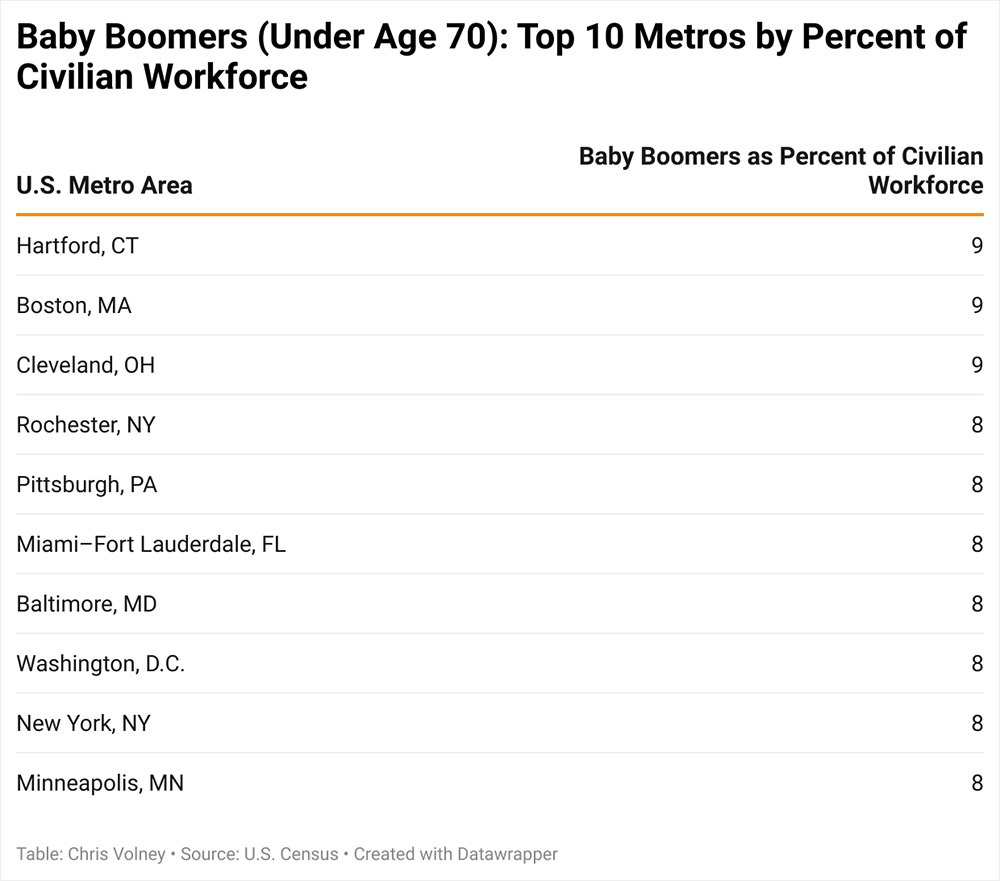
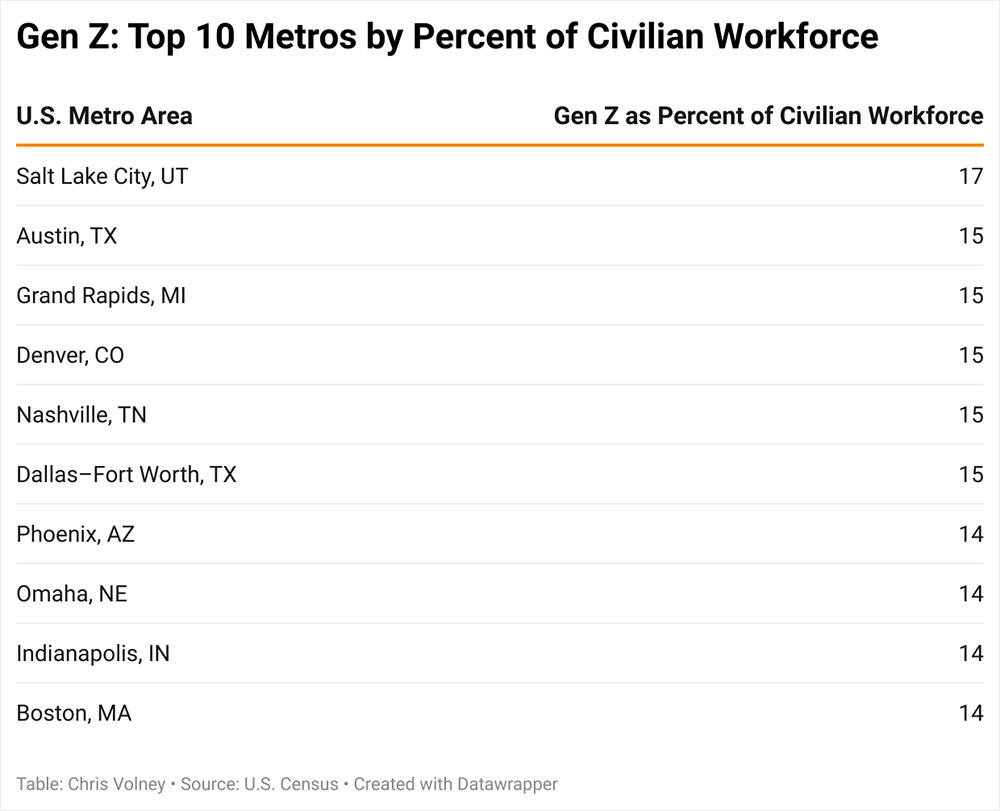
For example, a look at the top U.S. metro areas by Gen Z vs. Baby Boomer workforce representation can be instructive. Many of the metro areas with the highest representation of Gen Z in the workforce are economically dynamic Sunbelt cities with large universities such as Austin, Nashville, and Phoenix. The markets with the highest representation of Baby Boomers are more likely to be located in the Midwest and Northeast. Boston is notable for being on both lists, indicating that there is an abundance of both young and late-career talent, which translates to that market having less representation among the two middle generations (Gen X and Millennials).
Aside from identifying and selecting an optimal metro area, a secondary question often posed as part of the site selection process is where within a particular market is the best place to locate an office to support a company’s talent attraction goals. This is another area where generational and life-stage differences can lead to starkly different answers.
The post-pandemic debate about the future of work has largely been settled… hybrid or flexible schedules with a combination of in-office and at-home or remote work.
Historically, the Boomer generation has preferred single-use office campuses located in the suburbs, likely closer to where more of that generation lives. Younger generations, particularly Gen Z and Millennials, are more likely to live in urban mixed-use areas and prefer their offices to be in similar environments. These younger generations have come to see more fluidity between their home and work lives, so it makes sense that they want the area around their office to be similar to the places where they live. This has led to lifestyle factors like walkability, retail, restaurants, and recreation opportunities to be integral parts of the office site selection process.
Intuitively, this generally results in companies with a larger representation of Boomers seeking more suburban office locations, while those skewing younger will focus on more dynamic, urban-like settings that blur the lines between live, work, and play. Many companies are seeking locations that balance the needs of multiple generations, and this has contributed to the success of “urban-suburban” office markets that share many of the benefits of both downtown and suburban places. Examples include Tysons Corner outside D.C., Jersey City, N.J., Central Perimeter outside Atlanta, and University Town Center north of San Diego.
Multigenerational Workplace Strategy: How Do Employees Prefer to Work?
Aside from location, the experience within the four walls of the office is likely of even greater importance to employee attraction and retention, and this is another area where there are marked differences across generations. This piece explores three areas, out of many, where this is the case: proximity and workstyles, engagement and retention, and training and continuous learning.
Proximity and Workstyles
For much of their career, Boomers were accustomed to centralized offices and teams. However, Gen Z, like Millennials before them, are further redefining the workplace. In particular, Gen Z’s priorities include remote and hybrid-first expectations, flexible workspaces, and a global mindset.
Companies must rethink real estate footprints, invest in digital infrastructure, and offer flexible work models and workspaces to attract and retain Gen Z talent.
Engagement and Retention
Boomers often stayed with employers for decades, valuing stability and loyalty. Gen Z, however, is more open to job-hopping. Retention strategies must focus on engagement, not just compensation. They seek purpose, value alignment, mental health support, and career mobility.
Boomers historically preferred suburban office campuses; Gen Z and Millennials prefer urban mixed-use areas with walkability, retail, and recreation.
Retention now hinges on culture, transparency, and personalized career development, not tenure-based rewards.
Training and Continuous Learning
Boomers often preferred structured, instructor-led training and valued deep institutional knowledge. In contrast, Gen Z expects on-demand digital learning, interactive and gamified experiences, continuous learning, and social learning.
Companies need to invest in modern learning ecosystems and shift from static training to dynamic, learner-driven models.
Employers face tough decisions on how to accommodate the often disparate location and workplace preferences of multiple generations. While there are, of course, individual differences within all generations, Gen Z’s priorities overall are a stark departure from those of the Baby Boomer generation. If the goal is to attract and retain top talent, employers will need to adapt their strategies to reflect these distinct generational priorities.