


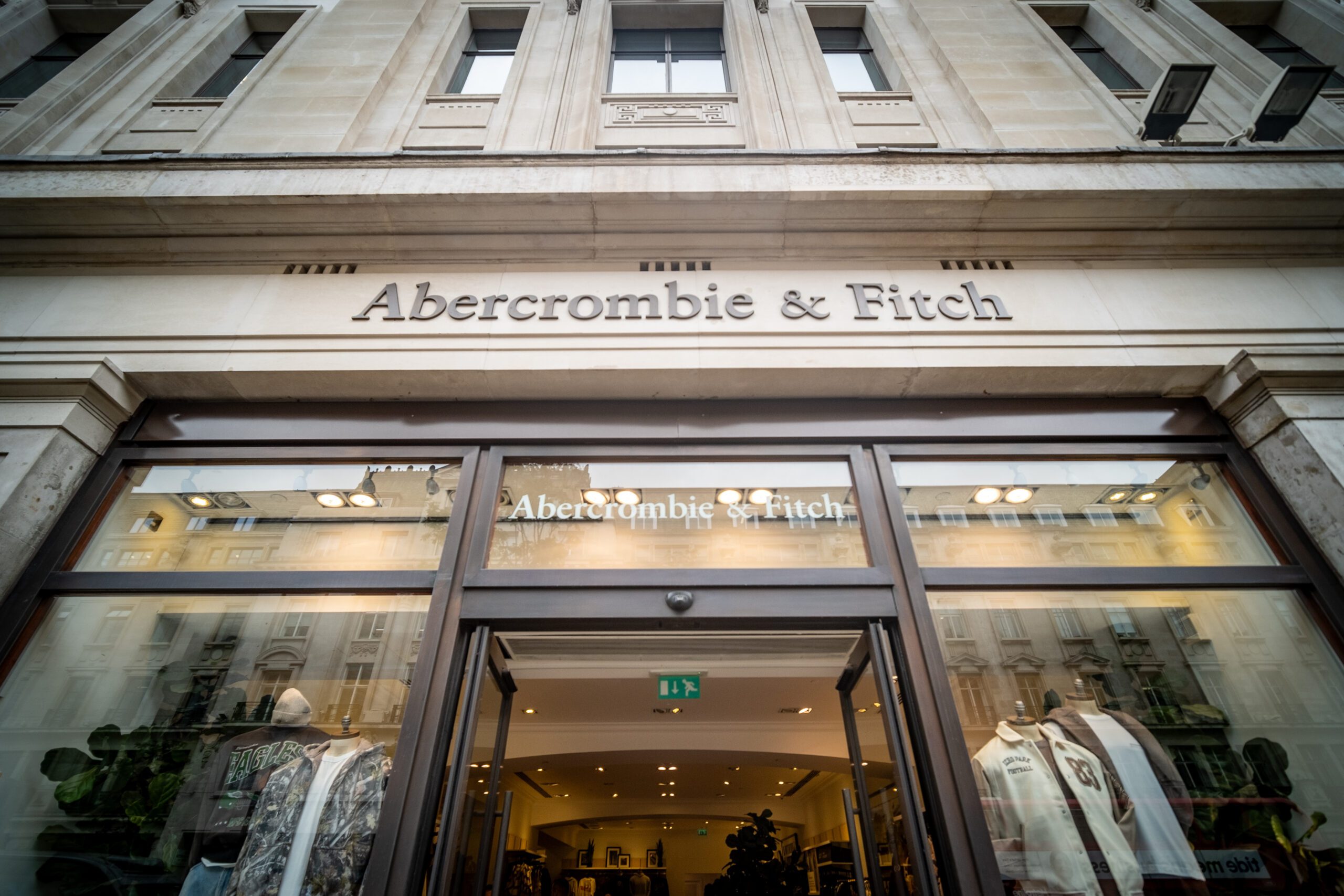
Mall apparel staple Abercrombie & Fitch Co. released its Q4 earnings, showing positive numbers with online sales playing a major role. However, the company also flagged possible headwinds.
Ultimately, net sales for the retailer increased by 5.4% year over year to $1.67 billion during the quarter. The results marked the 13th consecutive quarter in which it grew net sales.
Abercrombie & Fitch is No. 36 in the Top 2000 Database. The Top 2000 is Digital Commerce 360’s ranking of the largest online retailers in North America. Rankings are based on retailers’ annual ecommerce sales. There, it appears in the Apparel & Accessories category.
How Abercrombie’s sales performed online and in stores during Q4
Abercrombie & Fitch shared results from its fiscal full year, along with the latest numbers from its recent Q4.
Some of the highlights from the Ohio-based company’s report:
- Full-year net sales of $5.27 billion, the first time Abercrombie & Fitch has ever crossed $5 billion.
- Full-year net sales grew 6% compared to 2024, with growth across regions and channels, with Q4 up 5%.
- The company predicted 3%–5% net sales growth and a 12%–12.5% operating margin for fiscal 2026.
- Hollister posted its 11th consecutive quarter of net sales growth.
The Q4 growth reflected trends Abercrombie & Fitch saw throughout 2025.
During the full year, Abercrombie & Fitch continued its strong digital performance, with 44% of total sales originating online. Hollister’s share was about 31%, while Abercrombie stood at around 59%, the company shared on its March 4 earnings call with investors.
“We also surpassed 1 billion visits across our platforms for the first time, demonstrating the scale and direct reach we have with our customers,” said Fran Horowitz, Abercrombie & Fitch’s CEO.
Updates to Abercrombie & Fitch’s ERP
Robert Ball, the chief financial officer at Abercrombie & Fitch, credited a new enterprise resource planning (ERP) system with helping the omnichannel model succeed.
“This new ERP system allows us to support both the owned and operated omni business that we have, as well as the expectations of growth that we have across channels and categories in a more efficient way,” Ball stated.
While omnichannel is central to Abercrombie & Fitch’s strategy, physical stores remain a key part of that mix. Ball noted that its four-wall store operating margins are running around 30% in aggregate. Horowitz added that artificial intelligence (AI) will continue to be part of the company’s toolkit going forward.
“We’re also moving quickly to leverage AI to benefit the customer, and we’re modernizing systems to help us,” Horowitz said.
Potential tariff costs
Tariffs cost Abercrombie & Fitch roughly $90 million in 2025, and in 2026 the company is projecting an additional $40 million hit, assuming the 15% global tariffs remain in effect all year. Ball said the company’s diversified sourcing network is its primary defense.
“We currently source from over 16 different countries,” he said. “That’s been obviously a core enabler for us in our Read and React model here.”
While Ball noted that Abercrombie & Fitch’s approach to its supply chain is not changing, he did say that its network would continue to evolve.
Importance of omnichannel sales for Abercrombie & Fitch
Hubert Paul, partner in the consumer sector North America at Simon-Kucher, a global commercial growth and pricing consultancy, said Abercrombie & Fitch’s omnichannel investments have made it a standard within the retailer’s operating model. That means that it’s not just valuable as a marketing tool or high-growth category. Nevertheless, he added that Abercrombie & Fitch would need to continue investing in its physical stores.
“As Abercrombie & Fitch’s highest-value customers continue to shop across channels, it is critical to maintain a balanced investment in both digital and in-store experiences to ensure consistently high-quality execution wherever these customers engage,” Paul said.
For Abercrombie & Fitch to continue its successful run, Paul said investments should remain hyper-focused on elements that drive convenience and fulfillment while reducing friction — among them:
- Buy online, pick up in store (BOPIS).
- In-store ordering when a size is unavailable.
- Online inventory accuracy to optimize on-shelf availability.
- Frictionless returns.
“These actions will enable Abercrombie & Fitch to sustain AUR growth while driving unit growth from across channels, allowing them to maintain pricing integrity and help avoid going too quickly or often into promo/markdown cycle — the classic promo/markdown spiral to drive traffic/conversion,” Paul said.
Do you rank in our databases?
Submit your data and we’ll see where you fit in our next ranking update.
Sign up
Stay on top of the latest developments in the online retail industry. Sign up for a complimentary subscription to Digital Commerce 360 Retail News. Follow us on LinkedIn, TikTok, X (formerly Twitter), Facebook and YouTube. Be the first to know when Digital Commerce 360 publishes news content.