


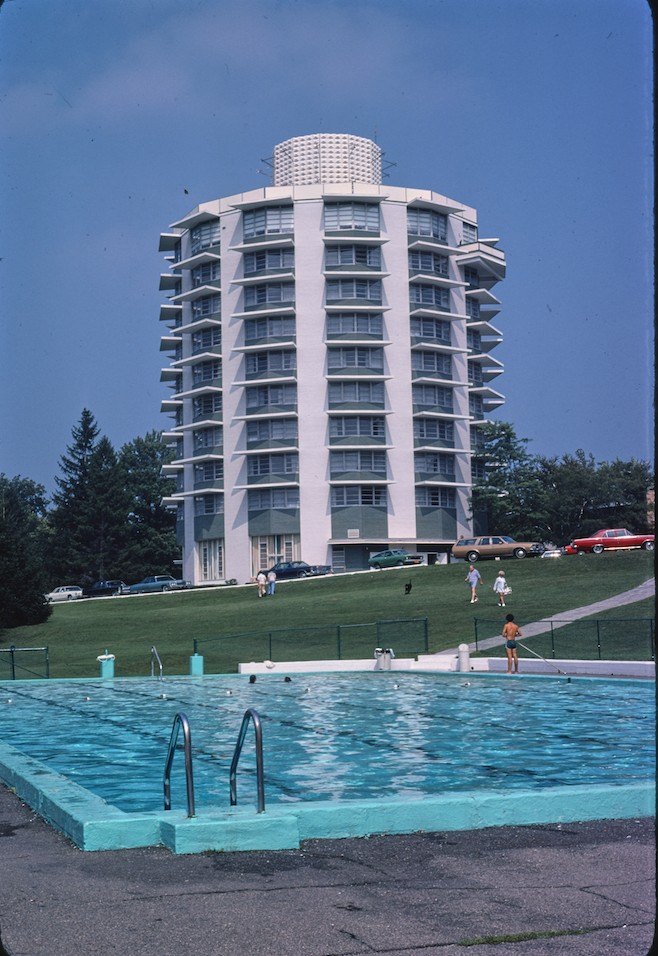
A developer hopes to bring the old magic back to an abandoned Catskills resort that was once considered iconic.
The formerly majestic Nevele Grand Hotel (also known as Nevele Country Club) in Ulster County, NY, used to be an integral part of the postwar communities of summer hotels, resorts, and bungalow colonies that made up The Borscht Belt in the Catskills Mountains.
From the 1940s to the late 1970s, the Ulster and Sullivan County areas of upstate New York, about 90 minutes from NYC, was where millions of urban dwellers spent their summers swimming, dancing, and taking in entertainment, especially comedy routines.
“It was an affordable place for middle-class urban dwellers to escape the city’s oppressive heat, to have some glamour, romance, and entertainment,” Andrew Jacobs, president of the board of directors of the Catskills Borscht Belt Museum, tells Realtor.com®.

The Catskills—immortalized in movies such as “Dirty Dancing” and “A Walk on the Moon” and the Amazon Prime series “The Marvelous Mrs. Maisel”—was a place of “desire and forbidden fruits” as well as chuckles.
“It was the birthplace of standup comedy,” says Jacobs, noting that famous names like Jerry Seinfeld, Jerry Lewis, Joan Rivers, and Mel Brooks all got their start in the Borscht Belt.
But the lively era came to an screeching end with what Jacobs calls “the 3 A’s”—air conditioning, air travel, and assimilation.
AC meant that the city summers were no longer so oppressive; plane travel to alternative vacation spots like Florida and Europe became much more affordable; and the various groups who populated the resorts—mostly Jewish, but also Irish, Italian, and African American—became more integrated.
“Kids no longer wanted to spend their summer vacations with people all from the same ethnic group,” Jacobs explains. “They wanted to mix.”
The reimagining of the Nevele Hotel
The three A’s meant that the Catskills summer resorts rapidly began shuttering throughout the 1980s.
“Most of the big hotels are just gone or in ruins,” Jacobs explains. “Nevele is still there, but it’s just a big, epic ruin. It’s really creepy.”
But hopefully not for long.
Real estate development firm Somerset Partners is pouring $300 million into the 500-acre Nevele property, with plans for a mixed-use community of townhouses, cottages and single-family homes, an 80-room boutique hotel, a spa, restaurants, and recreational spaces.
Founding partner Keith Rubenstein has a special connection to the hotel, having vacationed there with his family during the 1970s and ’80s. Rubenstein, who did not respond to requests for comment, sits on the Borscht Belt Museum’s board of trustees.

His biography says he is “leading efforts to develop a world-class luxury resort at the former Nevele Country Club” and that his parents even honeymooned at the hotel.
“It truly was an amazing place,” he reminisced in an interview with The Times Union.
There, he learned to ice skate, ski, play tennis, basketball, and golf, and occasionally mingled with big names like Tom Seaver, a former pitcher for the New York Mets.
“It has such a meaningful history, not just for me and my family but for so many families,” he said.
The Somerset project was recently granted a key environmental permit from the Department of Environmental Conservation, and has an estimated finishing time of three years, according to the outlet.
But there are challenges. A series of mysterious fires, two of which occurred in January, and one of which damaged the resort’s iconic main tower, have set back the timeline.
The cause of the fires is unknown but Rubenstein told the outlet that he suspects they could have been intentionally set as the abandoned buildings are magnets for squatters, curiosity seekers, graffiti artists, and even “paranormal explorers.”
“It’s a shame because people are trespassing on the property and it’s almost impossible to keep people out,” he said, adding that he has beefed up security there.

Renderings for the future development show several low-level, modern-style wooden buildings that fit seamlessly into the lush, rural mountain setting.
The development will “take advantage of the scenic beauty and also the proximity to the city,” says Jacobs. “The setting is really gorgeous and it’s sparsely developed.”
Local agent Fredericka Taylor of Taylored Real Estate, who lives in Ulster County, agrees renewing the ruins of the resort is welcome.
“The town and the local people would love to see that [area] active, open, and running again,” she tells Realtor.com. “I don’t think there’s anybody who is against that.”
Taylor, who specializes in selling old camps, resorts, and bungalows in the Catskills and Hudson Valley, has an active $2.5 million listing in the Nevele mold: The 94-acre former Brown’s Hotel, a Borscht Belt resort that later became the Grandview Condominiums before that burned down in 2012.
“There’s always calls from people looking for camps, retreats, or summer communities, and builders looking for properties with the proper zoning that would allow for residential development,” she says.
“The Catskills is really a wonderful place to either raise your children and grow old in or to have a second home.”

Revitalizing the Catskills
The Nevele Hotel won’t be the first deteriorated Borscht Belt icon to get an overhaul.
The site of the former Concorde Hotel is now Resorts World Catskills, a high-end hotel-resort, golf club, and casino. The Brickman, once known as “the resort with personality,” became a yoga retreat and ashram.
Other former Borscht Belt icons became Orthodox Jewish summer camps or year-round communities or upscale boutique hotels.
And in 2025, the Grossinger’s Resort in Sullivan County—famous for being the oft-cited inspiration for “Dirty Dancing”—was quietly sold to Florida-based PPG Development for $14.75 million. Although plans for the 1,100 acres haven’t been finalized, the buyer specializes in upscale resorts and golf clubs.
Jacobs says the Catskills—and especially the Borscht Belt resort culture—is ripe for a revival.
“There is a longing for that more analog time,” he says. “It had great fashion and music, and people are really nostalgic for the perceived simplicity of the era.”
The residential housing component of the Nevele development—which will consist of 40-plus single-family homes with floor plans ranging from 3,000 to 5,000 square feet and around 80 townhouses—makes the plan somewhat unique to the area.
“This is the future of the Catskills,” says Jacobs. “A place for second homes but that will also have communal spaces like a pool and restaurants. It’s bringing back the original tradition of the Catskills as a place to get away, and is filling a need.”
Taylor agrees that the Catskills may be on a path to its former glory—but with a modern sensibility. Rather than honeymoons and foxtrots, the area will be about upscale leisure and luxury second homes.
“The Nevele is an example of a reemergence of these types of resorts that were so popular from the ’40s through the ’70s, but in a different form,” she says.