Before AI was the big tech inevitability that would proceed whether anyone wanted it or not, there was the Metaverse.
Until very, very recently, you could still go to worlds.com, a 3D online chat program that launched in the mid 1990s, and navigate through its almost entirely abandoned virtual space, like an endless, pixellated Angkor Wat. Academic literature came to call spaces like these, and there are many, “Digital Ruins”.
Will we be left with any similar remnant of Horizon Worlds? Meta’s virtual reality social network was once sold as a key piece of the puzzle that would eventually cohere as “the Metaverse”, and early last week Meta announced that it was effectively shutting it down.
On Friday, the tech behemoth backtracked slightly; rather than completely taking the app off the Quest store, it will now continue to support games that already exist on Horizon World, but will not be adding anything new.
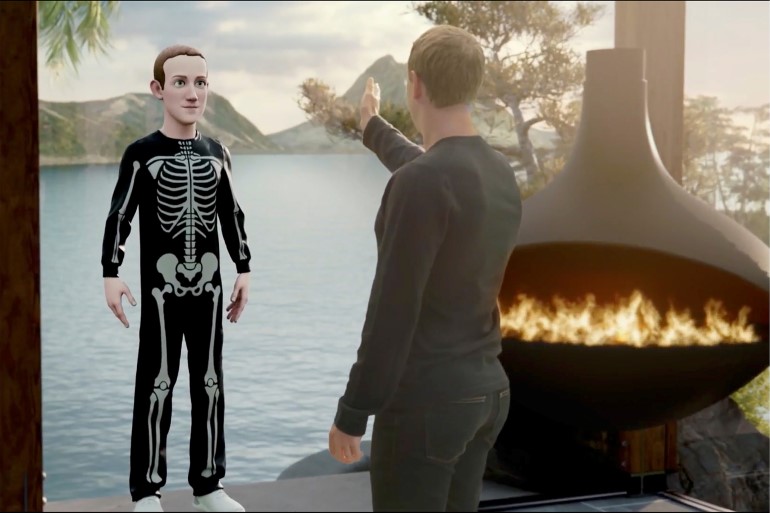
Less than five years ago, Mark Zuckerberg announced that Facebook was being renamed Meta and that he was making the development of its Metaverse a priority.
Zuckerberg would eventually sink US$77 billion (A$110bn) into Meta’s virtual reality push. Indeed, it’s easy to forget that before AI was the big tech inevitability that everyone in the world was forced to interact with whether they liked it or not, the metaverse filled that role.
The idea of the metaverse — a broad term for online worlds where the physical and virtual converge and people interact in a 3D space — was coined in Neal Stephenson’s 1992 sci-fi novel Snow Crash, but the notion of truly bringing one about really took off at the turn of the last decade.
A Forbes piece from 2020 captured the general tone of coverage at the time: having looked at the (uniformly positive, as far as the piece was concerned) ways a metaverse could affect every facet of life, it told us unequivocally, the metaverse was coming and asked: “How are you getting ready?”
Venture capitalist and former head of strategy for Amazon Studios Matthew Ball, who wrote prolifically about what the metaverse would or could be in the early 2020s, set out the preconditions for “true” metaverse, including that it “never ‘resets’ or ‘pauses’ or ‘ends’, it just continues indefinitely” and is “a living experience that exists consistently for everyone and in real-time”.
McKinsey only half wrong
In 2022, McKinsey consultants predicted that by 2030, “it is entirely plausible that more than 50% of live events could be held in the metaverse”. In these years, users bought around US$2 billion worth of digital land across different platforms.
But what swiftly became apparent was how bad, in its very bones, the idea really was. It wasn’t just the security, mental health, or surveillance implications of layering more internet over everything, nor the sense that it would remove the remaining slivers of human experience that had not been privatised.
Mainly, it was that the thing just didn’t work.
What was remarkable from the get-go was how amateurish it looked — the avatars, initially legless top halves, didn’t feel a great deal more sophisticated or tactile than, say, 1995’s 3D Movie Maker.
The image of Zuckerberg’s avatar in front of a fake Eiffel Tower became a perfect metaphor for the whole thing — billions being spent to create a world so much less impressive than the one we already inhabit.
When they promised to add legs to their avatars just under a year later, Rolling Stone wrote:
“It’s quite astonishing … to consider the amounts of labor and expense that goes into each fix, for a product that has become a consistent punching bag on social media and that the vast majority of Meta’s existing customers have no interest in using.”
What’s the problem?
The main problem was that metaverse developers didn’t seem to know exactly what problem they were solving.
In a July 2021 interview, as the hype around the coming metaverse approached its peak, Zuckerberg told The Verge (with apparently no irony): “We’re basically mediating our lives and our communication through these small, glowing rectangles. I think that that’s not really how people are made to interact.”
Which is true, but no-one seems to have concluded that the answer to that problem of modern life was yet more inescapable internet.
Take Lindt Chocolate’s attempt at a metaverse metaverse experience with its ugly, inconvenient and unintuitive 3D online store. If people did want a shopping experience that offered a break from the “small, glowing rectangles”, they could go to an actual shop, rather than navigating a worse version of online shopping.
Then there is Decentraland, another 3D online virtual world in which the primary activity was the buying and selling of NFT items and digital land, which also described itself as a “metaverse”.
Again, it was a clunky and ugly experience whose attempts at joyful communal experiences like raves or New Year’s Eve parties created eerie, uncanny and utterly dead experiences.
By 2023, the value of virtual land in Decentraland and elsewhere had plummeted.
The way talk of a metaverse has petered out is a reminder that blanket application of an inescapable, harmful technology that no one wanted doesn’t have to be as inevitable as it may seem.
It might be tempting to hope AI will go the same way, but of course both its practical and slop forms have already conclusively seeped into day-to-day life.
In fact, via decline porn, war misinformation and a million other inventions, AI has put an inescapable illusory veil over our world far more thoroughly than the metaverse ever did.