

One scoop to start: A boutique UK law firm behind some of the biggest football deals has taken an investment from a US private equity group, in a sign of the growing interest from private capital in the legal and sports industries.
Welcome to Due Diligence, your briefing on dealmaking, private equity and corporate finance. This article is an on-site version of the newsletter. Premium subscribers can sign up here to get the newsletter delivered every Tuesday to Friday. Standard subscribers can upgrade to Premium here, or explore all FT newsletters. Get in touch with us anytime: [email protected]
In today’s newsletter:
Unilever passes on the mayonnaise
On September 2 1929, the Dutch food group Margarine Unie and the British soapmaker Lever Brothers agreed a merger, creating the consumer goods company Unilever.
The Economist dubbed the deal “one of the biggest industrial amalgamations in European history”.
That marriage between personal care and food businesses turned Unilever into a dominant consumer goods giant with businesses spanning continents and brands from Lipton tea and Magnum ice cream to Dove soap and Axe body spray.
The union lasted just short of a century.
The FTSE 100 group on Tuesday announced it had reached a deal to sell off its food business to spice maker McCormick, creating a $66bn company with $20bn of annual revenues.
The cash-and-stock deal, structured as a Reverse Morris Trust, will allow Unilever to minimise its tax bill from the sale. The company’s shareholders will own 65 per cent of the combined group, while McCormick’s investors are expected to control the remaining 35 per cent.
Unilever will also receive $15.7bn of cash from McCormick under the deal terms.
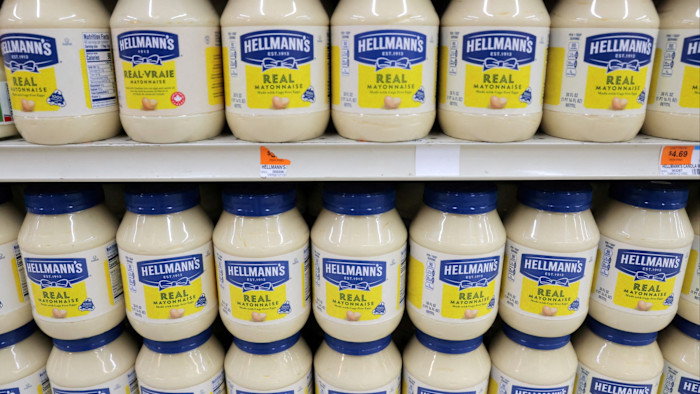
The merger will unite Unilever brands such as Hellmann’s mayonnaise and Knorr bouillon cubes with McCormick’s red-topped spices and Frank’s hot sauces.
For McCormick, the deal represents a long-awaited wish come true for the company’s leaders. Fernando Fernandez, Unilever’s chief executive, said it creates a “global flavour powerhouse”.
Unilever had also held talks with Kraft Heinz over a potential food deal, the FT previously revealed.
While some of Unilever’s food assets including its India business are not included in the deal, the sale represents the most significant step in the company’s decade-long exit from the food business.
It also comes as Fernandez, who has been in his seat for just over a year, tries to sharpen the company’s focus on faster-growing beauty and personal care brands.
Unilever has in recent years sold off other assets. It offloaded its spreads unit to KKR in 2017 for €7bn and traded its tea business to CVC in 2021 for €4.5bn. Last year the company spun-off its ice cream holdings into an independent entity.
It’s also made efforts to scale up, which have been less smooth. In 2022 Unilever faced an investor backlash after making a £50bn bid for GSK’s consumer health business, with activist Nelson Peltz joining the group’s board in the aftermath.
Unilever’s leaders have made a bet that for now its investors — and consumers — would rather slim down than bulk up.
Meet the investor who won the AI panic
When a tiny karaoke machine seller-turned-logistics firm triggered a $17bn slump in US trucking stocks earlier this year, one microcap investor was sitting pretty.
In February, Algorhythm Holdings — a roughly $6mn company that had recently pivoted from selling karaoke machines to AI logistics software — published a report on how AI could improve trucking efficiency.
In a market already on edge about AI disruption, trucking groups tumbled. Algorhythm’s shares rocketed as much as 450 per cent over three days.
And investor Streeterville Capital was positioned for a potential windfall.
The firm had struck a deal with Algorhythm last summer that let it purchase several times the company’s market cap in newly issued shares at a discounted price over a period of time.
As the share price surged last month, Streeterville offloaded millions of shares in trades that were potentially worth millions of dollars, the FT’s Rachel Rees reports.
Streeterville is run by John M Fife, a 65-year-old Chicago penny stock investor with a colourful, decades-long career. He’s had multiple brushes with regulators, and invested in a Chinese company caught up in what some analysts compared to a pump-and-dump scam. (There is no suggestion that the company or Streeterville were involved in the unusual share price moves.)
In 2007, the SEC charged Fife with fraud in a now-settled case involving “phoney family trusts” and “even more devious schemes”.
In 2020, in a now-dismissed charge, the SEC called Fife a “recidivist violator of the federal securities laws”, alleging he had made $60mn over five years from buying and rapidly selling newly issued shares, focusing on hyped sectors such as “marijuana, blockchain, bitcoin” and more. Fife said the charge was “legally baseless”.
Algorhythm’s chief executive told the FT that Fife’s history recommended him as an investor: “He has been doing business for a long time and has a great reputation.”
Job moves
-
Sequoia Capital has named former global managing partner Doug Leone as chair.
-
Goldman Sachs has hired David Benichou as co-head of investment banking for France, Belgium and Luxembourg. He joins from Morgan Stanley.
-
Deutsche Bank has hired Simon Alexander as co-chair of corporate broking in UK investment banking and capital markets. He previously worked at HSBC.
-
Citi vice-chair Jay Collins is leaving the bank after three decades.
-
Mudrick Capital Management has hired Andrew Meares as managing director in London. He joins from Taconic Capital Advisors.
-
Former British Airways boss Willie Walsh has been appointed as chief executive of IndiGo, India’s biggest airline.
Smart reads
Small but mighty Law firms specialising in global finance would be hard-pressed to find a more hospitable home than London. Macfarlanes, the unassuming but highly profitable City law firm, has hitched its success to the British legal system’s dominant place in global finance and private wealth, the FT’s John Gapper writes.
Cyber theatre As war continues in the skies of the Middle East, Iranian hackers are fighting on another front, the FT reports. Tehran has been launching cyber attacks on Israel and the US, aiming to collect intelligence, spread confusion and jam the gears of its adversaries.
New diet American private equity firms are betting on fast food in Japan, Bloomberg Businessweek writes, as the population’s dining habits change amid demographic shifts and rising prices.
News round-up
Nvidia invests $2bn in chipmaker Marvell to boost AI networking (FT)
Huawei comeback loses pace as cloud and phones falter (FT)
Court of Appeal rules non-lawyers can work on litigation cases (FT)
Whoop hits $10bn valuation as health tracking takes off (FT)
Allbirds, once valued at $4bn, just sold its assets for next to nothing (Wall Street Journal)
Due Diligence is written by Arash Massoudi, Ivan Levingston, Ortenca Aliaj, Alexandra Heal and Robert Smith in London, James Fontanella-Khan, Sujeet Indap, Eric Platt, Antoine Gara, Amelia Pollard, Kaye Wiggins, Oliver Barnes, Tabby Kinder and Julia Rock in New York, George Hammond in San Francisco and Arjun Neil Alim in Hong Kong. Please send feedback to [email protected]