


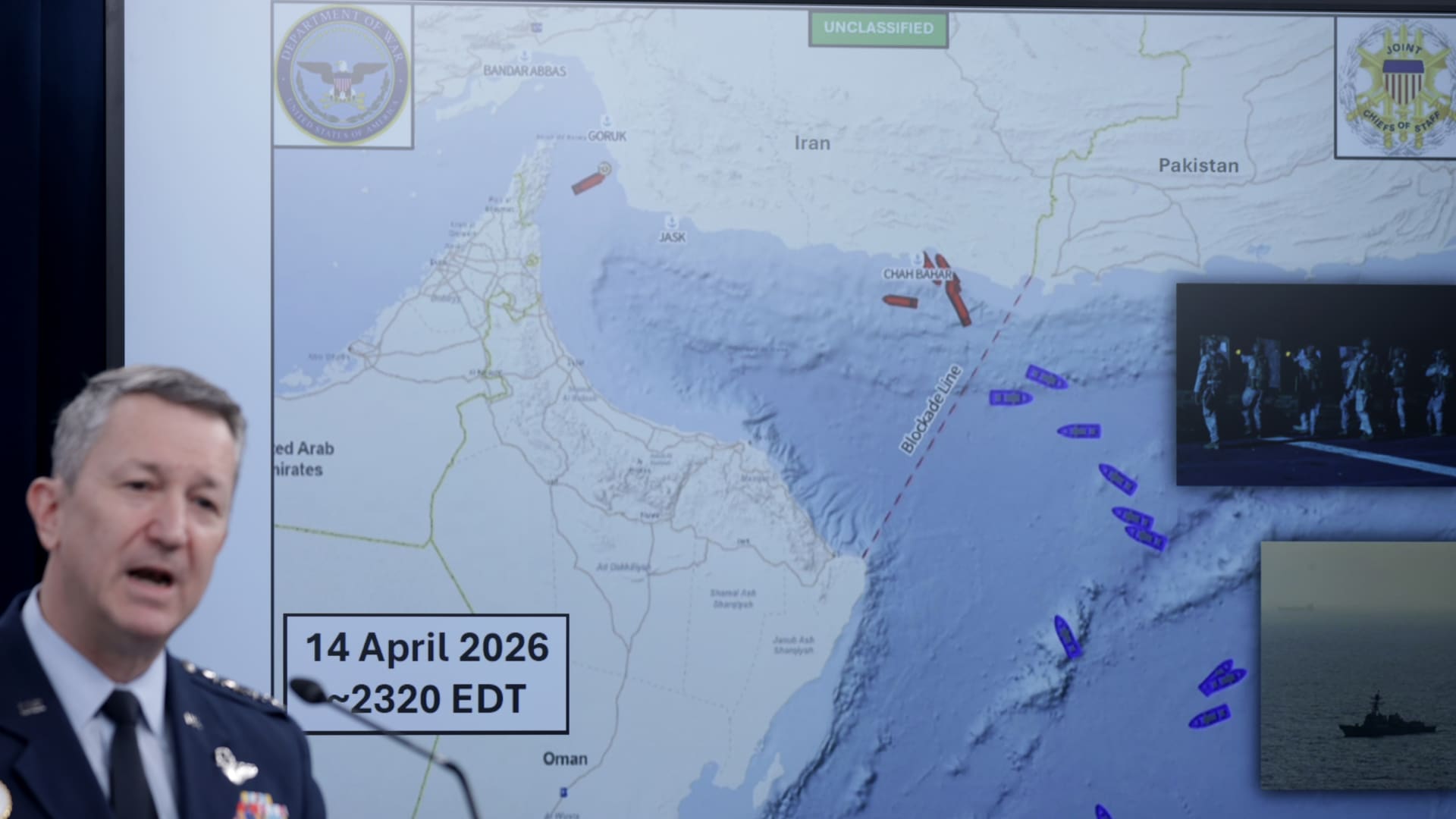

Locked in a standoff with Iran that will break only when economic pain is no longer tolerable, President Donald Trump may have to maintain his naval blockade against Iran for weeks — forcing serious economic consequences on the world.
Trump said Wednesday that he will keep the U.S. blockade against Iran in place until it agrees to a nuclear deal. Tehran, meanwhile, refuses to reopen the Strait of Hormuz until the U.S. calls off its Navy.
It’s unclear which side will budge first.
Trump said Sunday that Iran’s oil infrastructure is days away from exploding because crude is bottled up due to the blockade.
“Something happens where it just explodes,” Trump told Fox News. “They say they have only three days left before that happens. When it explodes, you can never rebuild it the way it was.”
But Iran has weeks of space left in its tanks to store oil that it can’t export, experts said. This should give Tehran time to ramp down oilfields in an orderly way that avoids permanent damage, they said.
The oil supply shock, meanwhile, grows worse every day Iran keeps the strait closed, putting pressure on the U.S. as the global economic damage mounts.
“The question for me is who has a longer runway — Trump or Iran,” said Fernando Ferreira, the head of Rapidan Energy’s geopolitical risk service.
Iran tankers blocked
Tehran will feel the heat from the U.S. blockade. There has been no confirmed passage of an Iranian tanker through the U.S blockade zone, according to the ship-tracking firm Kpler.
Iran-linked ships have crossed the strait but they did not make it past the blockade, which stretches from the Gulf of Oman to the Arabian Sea, according to Kpler.
With Iran’s tankers hunted by the U.S. Navy, oil and condensate loadings at its ports have collapsed from 2.1 million barrels per day (bpd) before the blockade to just 567,000 bpd after, Kpler found.
Iran will have to start filling up its storage tanks because the oil cannot be exported. Eventually, Tehran will have to cut oil production as the the storage tanks near capacity.
Storage capacity
That is the point where Tehran would start feeling the squeeze but it could take a long time to force a reaction, according to Rapidan Energy.
“They prepared for a blockade,” Ferreira said. “They thought it through. They saw what happened in Venezuela.”
“They’re prepared to hold out for months,” the analyst said.
Iran has at least 26 days before its storage tanks fill and production cuts become unavoidable, Ferreira said. The estimate assumes 26 million barrels of onshore storage and 21 million barrels of floating storage in 18 empty, sanctioned tankers in the region, he said.
But it’s a conservative estimate, Ferreira cautioned. Iran’s maximum storage capacity suggests it has space for another 39 million barrels, giving it another 22 days beyond the 26, the analyst said.

There are also 31 ships linked to Iran that will head back to the Middle East through late May which could provide another 50 million barrels of storage, Ferreira said. That would allow Iran to hold out as long 76 days, or well over two months, he said.
These estimates assume Iran is constantly filling its storage at a rate of 1.8 million bpd, Ferreira said. In reality, Tehran will likely start ramping down production, which would stretch the storage further, he said. They also assume Iranian oil exports will not circumvent the blockade at all, the analyst said.
“The blockade can be very effective,” Ferreira said. “It’s about the timeline for it to put Iran under excruciating pain.”
It will take weeks or months to put Tehran under that kind of pressure, he said. “That runway might be longer than Trump has in mind for results,” the analyst said.
Production shut down
Oilfields can be permanently damaged if they are shut down in a sudden, disorderly and uncontrolled fashion, said Antoine Halff, an expert at the Center on Global Energy Policy at Columbia University.
But Iran’s storage capacity buys time to shut down oilfields in an orderly manner, said Halff, who served as chief oil analyst at the International Energy Agency. There’s no reason why Iran’s infrastructure would explode despite Trump’s weekend comments, he said.

“If you do it all in an orderly way, you minimize the damage to the field. You may not have any damage to the field,” said Halff, who was also an economist at the U.S. Energy Information Administration.
“It’s certainly a challenge short term because they’re out of cash, but in terms of the field operation it’s not a big challenge,” he said.
Iran might just cut production to the minimum level needed for domestic consumption which would make the whole question of storage space irrelevant, said Homayoun Falakshahi, head of crude oil analysis at Kpler.
The bigger question is when does Iran run out of revenue, Falakshahi said.
Iran has 120 million barrels of oil loaded on tankers east of the U.S. blockade zone that can be delivered to customers including China, the analyst estimated. That’s equivalent to about two months revenue for Tehran, he said, though it could face challenges selling the oil and receiving the cash.
“If the blockade holds for another two months, Iran’s oil revenues could crash to zero,” Falakshahi said.
“The administration’s gamble is that this forces the Iranians back to the negotiating table with willingness to give a lot more concessions,” he said.