

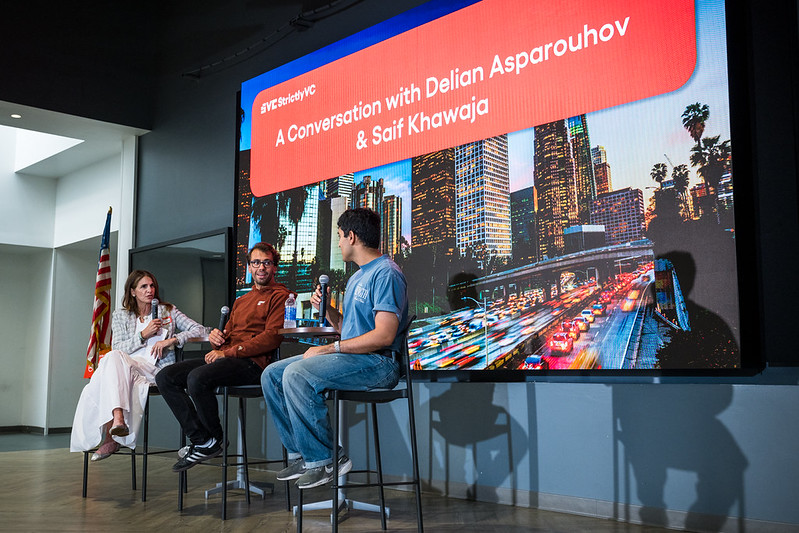
Earlier this week, at TechCrunch’s newest StrictlyVC event in El Segundo, Shinkei Systems founder Saif Khawaja and Founders Fund partner Delian Asparouhov sat down for a conversation that kept circling back to a question that doesn’t usually come up at a venture event: How do you know if a fish is stressed out?
It’s a fair question for Khawaja to field, since his company, Shinkei, has built its entire business around the answer. Shinkei makes a refrigerator-sized robot called Poseidon that fishermen install on their boats. The machine scans each fish with computer vision, identifies the species, and locates the brain. It then pierces the brain and severs the gills, so the fish dies before it can thrash or suffocate.
It may not sound so compassionate, but it’s much better than the alternative, which is a slow death over a few minutes to an hour that floods the fish with stress hormones and lactic acid, which dulls flavor and shortens shelf life. The whole thing is an automated, industrial-scale version of ike jime, a centuries-old Japanese technique traditionally performed dockside by trained fishermen at the moment of catch. By killing the fish instantly and draining its blood, ike jime delays decomposition long enough for the flesh to be safely aged for days, sometimes longer, before it’s served. That aging period is what gives top-tier sashimi its concentrated, umami-heavy flavor, as enzymes slowly break down the muscle.
Khawaja’s origin story is somewhat unusual for a hardware pitch. He grew up taking fishing trips with his family in the Middle East, and the idea for Shinkei didn’t click until college, when he read an essay by an animal rights philosopher titled “If Fish Could Scream.” Its premise was that fish lack vocal cords, so the suffering most of them experience on the way to your plate is essentially invisible.
But Shinkei’s ambitions have expanded well past the killing machine. The company now describes itself as a vertically integrated fish harvester and processor, deploying robotics and AI across the chain from boat to plate. Shinkei gives Poseidon machines to fishermen for free, then pays those fishermen a premium price for the fish that come out of them, well above what the catch would fetch at a standard dock auction. In exchange, Shinkei takes full possession of the fish rather than letting fishermen sell it on the open market. The catch then ships to a 16,000-square-foot plant Shinkei bought in Tacoma, Washington, where it’s broken down and sold under the company’s consumer brand, Seremoni, marketed as “ceremony grade” fish.

The most visible proof point so far is on the menu at Erewhon, the Los Angeles grocery chain beloved by influencers. Erewhon sells Shinkei’s fish as Seremoni Grade Miso Black Cod, hot off the prepared-foods bar, and the marketing around it leans hard on the “sustainably caught, humanely harvested” framing. The arrangement is still a pilot, running for now out of Erewhon’s Manhattan Beach location, with wider rollout to other stores contingent on how well it sells. Khawaja says the company already supplies fish to restaurants holding a combined 50 Michelin stars, and claims something that has reportedly never happened before: Japan importing American-caught fish into its own fish markets, which have historically treated American seafood as distinctly inferior to the domestic product.
Whether buyers will pay a premium for “humanely killed” fish, the way many now do for humanely raised beef and poultry, is still an open question, and even Khawaja says it’s secondary when explaining the company. He told the El Segundo crowd the real selling point isn’t the animal-welfare story so much as the practical one around quality. A catch that might normally have a 5-to-7-day shelf life can stretch to 12 or 14 days, he said, and the company has cooked fish three weeks after coming out of the water with no issue. Shinkei’s newest product, an in-plant sensor system, tries to quantify that by scanning fish and projecting an individual shelf life for each one. That matters in an industry where, by Khawaja’s estimate, roughly 18% of product is lost to spoilage just between dock and store, before retail loss is even counted.
That spoilage problem is tangled up with a detail of the American seafood supply chain that surprises most people who haven’t worked in it. A meaningful share of fish caught in U.S. waters by U.S. boats gets frozen and shipped overseas, often to China, for the labor-intensive work of heading, gutting, scaling and filleting, then shipped back to be sold here. Industry estimates of how much American seafood is imported run as high as 90%, though roughly half of that, by some estimates, actually originated in domestic waters before making the round trip abroad. Reporting has tied parts of China’s seafood processing sector to forced labor, including Uyghur workers in Shandong province and North Korean labor in Liaoning, making the system a target of U.S. trade and labor scrutiny in recent years.
There’s been a push within the industry to “re-shore” some of that processing, spurred partly by tariffs and pandemic-era disruptions that made the China round trip less attractive. The bet that Shinkei — and Founders Fund — are making is that re-shoring the entire chain, catch, kill, process, and distribute, all under one roof in Tacoma, can be done profitably enough to outcompete it.

For Founders Fund, the wager fits a pattern, which is backing founders who are often outside of fashionable categories. Asparouhov, who speaks a mile a minute and without reserve, put it plainly to attendees: there’s essentially nobody else on Earth who wants to spend their life on robots that kill fish, and given the smell of the Shinkei’s office, it’s no wonder. (We all laughed at the observation, though it undersells the field a little. In addition to Shinkei, a Japanese firm called Nichimo sells a device that stuns fish to assist humans performing ike jime by hand, and several Norwegian startups are building robotic systems for more humane fish slaughter and processing. Shinkei’s apparent edge, for now, is being the only one running the fully automated version of the technique at scale on U.S. boats.)
In fact, Asparouhov said the firm intentionally keeps its exposure to crowded categories like generic AI applications relatively low. By his math, AI and defense together account for something like 15% to 20% of the fund’s deployed capital, well below what he estimated is typical elsewhere in venture. Shinkei sits alongside Halter, a New Zealand-founded company making solar-powered, GPS-equipped cattle collars that let ranchers herd cattle remotely, and Ohalo Genetics, the crop-genetics company started by “All-In” podcast co-host David Friedberg, as evidence that the firm’s appetite for food and agriculture isn’t a one-off.
Of course, the fund’s headline-grabbing recent win has nothing to do with fish. Its early and aggressive bets on Elon Musk’s SpaceX — a relationship that traces back to Peter Thiel and Musk’s shared history at PayPal — are reported to have generated many tens of billions of dollars for the firm, by some accounts the largest venture outcome ever recorded. Asparouhov argued that win will accelerate a broader shift in venture toward hardware and physical-world businesses, noting that most of the largest companies on the Nasdaq today already involve complex electromechanical systems rather than pure software. He predicted more of SpaceX’s alumni, flush with liquidity and shaped by working alongside Musk, will go on to start their own ambitious physical-world companies.
Whether Shinkei becomes one of the firm’s next big wins will take time to know. It’s bitten off a lot. The company is a robotics manufacturer and a seafood processor and a consumer brand, all running at once, and each with its own daunting challenges. Fishermen are used to working a certain way. Distributors are built around decades-old habits. Chefs and grocery buyers still have to be convinced that a story about humane fish slaughter is worth paying more for. That’s saying nothing of the hardware, which has to survive saltwater, fish guts, and life on a commercial boat, or that the product it’s selling is perishable, so there’s little room for the kind of stumble a straightforward software company can shrug off.
Still, talking with the two together in El Segundo was enough to make the audience understand why Founders Fund finds the bet compelling. The firm doesn’t just think it has found a founder building something novel in a surprisingly dysfunctional industry; it thinks it’s the kind of company almost nobody else in the United States even wants to build.
When you purchase through links in our articles, we may earn a small commission. This doesn’t affect our editorial independence.