


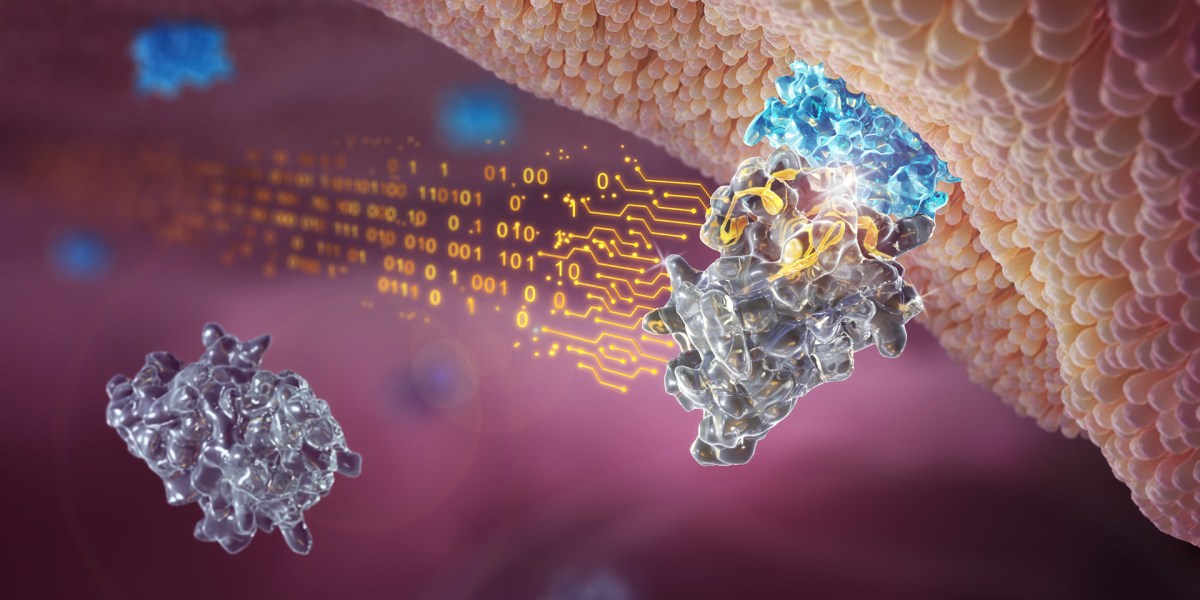

AI-assisted design is a growing part of how biologic drug candidates are developed, and companies like AstraZeneca are actively building its engineering teams to push this further. “Everything we do, whether it’s design, make, test, or analyze, is now computationally enhanced,” says Puja Sapra, senior vice president and head of R&D biologics engineering and oncology targeted discovery at AstraZeneca. “The cycle times are getting shorter while productivity and innovation increase.”
Sapra explains that AstraZeneca’s approach follows a build-measure-learn loop. AI generates or prioritizes candidate molecules computationally, predicting which designs are most likely to succeed. Scientists then focus lab resources only on the top-ranked candidates. This leads to a tighter feedback cycle with fewer dead ends, faster iteration, and the ability to go after disease targets that were previously considered untreatable by medicine. Because the number of possible molecular combinations far exceeds what any human team can systematically explore, using AI to narrow and refine the options for testing has become a major focus in biologics drug design.
Navigating complex drug design problems
Beyond accelerating timelines, AI is also being applied to the discovery of entirely new classes of medicines. Traditional biologics typically target one disease pathway. The next generation of drugs can hit multiple targets simultaneously or precisely deliver therapeutic payloads to specific cells. Achieving this requires optimization across many variables at once. Looking ahead AI-driven models could help design these increasingly complex, multi-specific biologics, explains Puja Sapra. “For example,” she continues, “such models could help identify which two or three targets to prioritize based on the underlying biology, then optimize across multiple parameters to balance a molecule’s potency, stability, manufacturability, and safety.” “Drugging the undruggable is becoming a reality,” Sapra says. “These technologies will eventually enable us to develop medicines against targets once thought impossible to reach. The potential for benefit to patients is remarkable.”
The data moat
McKinsey estimates that generative AI, combined with other computational tools, could cut drug discovery timelines by as much as 50%. But every AI model is only as good as its training data. In drug discovery, that means ample quantities of high-quality biological data. Experiments can provide a rich source of such data. Whether they succeed or fail, each experiment generates a signal about what does and does not work.
“Data is our differentiator,” says Sapra, explaining how the company’s datasets are proprietary and multimodal and include molecular structures, binding measurements, safety profiles, and manufacturing outcomes. “We’ve built an intentionally diverse portfolio across multiple disease areas and drug types. All of that data empowers us to fine-tune frontier AI models with richer, more representative training sets.” She continues, “Further, we have invested in deep screening technologies to generate additional datasets required in volume to constantly refine and validate our models.”
Building an autonomous discovery engine
To bring all of that data together in one place, AstraZeneca is building what it calls a “lab of the future” facility in Kendall Square, Cambridge, Massachusetts where AI and robotic automation will be able to form a continuous, closed-loop discovery system. “Where a self-driving car uses sensors and models to navigate its environment, this system uses AI to make predictions, robotic systems to execute experiments, and instruments to generate data,” explains Sapra. That data feeds directly back into the models, accelerating each subsequent cycle.
“Throughout, scientists will remain central to the process, providing the oversight, judgement, and strategic direction that ensure outputs are explainable, tolerable, and directed toward potential patient benefit,” she adds.
Eventually, automated high-throughput systems will be able to make and evaluate thousands of molecular interactions on a weekly basis. “This will generate AI-ready data at a scale that traditional workflows cannot match,” Sapra says. “Robotic sample handling, automated quality checks, and integrated data pipelines also have the potential to help accelerate early drug development timelines significantly.”