

On August 6, the first tranche of locked-up SpaceX shares was released. Roughly 911.5 million shares became eligible to trade in a single session.
SPCX went up 6%.
Then it went up again the next day, closing out a two-day gain of about 11% on the exact event everybody had circled on their calendar as the plunge.
I had circled it too.
The Consensus Was Obvious, And Obviously Wrong
SpaceX’s public float before that day was about 639 million shares. The unlock added roughly 143% to the tradeable supply overnight.
Put another way, the freely tradable portion of the company went from about 4.9% of shares outstanding to about 11.8%. The float more than doubled, from roughly 639 million shares to about 1.55 billion.
Short interest had built up in anticipation. Every reasonable person expected a flood of seller to push the stock price below $100.
The sellers didn’t show, and I wasn’t able to buy the dip as a result.
Why The SpaceX Sellers Didn’t Show
The relative pain had already been taken.
Shares IPO’d at $135 on June 11 and spiked above $225 in the first days of trading. Then they fell more than 50% to close at $108.27 on August 5, after the company’s first public quarterly results.
Every share of that decline was sold by the free float. The locked-up holders couldn’t participate. Only the roughly 639 million shares that could trade from day one were doing any of the damage.
People who could sell spent seven weeks selling ahead of people who couldn’t, and short sellers piled on top of them. By August 6, the supply everyone was bracing for had already been front-run.
Then two things happened at once.
The shorts had no flood to sell into, so some of them covered (bought).
And the newly freed holders opened their screens to a stock down more than 50% from its high and sitting below its IPO price. If you’ve held SpaceX privately for a decade with a cost basis in the single digits, you are in no rush to hit the bid at the local low. You’ve waited 20 years. You can wait a few more weeks or months.
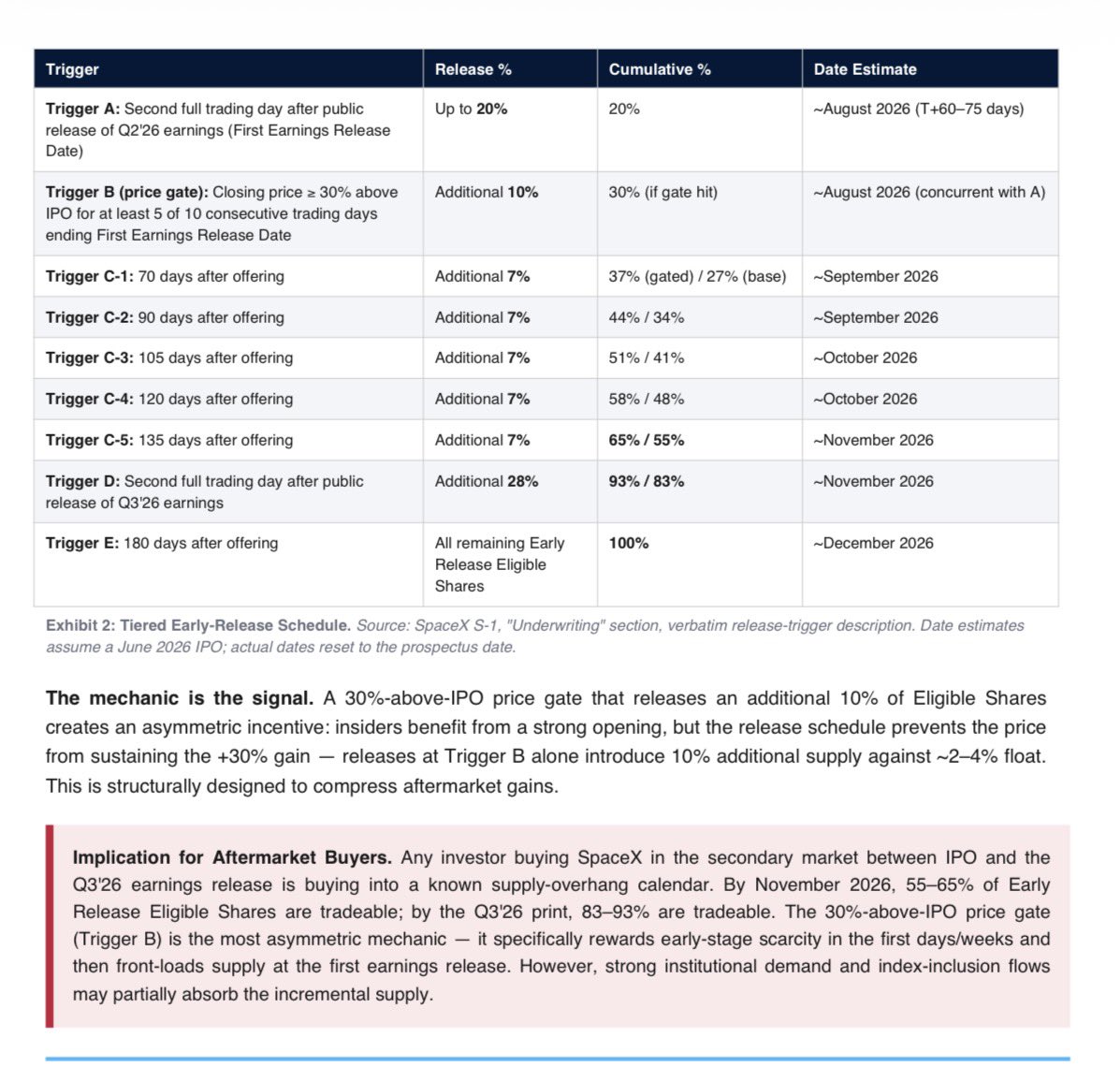
The staggered structure helped too.
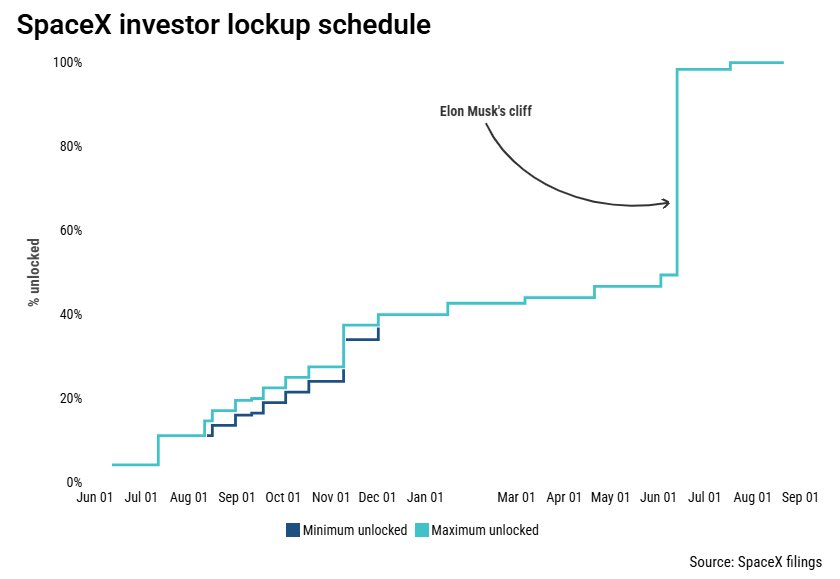
SpaceX released the block in stages rather than one cliff. About 20% came free on August 6, tied to first earnings. Smaller tranches follow every few weeks through October, a larger release comes after Q3 earnings, and the rest of the 180-day block frees up December 8. Elon’s own block of roughly 6.4 billion shares stays locked until June 2027.
Passed On The IPO, But Owned It Anyway
I didn’t buy the IPO. I wrote about why in Risky Exit Liquidity: Why I’m Passing On The SpaceX IPO. It felt too risky at a $1.2 trillion valuation to invest new money.
There was also a mechanical reason. Fidelity, my main brokerage, enforces a 15-calendar-day holding period on IPO allocations. Flip inside that window and you’re banned from IPO participation for six months. Not a trade I wanted to be locked into.
But I already owned SpaceX through a traditional venture capital fund. I just didn’t know exactly how much or when the shares were purchased.
When The Fund Purchased SpaceX And At What Price
Back in 2022 I committed $200,000 to a traditional venture capital fund vintage, a year after the mania died down. A fund like that invests most of the capital over a three-year period, and you don’t know exactly what it bought, how much of it, or at what valuation until well after the fact.
The March 31, 2026 capital statement showed SpaceX at 9.5% of the fund and my ending balance at $348,549. So a 9.5% position implied about $33,100. That was the extent of my knowledge.
Then the distribution letter arrived on August 7, 2026, with the details regarding the price of purchase and the date.
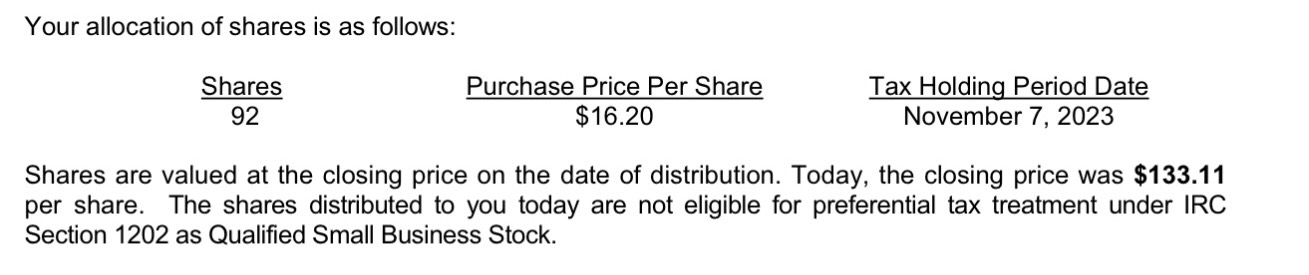
The fund bought SpaceX at $16.20 a share and distributed shares against a reference price of $133.11.
That’s an 8.2X multiple on invested capital in two years and nine months. On paper it’s a fantastic return.
Now the part that brought me back to earth.
Need To Invest Big Money To Make Life-Changing Money
My first reaction to the distribution was disappointment. That’s it? 92 shares. About $12,250.
That is roughly what our family spent on 30 days in Honolulu this summer, including flights, three weeks of summer camp, food, transportation, clothing, and entertainment. A whole summer of memories, or 92 shares of a rocket company.
Then I remembered the 92 shares are only 20% of my stake, because the fund can only distribute what’s actually unlocked. The other 368 shares come as the remaining tranches free up. So my full position is 460 shares, worth about $61,200 at that reference price.
Better than a poke in the eye. Still not enough to buy a Tesla Model Y Performance out the door at $60,000, since I owe taxes on anything I sell.
For context, my largest individual public holdings are more than 15X the size of this position. If SpaceX fell 50% tomorrow, it wouldn’t move the needle. If this were a top-five holding, I may trim a little based on valuation alone. At $61,200, the math doesn’t justify the tax bill.
Unfortunately, you need to invest big money to make life-changing money. In 2022, I committed $400,000 total to the venture capital firm’s two funds: $200,000 to its early stage fund and $200,000 to its growth stage fund, which owns SpaceX shares. I should have invested more because 2022 is turning out to be a great year.
What I’m Doing With My SpaceX Shares
The prudent investor in me says sell the 92 and let the remaining 368 ride, since they free up over the next several months anyway. Take some off, stay in the game.
The person who doesn’t want to be on the government’s leash by paying more taxes says hold everything. The company is growing fast, just raised an enormous amount of capital, and betting against Elon has been a losing trade for 20 years running.
The honest answer is that it doesn’t matter. $61,000 doesn’t change my life, let alone the ~$12,000 I can sell today before taxes. There is nothing I want to buy that cash flow can’t cover, which I proved to myself with a 30-day aggressive $40,000 spending experiment in Hawaii this summer.
So I’m holding. There are plenty more starlink satellites to put into orbit to cover the world’s demand. The next generation of satellites will be vastly more capable. Demand for AI compute seems insatiable, as AI revolutionizes the world. And maybe there will be exciting new space development programs in the future. I’m curious to see how far Elon can take his space expansion dreams.
The whole point of investing in great businesses is not prematurely exiting a growing field. That principle doesn’t stop applying just because the shares finally showed up in my brokerage account. It also doesn’t hurt that Morgan Stanley has a $300 price target with a $600 bull case.
Another Lockup Test With VCX
What’s interesting about the SpaceX case study is that I ran the same experiment twice. I invested a similar amount in Fundrise’s Innovation Fund at the beginning of 2023, back when it wasn’t listed, and kept dollar-cost averaging into it until February 2026 as a hedge against a difficult future for my children due to AI.
Fundrise announced on July 24 that it was accelerating the lockup expiration on the Innovation Fund (NYSE: VCX) from September 14 to August 13. Previously restricted shares become tradeable on August 14.
Roughly 100,000 pre-listing holders with a cost basis in the $10 to $19 range are about to get liquidity on a stock that has traded above NAV since it listed. The consensus is that it goes down on the new supply.
That is the same consensus everyone had about SpaceX on August 6.
I don’t know what will happen. What I do know is that the market spent weeks pricing in the SpaceX unlock and got the direction wrong anyway. The premium in VCX has already compressed substantially from its peak, which looks like the market front-running the event, exactly as it did with SPCX.
The shape is the same. Rocket up after listing, then a slide into the lockup date while everybody positions for the flood.
And here’s the question long-term investors have to ask. If you’ve held VCX for three years, are you really dumping everything in the 20s and low 30s?
My Plan For VCX Upon Lockup
My plan is to hold what I own and buy more after the lockup if VCX trades below my September NAV estimate of $31. I’ve already taken profit selling my unrestricted shares when valuations were aggressive. Right now, valuations are reasonable.
I find it uncanny that VCX is trading right around my NAV forecast put out a month ago, the day before the lockup expires. Maybe my base case NAV forecast of $45 in 2027 and $60 in 2028 will come true too. Only time will tell.
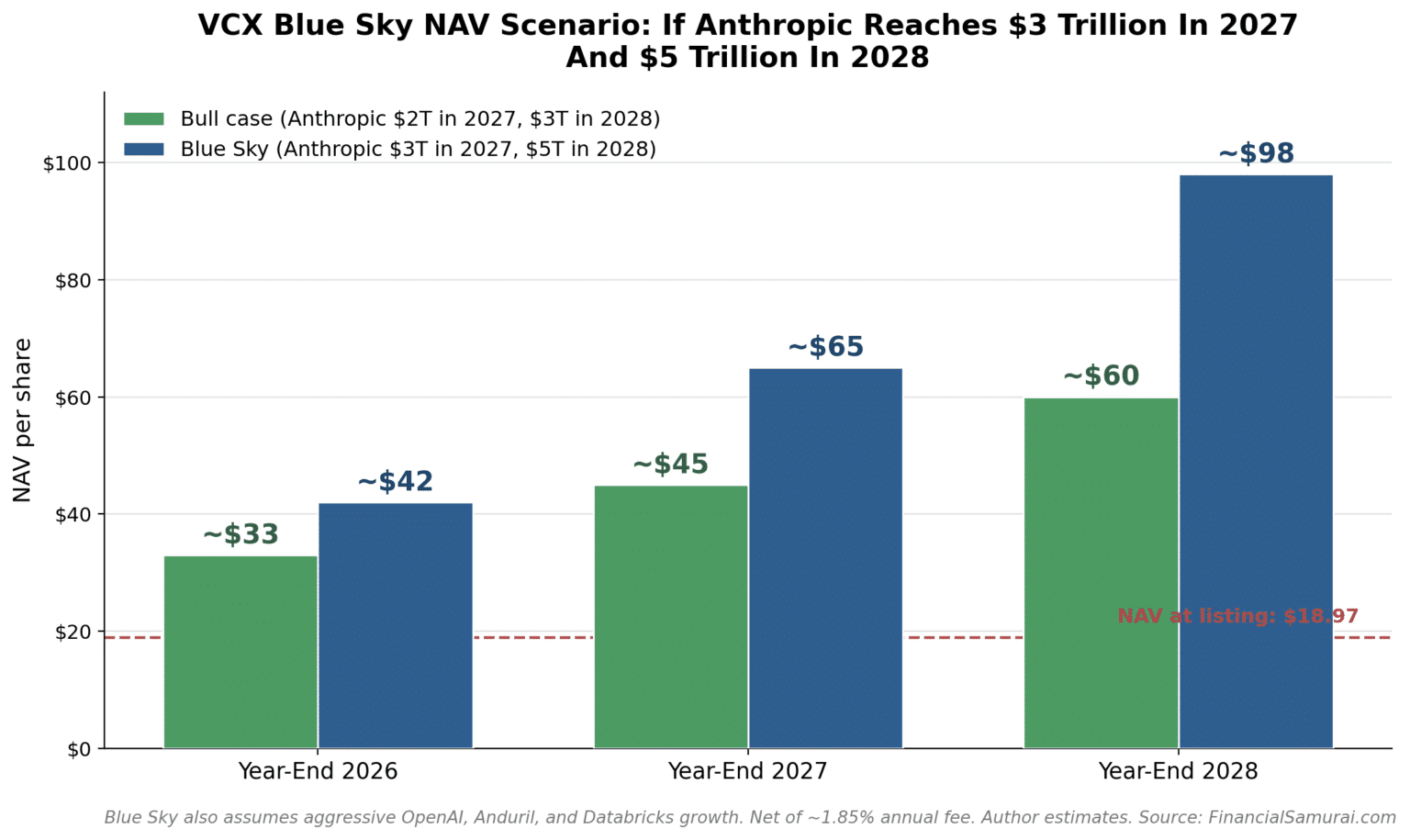
The further it falls below $31, the more I buy. If it hits $25, I plan to back up the truck. I’ve set aside about $150,000 for the event across four of my portfolios.
The reason is Anthropic, and the potential for retail mania to return. Sitting in San Francisco, watching buyers front-run each other in home bidding wars, and talking to venture capitalists, angel investors, and people working inside the AI labs, my read is that demand for an Anthropic IPO would be groundbreaking. I put that probability at 80%.
I could be wrong. 80% is not 100%. Meanwhile, robust demand during the Anthropic IPO may not ignite VCX again, which has more than 20% of the fund in Anthropic. But I’d rather own the exposure before the event than fight for it on day one with everybody else. Battling for hot IPO shares is a losing proposition.
It’s the same reason I’d rather buy my dream San Francisco home before thousands of AI workers get liquid than bid against them at an open house. There is no way I’d be able to afford my house I bought in 2023 today.
The latest reports from the WSJ have Anthropic going public in September or October of 2026. Therefore, the timing of this lockup expiration couldn’t be better.
My cash is ready to buy the dip. And if my game plan doesn’t work out, that’s just the way things go with risk assets. At least I came up with a plan and tried.
Full disclosure: I’ve been a Fundrise affiliate partner since 2016 and I own VCX shares I bought before it listed. About 5% of VCX is in SpaceX. Risk assets can and do lose money. Please invest at your own discretion.
The same 2022 vintage fund that held 9.5% of its value in SpaceX also holds 14.3% in Anthropic, as of the March 31, 2026 capital statement when Anthropic was valued around $360 billion. My goal is to own at least $500,000 worth of Anthropic shares before IPO. As a FIRE investor, my goal is to earn investment returns to provide for my family since I don’t have a day job.
Reader Questions
If you own SpaceX shares, did you sell into the unlock or hold? What was the deciding factor?
For those holding VCX through August 14, have you already decided what you’re doing, or are you waiting to see the tape?
Have you ever received an in-kind distribution from a fund and been surprised, in either direction, by what actually showed up?
Own The AI Buildout Without A Countdown Clock
Watching a position swing on an earnings print and then swing again on a lockup date is a reminder of why I keep a meaningful chunk of net worth in real assets. Real estate produces income, it doesn’t require me to have an opinion by 9:30am, and nobody publishes a countdown clock to my rental property’s lockup expiration.
There’s a less obvious overlap with everything above too. AI runs on compute, and compute has to physically live somewhere. The hyperscalers are spending hundreds of billions a year on data centers, and every one of them needs land, permits, and power the grid was never built to deliver. The fortunes of the steam era weren’t made on the engine. They were made on the railroads and steel the engine required.
Fundrise invests in that buildout alongside residential and industrial property in lower-cost regions of the country. I’ve invested over $300,000 in its real estate product so far. The investment minimum is $10, so you can test the waters before committing real capital.
Subscribe To Financial Samurai
To get my posts in your inbox, join 60,000+ readers and sign up for the free Financial Samurai newsletter here. For new post notifications, ad-free for the first few hours, sign up here.
Money is too important to be left up to pontification, which is why I’ve been writing from firsthand experience since 2009.