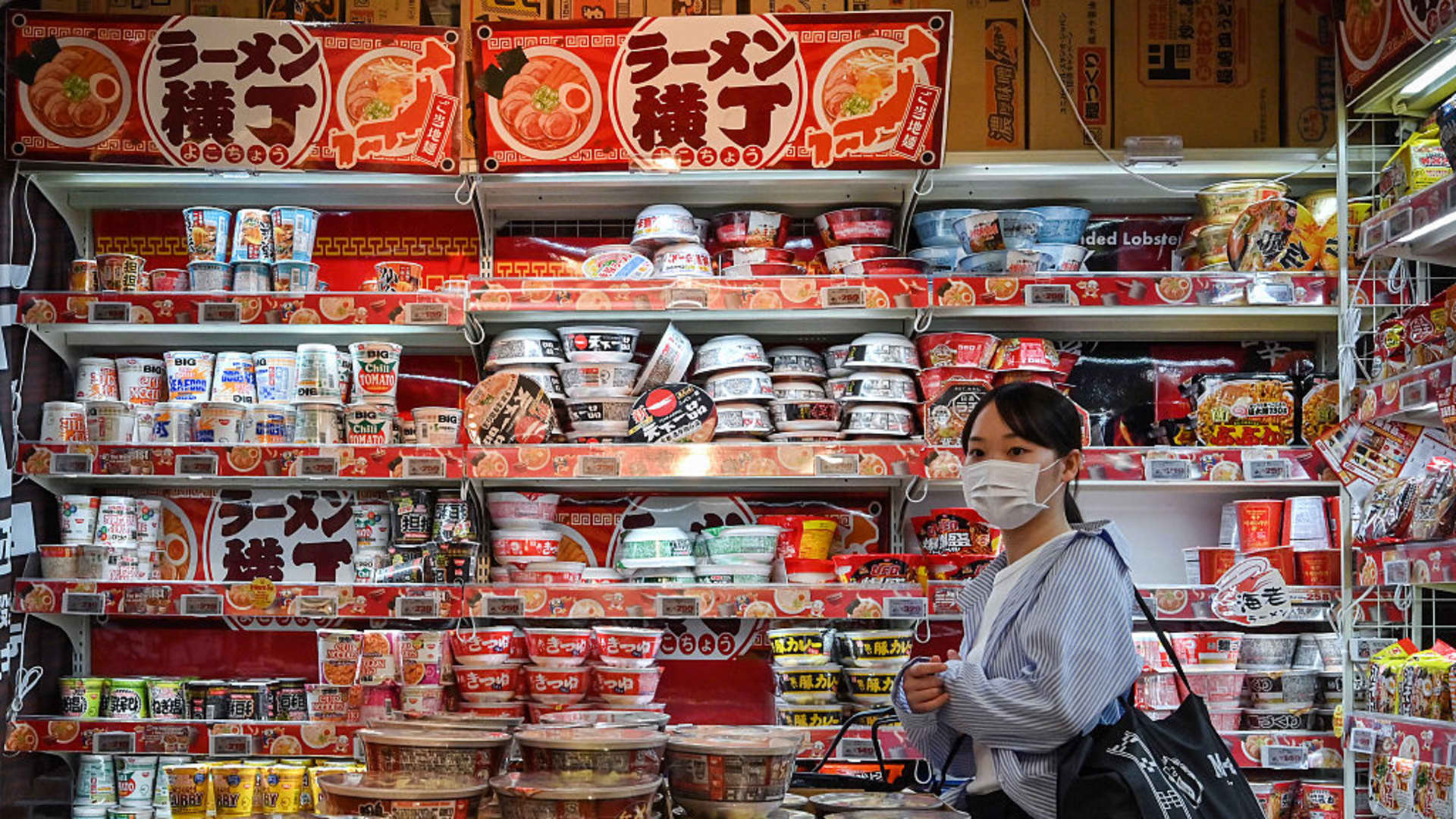
This photo taken on April 21, 2025 shows a customer walking past a display of instant noodles at a branch of Japanese discount retailer Don Quijote, also known overseas as Don Don Donki, in the Shibuya district of central Tokyo. (Photo by Richard A. Brooks / AFP) (Photo by RICHARD A. BROOKS/AFP via Getty Images)
Richard A. Brooks | Afp | Getty Images
Japan’s economy expanded 1.1% in the second quarter on an annualized basis, missing expectations for 2% growth as softer domestic demand offset strong exports.
The figure was compared to the 2.1% in the previous quarter.
This is the first full quarter to include the impact of the Iran war, which has brought energy prices higher for business and households.
Following the data release, the Nikkei 225 rose 0.43%, while the yield on the benchmark 10-year Japanese Government Bonds was at 2.88%. The yen strengthened slightly against the dollar, trading at 159.1.
Exports were the main driver of growth, with shipments from the country beating expectations for all three months of the quarter. However, this was helped by the weak yen as opposed to simply a higher volume of shipments.
Compared to the first quarter of 2026, GDP climbed 0.3%, missing expectations of 0.5%. While exports contributed 0.5 percentage points to the GDP figure, this was weighed down by weaker domestic demand, which dragged growth down by 0.2 percentage points.
The drop in domestic demand was mainly due to a reduction in public inventories, which was identified as the release of national oil reserves by the government to cope with the Middle East conflict, according to Norihiro Yamaguchi, lead Japan economist at Oxford Economics.
Consumption was also another surprise, Yamaguchi wrote, saying that non-durable goods purchases and service consumption dipped with worsened sentiments. Business investment also shrank a on quarterly basis.
On a year-on-year basis, the country’s economy expanded 0.7%, up from 0.5% in the first quarter.
Earlier this month, the Bank of Japan released its economic activity outlook, and raised its GDP growth outlook marginally to 0.6% from 0.5% for its 2026 fiscal year ending March 2027.
“Japan’s economy is expected to continue growing moderately, albeit at a decelerated rate,” the central bank said, pointing at high crude oil prices from the conflict in the Middle East.
However, this is likely to be partially offset by measures from the government to curb high oil prices for households, as well as an increase in global AI-related demand. Many Japanese companies are involved in the semiconductor supply chain.
Yamaguchi was more pessimistic on inflation, and said “The boost to consumption from policy measures is already fading, and inflation will increase in H2 as firms will pass on increased costs, deteriorating consumers’ purchasing power.”