


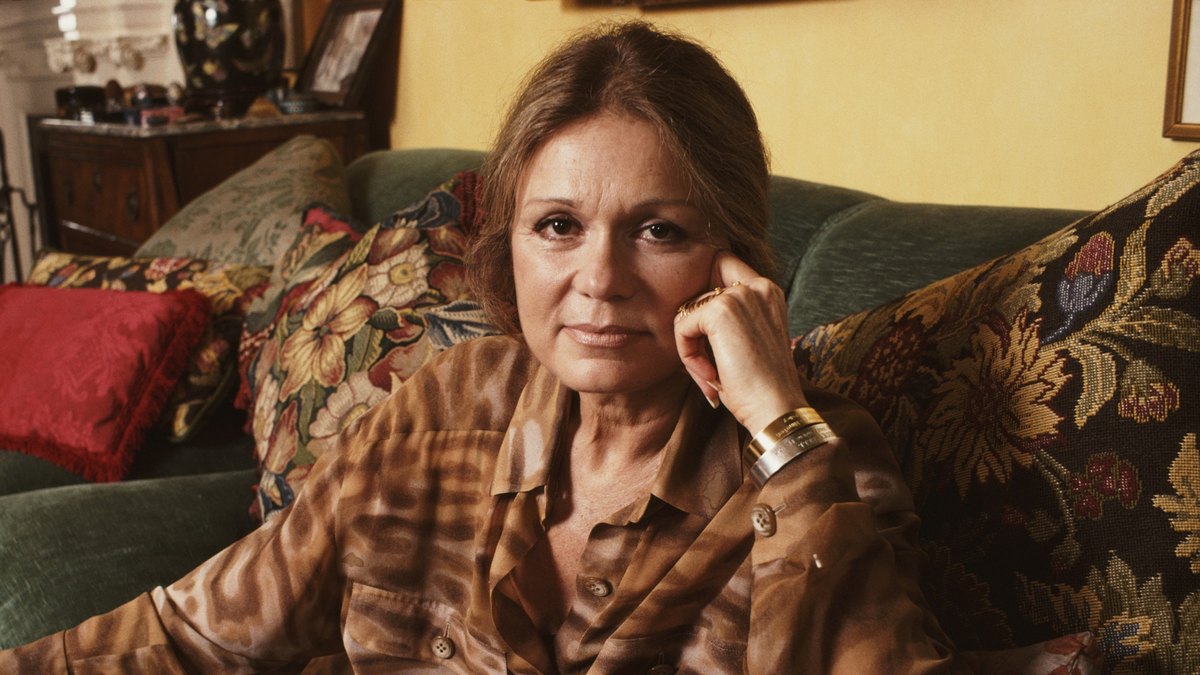
Political activist Gloria Steinem has passed away inside her longtime New York City home at the age of 92.
The news of her death was announced via a statement posted on her Instagram page, which read, “Yesterday, Gloria Steinem passed away peacefully at her home in New York City, surrounded by some of the many who loved her. Gloria’s near-century on earth were years well-lived, and she continued working for equality until the very end.”
The writer, who served as the face of second-wave feminism in the 196s and 1970s, was described as an “independent spirit” who had a talent for listening to others.
“Gloria’s greatest gift was her ability to listen to others, to make others feel seen and heard. Her words, actions, and example gave people permission to be their truest selves. Gloria lived true to her independent spirit, always with curiosity and a great sense of humor,” the message continued.
The statement noted that Steinem “spent her recent years doing the two things she loved most: being in community with others and writing.”
“Gloria loved the tradition of lighting signal fires on hills to light the way to the other side of the mountain. Lighting your own candle for Gloria makes you part of this global and celestial community circle,” the post concluded.
Steinem moved to NYC in her mid-20s, and by 1968, she picked up her 1880s brownstone, which was situated in the Upper East Side.
Steinem moved into the parlor floor of the property with artist Barbara Nessim. It would ultimately become the place Steinem called home for the rest of her life.
Evidence of her early days in Manhattan remained even decades later. The activist and her roommate overhauled a discarded Connecticut porch into a chic lounging space in the living room, creating one of the property’s most unique architectural features.
“Whoever came in first at night got the bed up on the porch, and the other got the couch,” Steinem previously told Architectural Digest.
But the apartment’s history extended far beyond its interiors. Steinem used the residence as a place to bring together some of the women who were shaping American politics, media and the feminist movement.
In 1971, a gathering in her living room helped lay the groundwork for Ms. magazine. Among the notable figures she later entertained at home were politician Bella Abzug and Wilma Mankiller, who became the first woman elected principal chief of the Cherokee Nation.
Her footprint in the building grew in 1987, when Steinem acquired the ground-floor apartment and incorporated it into her residence. The added rooms became a study and accommodations for guests.
She also turned her attention outdoors after frequent visits from her friend, author Alice Walker, inspired her to create a garden on the rear terrace.
The result was a property that truly evolved over decades without losing the evidence of Steinem’s life inside it.
When Steinem gave Architectural Digest a tour of the duplex decades after she first moved in, its rooms were packed with books, photographs, artwork, textiles and keepsakes rather than adhering to a meticulously minimalist aesthetic.
Her office occupied part of the living room, complete with a Tiffany-style lamp gifted by a former neighbor. Nearby, a specially made folding screen resembled bookshelves, with the names of Steinem’s friends appearing on its faux volumes.
The primary bedroom offered another glimpse into her personal style. Vintage striped Ralph Lauren fabric covered the walls, an antique silk Uzbek suzani lay across the bed and bookcases occupied the room. Several pairs of the aviator glasses that had become synonymous with Steinem were also kept nearby.
Her decades of activism were woven into the decor as well. Political buttons and pins appeared among her mementos, while a sign commemorating the 2017 ceremonial naming of “Ms. Magazine Way” in New York City was displayed in the hallway.
In her later years, interior designer Jane Hallworth helped update parts of the aging property while leaving much of its personality intact.
Work on the ground-floor kitchen included plumbing improvements as well as new cabinetry, marble counters, a farmhouse-style sink and a new range.
The primary bathroom was also refreshed with blue tile in the bathing area and a vintage Moroccan light fixture.
The guest room held still more reminders of Steinem’s relationships, including needlepoint pillows created by her friend Marlo Thomas. Outside, the garden featured a bronze sculpture that friends presented to Steinem in celebration of her 90th birthday.
For all of the possessions accumulated there, however, Steinem’s attachment to the apartment appeared to run much deeper than its design.
Her childhood had involved frequent travel, and her work as an adult continued to take her around the world. The Manhattan residence offered a permanence that had once been unfamiliar to her.
“I made a home for myself,” she told the outlet. “But it took a while to learn that I didn’t have to live out of boxes and suitcases.”
And Steinem had already considered how that home might continue serving women in the future. She revealed plans for the residence to eventually become a space where women could come together for conversations and, when necessary, find refuge.
It was a fitting ambition for an apartment that had already spent decades functioning as much more than a private residence—a place where friendships were nurtured, political ideas were debated and pieces of feminist history were made
Steinem, who was born in Toledo, Ohio, in 1934, is described on her website as the “founder of New York and Ms. magazines, and is the author of An Unexpected Life, The Truth Will Set You Free, But First It Will Piss You Off, My Life on the Road, Moving Beyond Words, Revolution from Within, and Outrageous Acts and Everyday Rebellions, in addition to many collections and essays,”
“She co-founded the National Women’s Political Caucus, the Ms. Foundation for Women, the Free to Be Foundation, and the Women’s Media Center in the United States. As links to other countries, she helped found Equality Now, Donor Direct Action, and Direct Impact Africa,” the biography added.
“Among many tributes and honors for her activism, in 2013 she was awarded the Presidential Medal of Freedom by President Barack Obama and in 2019, she received the Freedom Award from the National Civil Rights Museum,” the website continued, adding that “Gloria’s home is the heart of Gloria’s Foundation and has become renowned as a magnetic and life-changing center for feminist and activist thinkers from around the world.”
Steinem also “helped to found the Women’s Action Alliance, a pioneering national information center that specialized in nonsexist, multiracial children’s education, and the National Women’s Political Caucus, a group that continues to work to advance the numbers of pro-equality women in elected and appointed office at a national and state level.”
“She also co-founded the Women’s Media Center in 2004. She was president and co-founder of Voters for Choice, a pro-choice political action committee for twenty-five years, then with the Planned Parenthood Action Fund when it merged with VFC for the 2004 elections,” her website concluded.
In 2000, Steinem tied the knot to animal rights activist David Bale.
Three years later, Bale, the dad of actor Christian Bale, died from primary brain lymphoma.
She began her remarkable career as a journalist, having notably reported on the conditions inside Hugh Hefner’s Playboy palace.
“That speak-out was the beginning of activism for me,” Steinem, who had a secret illegal abortion at the age 22, told the Associated Press in 2022, recalling on the reversal of Roe v Wade. “Either our control over our own bodies is equal, regardless of sex or race, or we’re not living in a democracy.”
In 2020, Steinem’s life was featured in the film “The Glorias, A Life on The Road,” which was based on her 2015 memoir and starred Julianne Moore.
Get real estate news in your inbox