


Once both our children began school full-time in 2024, my wife and I had more breathing room. At least six hours a day of free time. No more wrangling toddlers in the chaos of the early years.
I used the time to finish Millionaire Milestones, which became a USA Today bestseller in 2025. Now I’m working on a new book about why your children will be OK, also with Portfolio Penguin, out in 2027.
My wife decided to get her teaching credentials online through UCLA over six months. Then she started substitute teaching at our son’s first preschool nearby to gain real-world experience.
She loves kids and is great with them. If she keeps it up, she’ll have a year of full-time classroom experience under her belt within three years. And if we relocate to Honolulu, maybe she could find a teaching job at one of the schools we’ll be applying to. A built-in community from day one.
Supporting Her In Her New Endeavor
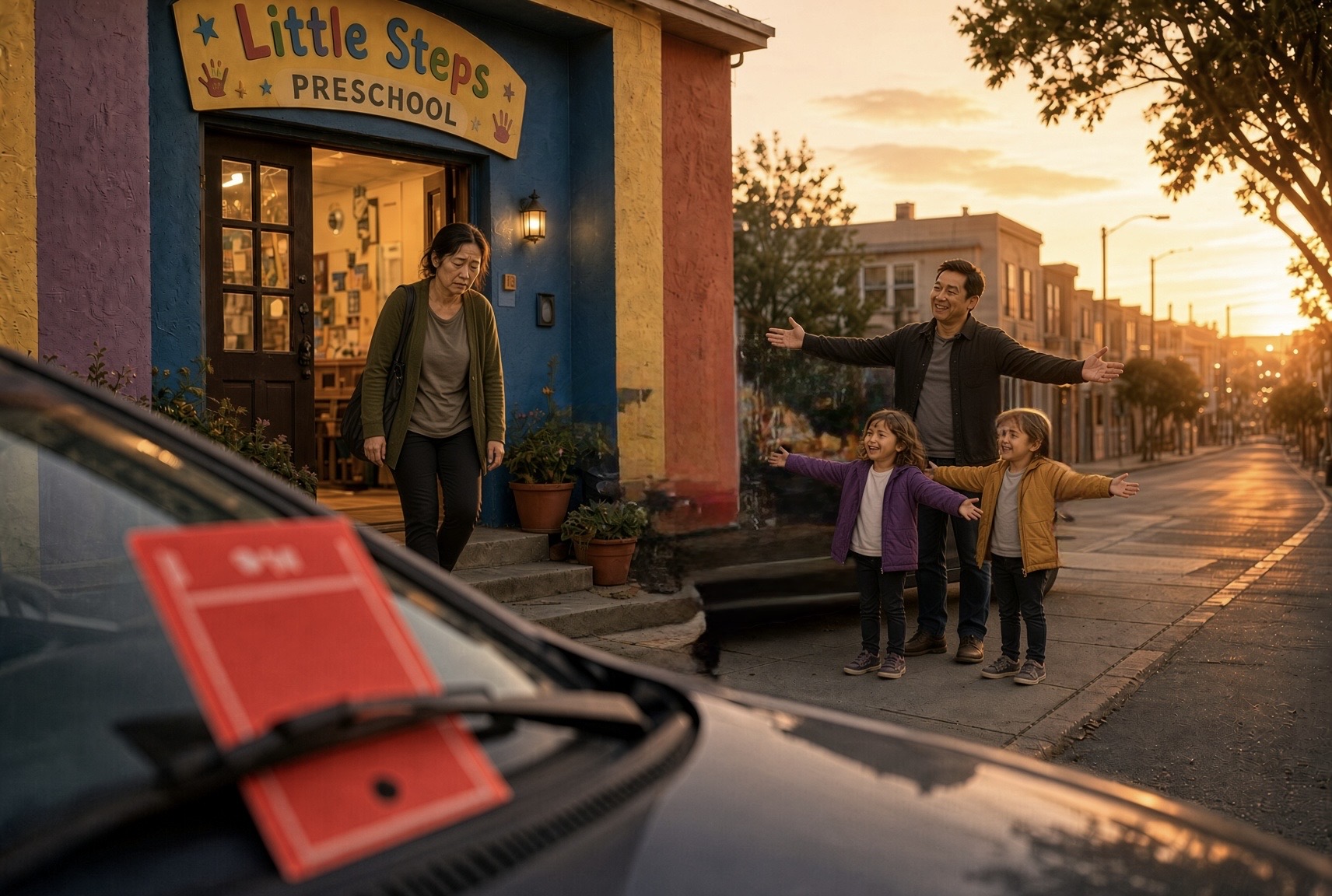
One way I support her is by driving her to and from work around my school drop-off and pick-up runs. Being a preschool teacher means standing on your feet for six of the 7.5 to 8 hours of the day. Her school also does daily nature walks to Golden Gate Park. Shuttling her saves nearly two miles of walking up and down a hill after an already exhausting day.
One afternoon I picked up the kids around 4:45pm, then swung by to get mommy at 5pm. She was tired. Everyone was hungry. We drove around the corner to a popular bakery and I parked in a red zone between two driveways of an autobody shop, not double parked. Three minutes, tops. The auto body shop had workers parking client cars out front all the time, including ours years ago. I figured I was safe.
I was not.
When I came out, a parking attendant was already writing me up. I asked nicely if he could let it slide. He said no. The law is the law.
No Good Deed Goes Unpunished
What stung wasn’t just the ticket. It was the math.
My wife had just spent eight hours on her feet earning $26 an hour. That’s $208 gross. After taxes, because we have passive income and online income that pushes us into a higher bracket, her take-home was closer to $145.
I wanted to do something nice. Pick up my tired wife. Feed my hungry kids. Instead, I might have wiped out her entire day’s take-home pay with one poorly parked car.
This is financial despair in its purest form. You work all day. You try to do something kind for your family. And you end up paying money just for the privilege of having worked.
We checked online for two weeks and saw nothing. So we forgot about it, and felt hopeful.
Then, 62 days later, at an SF Giants game, an e-mail from my tenant:
“Hi Sam, sorry for notifying you late. Parking ticket for you. Just found this today under some stuff in the garage.”
The ticket was dated August 31. Due date September 21. I was reading it on September 22.
$108 ticket plus $45 late fee. $153 total.
That’s the gut punch that turns a good evening into a quiet drive home.
Financial Despair Is More Common Than People Admit
This is such a small story. I know that.
But I think a lot of people reading this know exactly what financial despair feels like. You work hard, do the right thing, try to take care of your family, and then something stupid and random erases it. A parking ticket. A medical co-pay that arrives six months late. Having a toddler swell up from an egg allergy and riding a $3,000+ ambulance ride to the ER. A bounced direct deposit. An overdraft fee triggered by a school fee you forgot about. A new government tax.
The math starts to feel rigged. Not because anyone is plotting against you, well maybe, but because the margins are just so thin. When you’re living close to the edge, one $153 surprise isn’t an inconvenience. It’s a week of groceries. It’s the difference between making rent on time or not.
That financial hopelessness is real. Even people doing everything right, showing up every day, working hard, raising their kids, still get blindsided by bad luck and bad timing. The system doesn’t care how tired you are. The late fee posts anyway.
And once you start doing the math in your head, it gets darker. After federal taxes, state taxes, payroll taxes, and whatever surprise the city throws at you, the gap between what you earn and what you actually keep can feel insulting. That’s when financial hopelessness starts to creep in. Not because you’re failing. But because the rules seem designed to keep you running in place, forever.
I got a little of both. Despair and anger.
The Last Time I Felt True Financial Despair
The $153 parking ticket stings. But the last time I felt genuine financial despair, the kind that keeps you up at 1am staring at the ceiling, was 2008 and 2009.
I was in my early 30s, working in equities at a time when equities were collapsing. My net worth got slashed by 40% that took 10 years to build. Colleagues were being laid off in waves. The job I had worked toward since college suddenly felt precarious. The entire financial system, the one I had built my career inside, felt like it was coming apart at the seams.
What made it feel like despair, and not just stress, was the helplessness. No amount of working harder was going to fix a global credit freeze. You could do everything right and still lose. The rules had changed overnight and nobody had told you.
But that period of despair also rewired how I thought about money permanently. No longer was money sacred, as it could disappear in an instant. I also began quietly building the financial buffers that would eventually let me walk away in 2012.
Financial despair, it turns out, was the tuition I paid for financial freedom.
Financial Despair Can Also Be A Turning Point
What I’ve learned over the years is that financial despair, as miserable as it feels in the moment, is one of the most motivating forces in the world. Not because suffering is good. But because when something costs you enough, you actually change.
When I was working 60-hour weeks in finance and San Francisco passed a retroactive income tax targeting high earners, my effective tax rate shot to nearly 40% and my marginal rate hit around 56%. I was not happy. That financial despair is what pushed me to figure out how to negotiate my own severance and walk away in 2012.
Pain planned my way out of that job, and my life is much better as a result.
Same lesson applies now. The next time I pick up my wife from work, I’m not getting out of the car. Not for snacks, not to open her door, nothing. We’re going straight home.
In the process, we’ll spend less at local shops and restaurants. We’ll eat slightly less unhealthy foods. And we’ll save and invest more money. Three unintended wins from one expensive lesson.
And because I had apparently forgotten I was a taxpaying San Franciscan with rights, this $153 reminded me to actually use the 311 system. Now, I’ve argued before that the people who pay the most taxes should receive the least services, as a form of cosmic justice for earning too much. But just this once, after paying $153 for the crime of feeding my family, I’d like to feel like I’m getting something back. The city charges plenty. May as well use what I’ve paid for.
Here’s what you can request by calling 311 or using the SF311 app:
Street & Sidewalk Maintenance
- Fixing potholes and broken roadways
- Repairing damaged sidewalks and tripping hazards so I don’t twist my ankle
- Fixing broken streetlights or missing traffic signs, maybe even wash them, which I did on my block with detergent and a brush
- Removing abandoned vehicles left more than 72 hours
Waste, Cleaning & Public Nuisance
- Clearing illegal dumping (furniture, mattresses, appliances)
- Removing graffiti from public property
- Cleaning streets and sidewalks after dumping or waste
- Scheduling free bulky item pickups
Trees, Parks & Infrastructure
- Clearing fallen trees or dangerous hanging limbs
- Reporting broken playground equipment or damaged park facilities
- Clearing blocked storm drains causing flooding
The Way Out Of Financial Hopelessness
One parking ticket shouldn’t derail your financial life. But it can change your habits, your awareness, and your willingness to push back in small ways.
The people who eventually escape financial hopelessness aren’t the ones who avoid all bad luck. They’re the ones who get enough of it to finally stop tolerating the things that weren’t working. They change their routines. They question the systems around them. And they start demanding something back for what they pay in.
If there is one concrete step to take right now, it’s this: calculate your real hourly rate. Take your monthly take-home pay, divide it by the actual hours you spend earning it, including the commute, the prep, the decompression time after work, and the mental bandwidth it consumes on weekends. That number is almost always lower than people expect. And once you see it clearly, every unnecessary expense stops looking like a small thing. A $153 late fee isn’t just $153. At $20 an hour after taxes, that’s nearly eight hours of your life you’ll never get back.
Seeing the true cost of things in hours, not dollars, is one of the fastest ways to stop leaking money and start building real buffers. Your motivation to save and invest more will go through the roof! It also makes you question what you really want to do with your time.
My wife’s $26/hour salary won’t make us rich. But she shows up, she’s building something real, and she cares deeply about what she does. That matters.
The $153 is gone. The lesson, and the 311 call I’m about to make about the pothole in our neighborhood, will stick around a lot longer.
Financial despair is real. But so is the momentum that comes after it. Sometimes the best tickets are the ones that finally wake you up.
If You’re Feeling Financial Despair, You’re Not Alone
If this post resonated with you, I’d love to hear your story. Leave a comment below.
- Have you ever felt like you ended up paying money just to go to work?
- What was your version of the $153 parking ticket? A surprise bill, a late fee, a tax surprise?
- How did financial despair or financial hopelessness end up changing your behavior for the better?
Track Every Dollar So Nothing Catches You Off Guard
One reason financial despair hits so hard is because most people don’t have a clear picture of where their money is going until something goes wrong. A late parking ticket. An overdraft. A tax bill that arrives out of nowhere.
The free tool I use and recommend is Empower. It lets you link all your accounts in one place so you can track your net worth, monitor your spending, and actually see the full picture of your financial life. No more surprises buried in the garage.
Empower also offers a free consultation with a licensed financial professional if you have at least $100,000 in investable assets. Sometimes all you need is one conversation to stop the bleeding and start building a plan. It’s worth doing. Schedule a free consult here.
Join 60,000+ Readers Who Refuse To Stay Stuck
If you found this post useful, consider subscribing to the Financial Samurai newsletter. I’ve been writing about money, work, and real life since 2009, based on firsthand experience, not pontification. Money is too important to be left up to guesswork.
- Newsletter: Get my best thinking a few times a week. Sign up here.
- New post notifications: Get each new post by email, ad-free for the first few hours. Sign up here.