


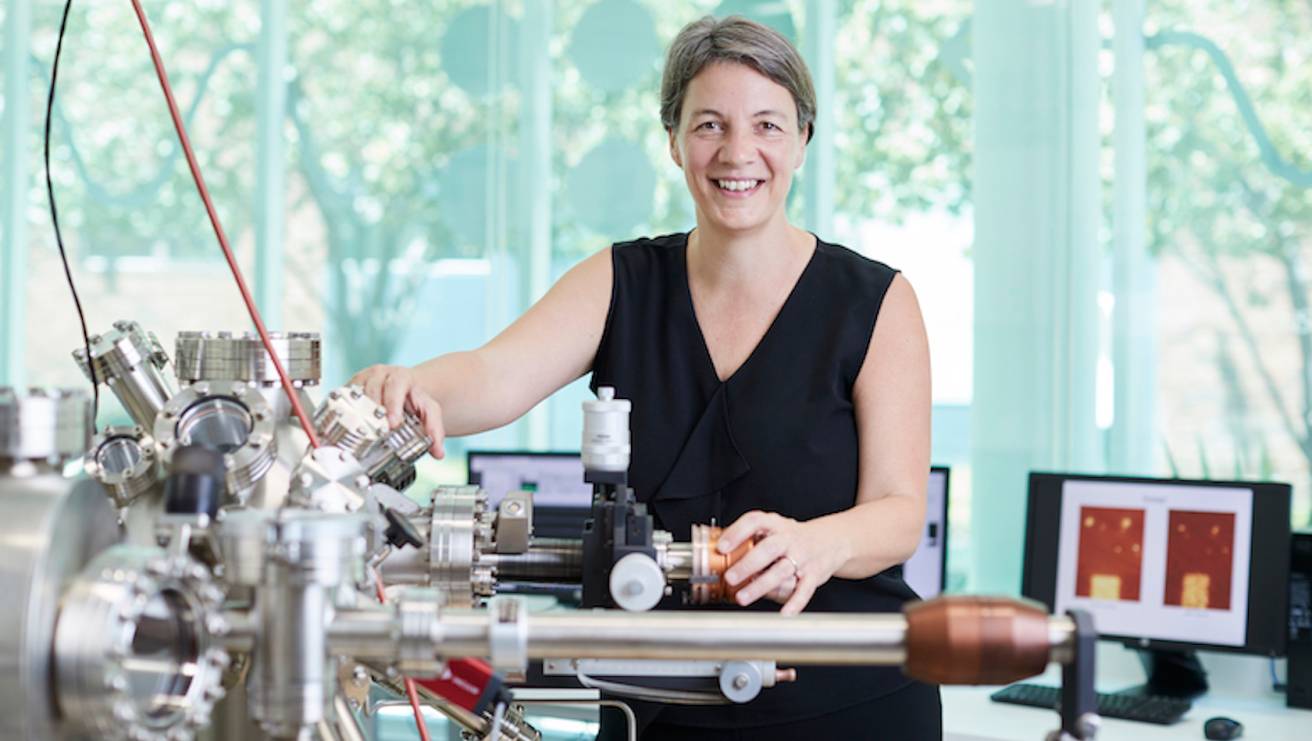
Silicon Quantum Computing and QuantX Labs are among six startups awarded a total of $12.3 million in federal government grants for quantum technologies.
Sydney-based SQC scored the biggest slice, $3.6 million, to expand its partnership with Schneider Electric and UNSW, using quantum-enhanced artificial intelligence to improve energy forecasting and renewable electricity use.
The UNSW spinout, founded by former Australian of the Year and Tech Council director Professor Michelle Simmons in 2017, also banked $60 million in National Reconstruction Fund (NRF) investment earlier this year, including $40 million in June, just three months after an initial $20m, as part of a larger raise currently underway.
Its latest project combines SQC’s Watermelon quantum-enhanced AI processor with Schneider Electric’s forecasting models.
Watermelon generates quantum features from classical data, helping AI models uncover complex relationships in sparse and time-series datasets. It can also be used to offload parts of AI model training, potentially reducing the computational burden of conventional systems.
The companies say initial testing of next-day energy forecasts using 12 months of data delivered an average 20% improvement in accuracy against a conventional computing benchmark, with gains reaching 41%.
The next stage will expand modelling to hundreds of Australian homes and integrate the technology into Schneider Electric’s AI workflows.
Better forecasts could help manage increasingly complex household energy systems as rooftop solar, batteries and electric vehicles change when electricity is consumed, stored and exported.
Adelaide’s QuantX Labs was awarded $2.2 million to build and test a quantum clock designed to keep electricity networks accurately synchronised without relying on external timing signals.
Founded in 2016 by Andre Luiten, the quantum sensing startup previously nabbed $2.7 million in Defence contracts for optical atomic clocks in 2024, following $1 million from SmartSat CRC in 2022 to develop a clock for satellite applications. It raised a $7 million Seed round in June.
QuantX’s latest project involves Siemens and Swinburne University of Technology, extending its precision timing work into energy infrastructure.
The remaining quantum technology grants span healthcare, biosecurity and logistics.
Victorian startup FeBI Technologies received $2.2 million to improve iron deficiency testing and diagnosis for First Nations peoples.
Western Australia’s Avicena Systems gets $2 million for a prototype quantum biosensor to improve border inspections.
Queensland’s iQ Sense has $1.2 million to develop real-time livestock health and disease monitoring, while Q Factorial receives $1.1 million for software to improve delivery and transport planning.
The funding comes through Round 2, Stage 2 of the Critical Technologies Challenge Program, which is designed to speed up commercialisation and adoption of Australian-developed quantum