



On February 9, OpenAI started testing ads in ChatGPT in the United States. By May 20, Google was describing new ad formats for AI Mode and Search. Paid messages were moving into the interactions where customers work through decisions, bringing sponsorship closer to the advice they rely on.
The interface already has the customer’s question and attention. An ad can use that context to be more relevant. But it also needs to be recognizable as advertising before the customer acts on it.
The Ad Is No Longer Beside the Decision
A banner is easy to recognize. So is a sponsored search result. The page gives you a rough sense of where the advertising ends.
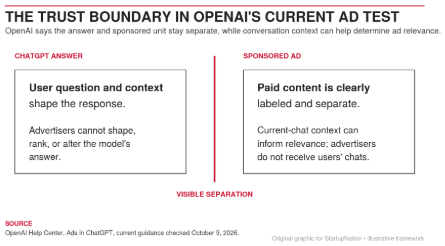
In a conversation, the system has already heard the customer’s problem before the paid placement appears. OpenAI’s current ad guidance says the context and intent of the current conversation can help determine which ad is relevant. With ad personalization enabled, selected signals from past chats and memory may contribute, too.
That puts more weight on the label.
Google is experimenting with a different presentation. In its May 20 announcement, Google described Conversational Discovery ads that can answer specific product questions and Highlighted Answers that may appear within AI Mode recommendations. It also said the formats remain labeled “Sponsored” and may include an AI explainer independent of the advertiser’s creative.
The question is how obvious that “Sponsored” label remains while a customer reads a recommendation and decides what to buy.
Trust Depends on Keeping the Commercial Layer Clear
Paid content should look paid.
OpenAI describes its ads as clearly labeled units, separate from ChatGPT’s answers and shown below the end of a response. According to OpenAI, advertisers cannot shape, rank, or alter the model’s answer.
Google’s formats place sponsored material in different locations, including within recommendations. Its public description also calls for a “Sponsored” label.
The platform designs the screen, but your brand still has to appear on it. If the sponsorship is difficult to recognize, customers may hold that against your business when deciding whether to keep reading or make a purchase.
StartupNation has previously covered customer trust as a business driver. In an ad-supported conversation, that decision may also involve leaving the interaction altogether.
Clear labeling won’t make every customer like an ad. At least they’ll know who’s paying.
Personalization Gets Useful Before It Gets Uncomfortable
Start with what actually reaches the advertiser.
For OpenAI’s test, that includes aggregated information about ad performance, such as views and clicks. According to OpenAI, advertisers cannot access users’ chats, chat history, or memories. Names, email addresses, precise locations, and other personal details are also excluded from the information advertisers receive.
Ad selection can draw on the current conversation and, with personalization enabled, selected signals from past chats and memory may help determine which ad appears.
That distinction matters. Describing the system as an advertiser reading someone’s conversation would give customers an inaccurate understanding of how it works.
Data collection and access are also worth reviewing in the other tools a startup uses. StartupNation has covered data-harvesting risks within everyday business tools, including the permissions involved and where collected information goes.
Before purchasing an ad placement, ask the platform team to explain why a particular ad appeared. That explanation should cover the information used to select it and what the advertiser receives.
Also check how users can hide or report an ad, turn personalization off, and find out why an ad appeared.
Hold off on describing the targeting to customers until your team can explain it in plain English.
We earn a commission if you make a purchase, at no additional cost to you.

We earn a commission if you make a purchase, at no additional cost to you.
Clicks Are Not the Only Signal Worth Measuring
Clicking an ad and liking its placement can be two very different reactions.
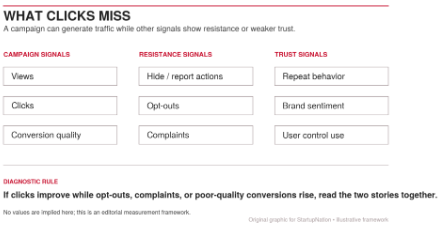
Hides, reports, and personalization opt-outs belong in the review, too. So do complaints that a recommendation appeared to have been bought.
Views and clicks fit neatly into a report. These other reactions take more work to interpret.
One public dashboard tracking ads in AI assistants estimates blocked ad units across supported platforms using anonymous, aggregated filter activity. Its counts are approximate. They show one form of ad avoidance without establishing whether a particular ad converted or whether users dislike AI advertising as a whole.
That’s why it’s useful to consider those figures alongside platform metrics.
Review the reasons for dismissals or reports where that information is available. Conversion quality belongs in the analysis as well.
Then look at whether customers returned, what they complained about, and how often they opted out.
More clicks alone wouldn’t justify a campaign if conversions declined or complaints and opt-outs increased.
Both sets of results deserve attention.
A Five-Question Trust Test for Founders
1. Is the Paid Content Unmistakably Labeled?
Look for “Sponsored” before clicking.
If you have to open a help page or dig through fine print to recognize a paid placement, the disclosure needs work.
2. What Information Makes the Ad Relevant, and What Does the Advertiser Receive?
For OpenAI’s test, distinguish between information used to select an ad and information shared with advertisers.
Conversation context can help determine ad relevance, while advertisers receive aggregated performance information, such as views and clicks. They do not receive the conversation itself.
Privacy copy, sales training, and customer explanations should describe that arrangement accurately without promising advertiser access or targeting capabilities the platform hasn’t offered.
3. What Control Does the User Have?
Try turning personalization off and hiding an ad.
Check how to report it and find out why it appeared.
These controls won’t make everyone comfortable with advertising. But if meaningful options are missing, it’s worth taking a closer look before buying the placement.
4. What Are You Measuring Besides Clicks?
Give conversion quality, complaints, opt-outs, brand sentiment, repeat behavior, and available hide or report signals more weight than raw click growth alone.
Extra traffic won’t make up for customers becoming less willing to trust the next recommendation.
5. Would the Placement Still Feel Fair if the Customer Knew Exactly How It Was Selected?
Answer from the buyer’s side of the screen.
On August 27, the Federal Trade Commission finalized orders involving firms accused by the agency of falsely claiming that an AI-powered advertising service could target people using conversations captured from smart devices.
The firms also claimed consumers had opted in. According to the FTC, the service didn’t work as advertised, and consumers hadn’t given the claimed consent.
Before making similar claims in a campaign, require evidence supporting the advertised capability and documentation of consent.
A technical possibility alone is not a sufficient basis for a targeting promise.
StartupNation’s discussion of trust in the AI stack encourages teams to understand the systems they use. That includes checking claims made about those systems and accepting responsibility for the trade-offs.
Higher-Intent Surfaces Need a Higher Trust Standard
Conversational AI can place a paid message close to the moment when a customer is deciding what to do.
That’s valuable territory. It’s also a risky place to blur the boundary between advice and sponsorship.
Ultimately, the placement should be judged partly by whether customers still trust the recommendation after seeing the ad.
That belongs in the campaign review, even if the dashboard has nowhere to record it.
Image by DC Studio on Magnific