



Most founders at SmartCompany and Startup Daily’s Growth Summit probably thought they knew whether or not they had a business strategy.
But keynote speaker Angad Soin had a different view that set off lightbulb moments among the 180+ founders, investors and executives at the recent Melbourne event.
“You have a strategy whether you know it or not,” the Xero MD shared. “Having one isn’t defined by a glossy strategy on a page. Ultimately, it is a set of goals enabled by choices you make every day.”
Soin’s keynote – It’s your business: The strategy playbook to shape your future – was part pep talk, part framework and – importantly – part warning.
The overarching message was that strategy isn’t optional for growing businesses. To make yours foolproof, you need to ask some tough questions that will dictate your ‘endgame’.
Average begets average
Benchmarking your way to a plan does not make a strategy, Soin shared.
For example, recent statistics state that the ‘average’ Australian small business typically adopt apps once they hit 7.6 employees.
But does that ring true for you? Are you different to ‘the average’?
“Designing a strategy for the average leads to average results,” he said. “Want to go put your strategy in an LLM? Go for it. It will design an outcome for the average.”
The real risk, Soin argued, is crafting a strategy around someone else’s mental model of success.
Soin drew from his own background at professional services firm Deloitte, where the path from analyst to partner is treated as the default aspiration. But it’s one that doesn’t necessarily suit everyone.
“Maybe you have an entrepreneur in mind who you look up to. You want what they have. But do you really?” Angad asked.
“Don’t build your strategy on someone else’s definition of success.”
The cascade that actually matters
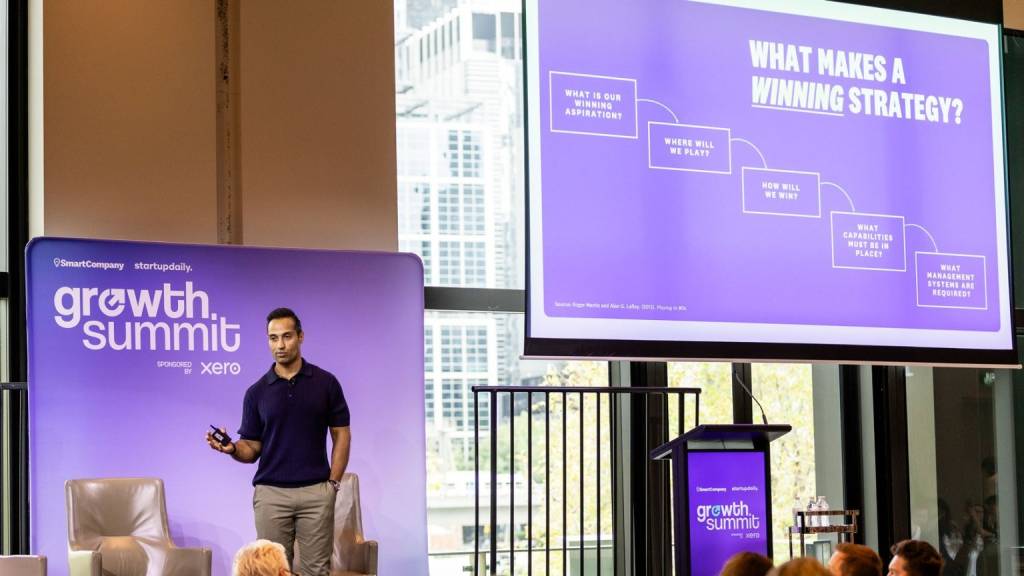
The framework Soin presented – drawn from Roger Martin and Alan Lafley’s bestseller Playing to Win – maps out strategy as an integrated cascade of five questions:
- What is our winning aspiration?
- Where will we play?
- How will we win?
- What capabilities must be in place?
- What management systems are required?
Soin stressed that the top three elements are all-important, and that the most common mistake is treating the cascade as purely sequential.
Strategy needs to loop back in on itself, with owners always testing whether their choices still hold true.
“You have to go back and test your choices,” he said. “If people are executing differently and the outcomes are different, what does that tell you about your strategy?”
He painted a picture with the example of playing board games with his kids: “One son thinks getting the pawn to the other side [of the chessboard] is the ultimate goal. In Uno, another thinks holding onto the best cards to have a killer win at the end is worth it if it means many losing hands.
“Some expert could clearly sit there and say that’s a losing strategy. But it achieves their aspiration and I am all for it. They have fun playing a game with their dad and siblings. Pure and simple.”
The endgame problem
That anecdote tied into a more sobering finding. Xero’s It’s your business report found that only 31% of business owners have a defined endgame in mind, while nearly half – 49% – don’t have long-term goals for their business at all.
“It’s worrying when so many small businesses don’t have a clear endgame,” Soin said. “Having clarity on your aspiration is a key part of the journey. It can change, but the lack of one makes day-to-day decisions hard.”
To drive home the point, Soin brought up a choose-your-own-adventure exercise. Choose A or B for each of the following questions:
1. You started a business to build a better lifestyle. All your financial metrics look good, but you aren’t living the lifestyle you envisaged.
A) Do you keep going? More time will come after the next milestone.
B) Do you slow down and reassess growth aspirations?
2. Business is going well, but when you reflect on where you’re spending time in the business, it’s not what you love doing.
A) Hire someone to do what you’re aren’t good at/don’t enjoy.
B) Learn the skills to make it less painful.
3. You have a series of investors at the table. One will give you a large investment for a higher valuation, others offer smaller investments and a lower valuation.
A) Take the bigger investment in exchange for less control.
B) Smaller investment and valuation, but greater control.
What did you choose? There are no right answers, only choices. The real question is whether you as a founder know what is guiding those choices. Was it your endgame? If you were truly faced with these scenarios, would your choices have led you to that outcome?
If you don’t have an endgame in mind, what were your motivations? The answers might suggest what you really want.
Asking the right questions to develop your strategy
To get to the heart of your strategy, Soin shared a set of helpful questions founders can take away, including:
‘Could customers flip a coin between you and a competitor?’
‘Are you trying to make everyone happy – do you ever say no?’
‘Do your goals match reality (i.e. your actions)?’
“Having a strategy, whether it’s in a glossy one-pager or on the back of a napkin, is critical to help you make decisions,” Soin said. “It is usually most useful in the hard times and to help test: are you true to your vision?”
Xero is the headline sponsor of the Growth Summit Melbourne. View more highlights from the Growth Summit here.

Find out what Xero can do for your small business here.