


Disputes over time are where construction projects often unravel. When milestones slip, fingers point and money gets withheld, teams turn to forensic schedule analysis to untangle what really happened. Whether you’re facing a delay claim or defending one, understanding how this process works can protect both your timeline and your bottom line.
What Is a Forensic Schedule Analysis?
Forensic schedule analysis is a structured examination of a construction project schedule and related records to determine the causes, duration and responsibility for project delays. It uses critical path method (CPM) schedules, updates and contemporaneous documentation to quantify time impacts and support claims, dispute resolution or litigation proceedings.
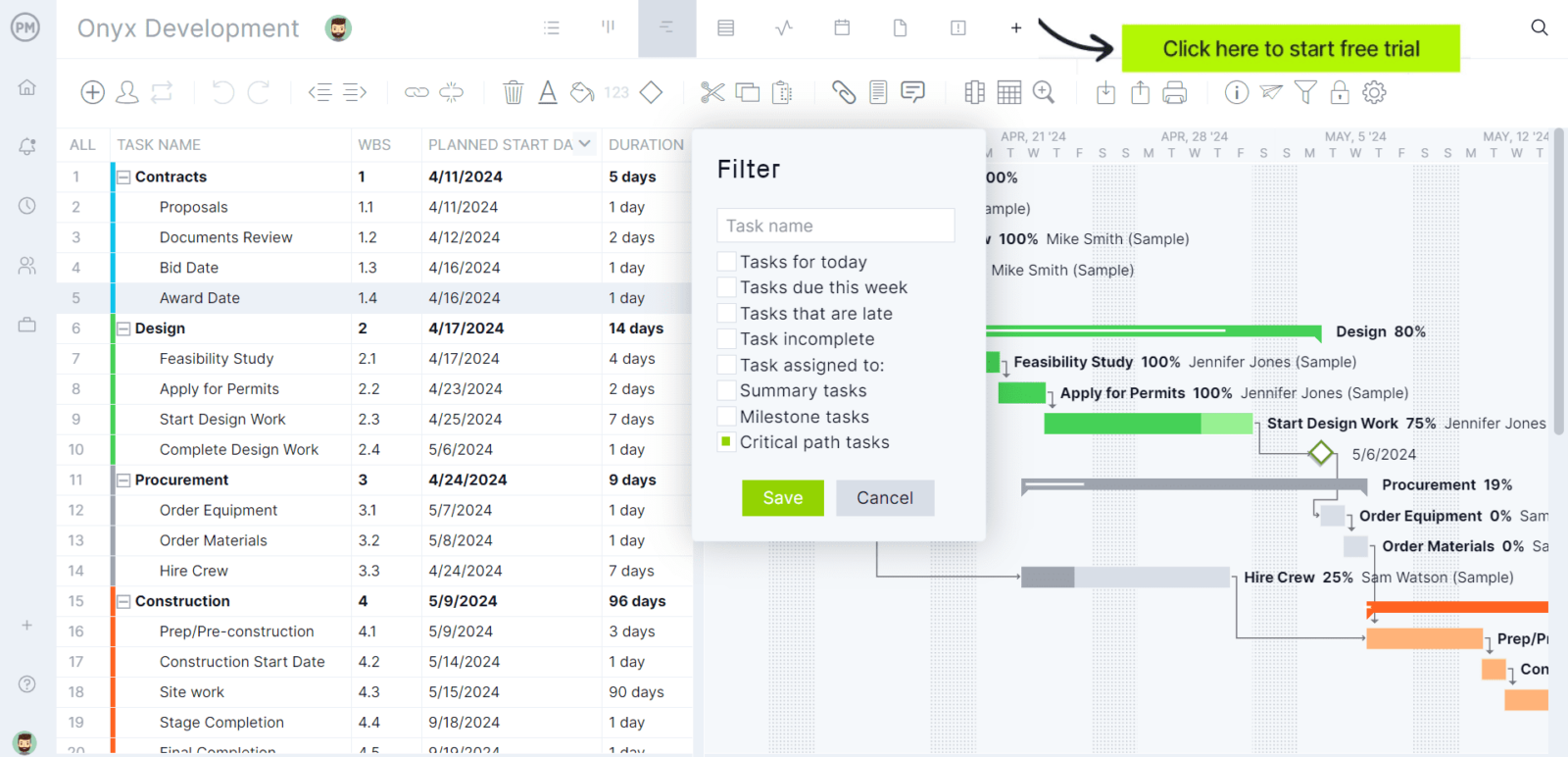
Forensic schedule analysis is a process that requires robust construction scheduling software like ProjectManager. ProjectManager’s Gantt chart allows you to create detailed construction schedules, establish baselines, identify the critical path, set four types of task dependencies, visualize milestones and compare schedule baselines vs. actual project performance with real-time dashboards and reports. On top of that, there are many other features for allocating resources, establishing budgets and tracking costs. Its version control is also helpful for keeping track of all changes made to a construction schedule over the course of a project. Get started for free today.
When Should Forensic Schedule Analysis Be Performed?
Timing matters. Forensic schedule analysis is typically performed after significant construction delays have occurred and a dispute over responsibility or entitlement to additional time arises. It is most valuable once enough project documentation such as schedule updates, daily site reports and cost records exist to reconstruct how the critical path activities evolved.
In practice, many general contractors initiate a preliminary review within one to two weeks after a major delay event, such as a design change, suspension or unforeseen site condition. A more comprehensive analysis usually follows after the next schedule update cycle, when updated CPM data, meeting minutes and change documentation can be incorporated to measure the actual time impact.
What Is the Purpose of Forensic Schedule Analysis?
At its core, forensic schedule analysis exists to determine who caused a delay, how long it affected the critical path and whether additional time or compensation is justified under the contract. It transforms competing narratives into measurable, schedule-based findings grounded in project records.
In practice, that core objective expands into several closely related functions. Depending on the size of the dispute and the stage of the claim, the analysis may serve multiple strategic and financial purposes beyond simply measuring delay.
- Extension of Time (EOT) entitlement: Establishes whether a delay event impacted the critical path and justifies a contractual time extension based on documented schedule updates and project records.
- Compensable delay quantification: Separates excusable, non-excusable and concurrent delays to calculate potential recovery for extended general conditions, field overhead and other time-related costs.
- Critical path impact analysis: Tests whether alleged delay events actually drove the project completion date by evaluating logic ties, float consumption and shifting critical activities.
- Delay claim defense strategy: Challenges unsupported assumptions or overstated impacts by reconstructing the schedule sequence and validating claimed time effects against contemporaneous documentation.
- Concurrent delay assessment: Evaluates whether owner-caused and contractor-caused delays occurred simultaneously on the critical path, which can limit or eliminate entitlement to time extensions or monetary compensation.
- Expert witness analysis: Translates complex CPM data into defensible findings prepared for deposition, arbitration or courtroom testimony, ensuring conclusions withstand cross-examination.
- Dispute resolution support: Provides a structured CPM-based narrative that links schedule updates, change orders and daily reports into a defensible position for negotiation, mediation or litigation.
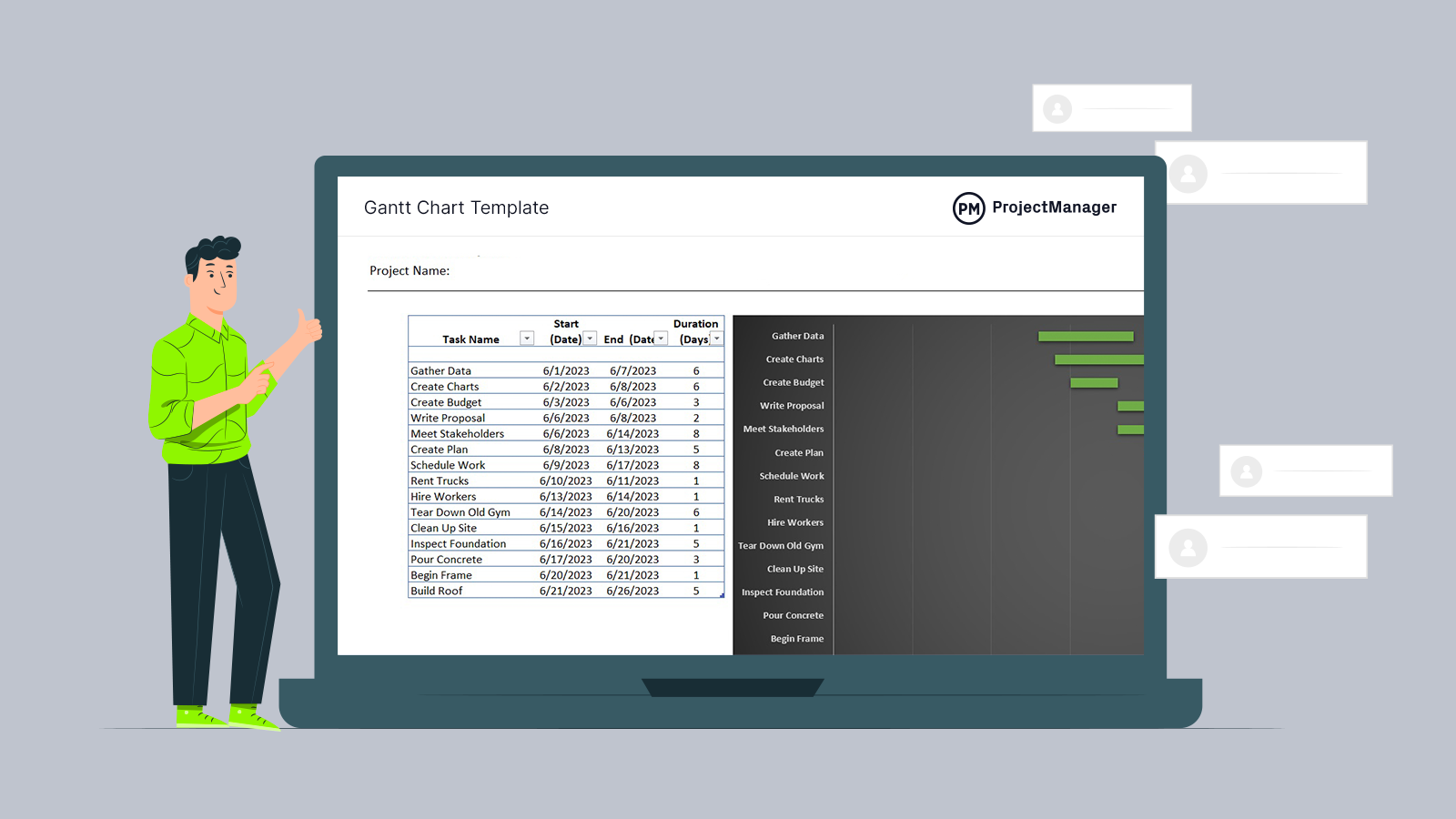
Get your free
Gantt Chart Excel Template
Use this free Gantt Chart Excel Template for Excel to manage your projects better.
Benefits of Forensic Schedule Analysis In Construction Projects
Few things are more expensive than arguing about time without evidence. Forensic schedule analysis benefits owners, contractors and subcontractors by replacing assumptions with documented findings. It clarifies responsibility, strengthens negotiating positions and reduces financial uncertainty when delays threaten construction budgets, milestones and contractual relationships.
- Objective delay clarity: Reconstructs the project timeline using CPM updates and records to provide a fact-based explanation of how and when the critical path was affected.
- Stronger claim positioning: Gives contractors or owners structured, defensible support for time extensions or delay damages before entering negotiation, mediation or arbitration.
- Reduced litigation risk: Identifies weaknesses in schedule logic, documentation gaps or concurrency issues early, allowing teams to address exposure before disputes escalate.
- Improved negotiation leverage: Equips decision-makers with quantified time impacts and documented evidence, making settlement discussions more efficient and less speculative.
- Better future scheduling practices: Highlights breakdowns in sequencing, logic ties or update discipline, helping project teams strengthen planning controls on subsequent projects.
Who Performs Forensic Schedule Analysis for a Construction Project?
Responsibility for forensic schedule analysis typically falls to construction scheduling consultants, delay analysts or construction claims experts with advanced CPM experience. On large projects, both the contractor and owner may retain separate experts to prepare independent analyses. While project teams provide documentation and schedule data, accountability for the analysis and its conclusions rests with the retained expert, especially if findings will support negotiation, arbitration or litigation.
- Construction Delay analysts: Focus specifically on evaluating project delays by reconstructing the critical path, analyzing schedule updates and applying recognized methodologies such as time impact or windows analysis. They interpret schedule logic, measure time impacts and prepare technical findings that quantify responsibility for delay events.
- Construction claims experts: Oversee the broader claims strategy by integrating schedule analysis with contract provisions, cost records and entitlement arguments. They coordinate documentation, develop defensible narratives and ensure forensic schedule findings align with legal positions for negotiation, mediation, arbitration or litigation proceedings.
- Construction scheduling consultants: Provide the technical CPM expertise required to audit baseline schedules, validate update integrity and test logic ties. In a forensic role, they extract, clean and analyze scheduling data to support delay assessments, often collaborating with claims teams and project personnel.
Forensic Schedule Analysis Process
When a delay turns into a formal dispute, the analysis cannot be improvised. A structured forensic schedule analysis process ensures conclusions are grounded in CPM data, project records and recognized methodologies. Each step builds on the last, moving from document review to defensible findings that quantify responsibility and time impact.
1. Define the Dispute Scope
Before touching the schedule, analysts narrow the focus of the dispute. They identify specific delay events, the number of days being claimed and the governing contract provisions. Clearly defining scope keeps the analysis disciplined and ensures findings address entitlement, causation and measurable impact to project completion.
2. Collect and Organize Project Records
Reliable forensic schedule analysis conclusions depend on complete construction project management documentation. Analysts gather baseline schedules, all periodic updates, daily reports, RFIs, change orders, meeting minutes and correspondence. Organizing these records chronologically allows the analyst to reconstruct events accurately and identify gaps, inconsistencies or missing data early in the review.
3. Validate the Schedule Baseline
Before measuring delay, the original CPM schedule must be tested for reasonableness. Analysts review schedule logic ties, activity durations, sequencing and contractual compliance to confirm the baseline reflected a realistic execution plan. If flaws exist, adjustments or assumptions may be required to avoid distorted delay conclusions.
4. Assess Schedule Update Integrity
Progress updates reveal how the critical path of the project evolved over time. Analysts examine update frequency, logic revisions, actual start and finish dates and shifts in float. This step determines whether updates reflect actual field conditions or contain revisions that may mask responsibility for delay.
5. Identify and Isolate Delay Events
Specific delay events must be tied to documented evidence rather than assumptions. Analysts isolate issues such as late design changes, access restrictions, material shortages or owner directives. Each event is linked to dates, affected activities and supporting records to prepare for measurable impact evaluation.
6. Select the Analytical Methodology
Method selection depends on record quality and dispute context. Analysts determine whether time impact analysis, windows analysis or as-planned versus as-built comparisons are most appropriate. Choosing the correct methodology ensures the findings align with recognized industry practices and withstand technical scrutiny.
7. Measure Critical Path Impacts
Once delay events are defined, their effect on the critical path is calculated. Analysts evaluate how activities shifted, how float was consumed and whether project completion moved. This step transforms narrative claims into quantifiable time impacts grounded in CPM schedule logic.
8. Evaluate Concurrent Delays
Projects often experience overlapping delays from multiple sources. Analysts assess whether owner-caused and contractor-caused delays occurred simultaneously on the critical path. Determining concurrency is essential because it can reduce, apportion or eliminate entitlement to time extensions or monetary compensation.
9. Quantify Time Extensions and Damages
Measured delay impacts are translated into contractual disputes. Analysts determine the number of days potentially owed as an extension of time and assess whether compensable delay costs may apply. This step connects schedule findings to financial exposure and negotiation strategy.
10. Prepare Findings and Expert Report
Conclusions must be documented clearly and defensibly. Analysts compile methodology, assumptions, data sources and results into a structured report suitable for negotiation, mediation or litigation. The final deliverable explains complex schedule mechanics in plain language while preserving technical rigor.
Free Related Construction Project Management Templates
We’ve created dozens of free construction project management templates for Excel, Word and Google Sheets. Here are some that can help with construction scheduling
Construction Schedule Template
This construction schedule template allows you to open ProjectManager’s Gantt chart view to create a construction schedule, identify task dependencies, find the critical path, establish baselines and much more.
Gantt Chart Template
This free Gantt chart template for Excel facilitates the process of creating a Gantt chart. Simply enter a project task list along with start and end dates and estimated task durations and the template will automatically generate a visual project timeline.
Critical Path Template
This free critical path template for Excel allows users to sequence project tasks and automates the critical path algorithm calculations to estimate the total duration of a project and identify the slack of each task.
ProjectManager Is an Award-Winning Construction Scheduling Software
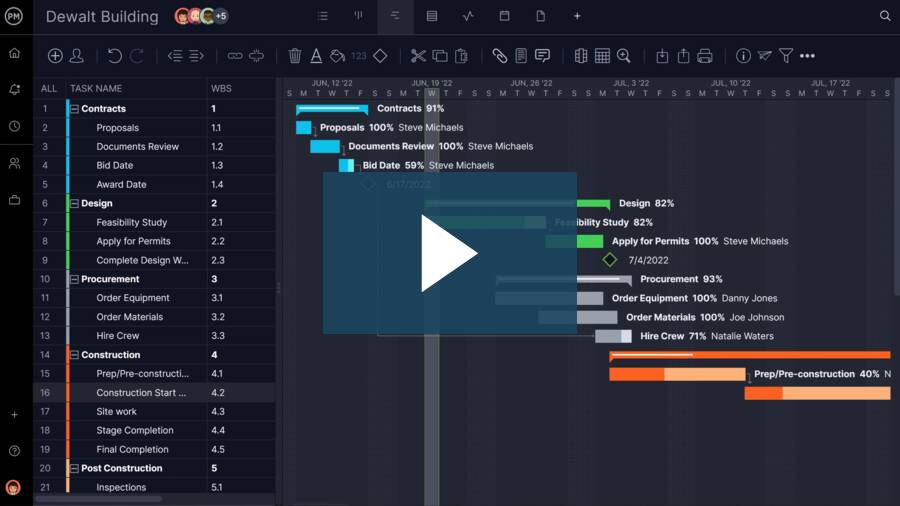
ProjectManager is an award-winning construction project management software equipped with powerful planning, scheduling and tracking features that allow to create detailed construction schedules, establish baselines, identify project risks and compare estimated project timelines and costs against actual project performance to quickly identify delays and cost overruns. Watch the video below to learn more!
Related Construction Project Management Content
Our content library features over 100 construction blogs, templates, ebooks and other types of content to help construction project managers better understand the many moving parts that must be managed to deliver successful construction projects. Here are some of them.
ProjectManager is online project management software with the tools you need for construction project management. Our features make planning, monitoring and reporting on your project more efficient and effective. Being online means our software is accessible everywhere and at any time. Plus, the data you get is more accurate because it’s updated immediately. Try ProjectManager for free with this 30-day trial offer.