


Traffic to retailers’ websites from generative artificial intelligence (AI) platforms has shifted the way consumers complete their online holiday shopping, according to data analysis from Adobe Analytics.
U.S. online holiday sales in 2025 reached $257.8 billion, Digital Commerce 360 previously reported. That’s 6.8% growth compared to $241.4 billion in the same period of 2024. And Salesforce had estimated that AI agents and other generative AI tools influenced more than 20% of all online retail sales globally during the holiday season. Both companies define the holiday season as Nov. 1 through Dec. 31.
Although consumers used generative AI across industries in that time frame, the year-over-year percentage increase in traffic to online retailers’ websites has been the largest, according to Adobe data. In November 2025 and December, traffic referrals from generative AI platforms increased 693% year over year. That compares with:
- Travel traffic (539%)
- Financial services (266%)
- Tech and software (120%)
- Media and entertainment (92%)
For retail, Adobe assessed the increases to be 769% year over year in November and 673% in December.
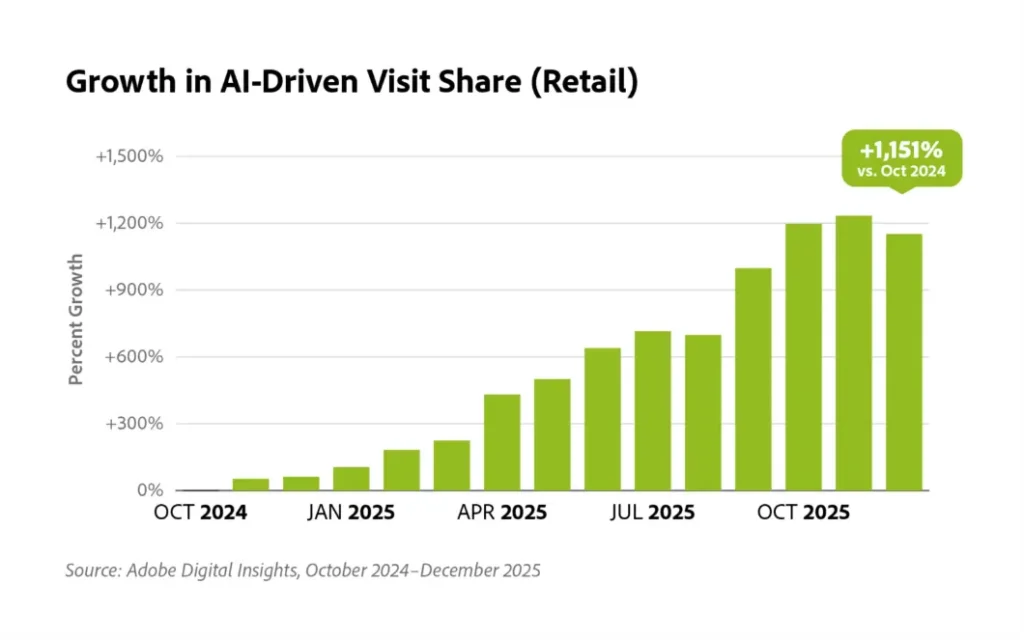
Year-over-year growth in online traffic from generative AI sources through the 2025 holiday shopping season. | Image credit: Adobe Digital Insights
Adobe Analytics reported that it bases its data on more than 1 trillion visits to U.S. retail sites, 100 million SKUs and 18 product categories. 215 online retailers in the Top 2000 use Adobe Analytics for their web analytics, and 106 use it for site design and development. Top 1000 online retailers also use it for content delivery and management, as an ecommerce platform, a marketing platform, for personalization and more.
How generative AI affected online shopping in the 2025 holiday season
Adobe data indicated that consumers were not simply using generative AI tools more when completing their holiday shopping online. Rather, they were converting 31% more than when they arrived at retailers’ websites from other traffic sources. That difference in conversion rates doubled compared to the 2024 holiday shopping season, according to Adobe.
That followed a trend of conversions from AI traffic being 54% higher than from non-AI traffic on Thanksgiving. On Black Friday, that was 38%.
Additionally, revenue per visit increased 254% year over year for traffic from AI referrals, Adobe found. That compares to an 85% year-over-year increase in revenue per visit from AI traffic between January 2025 and July that year.
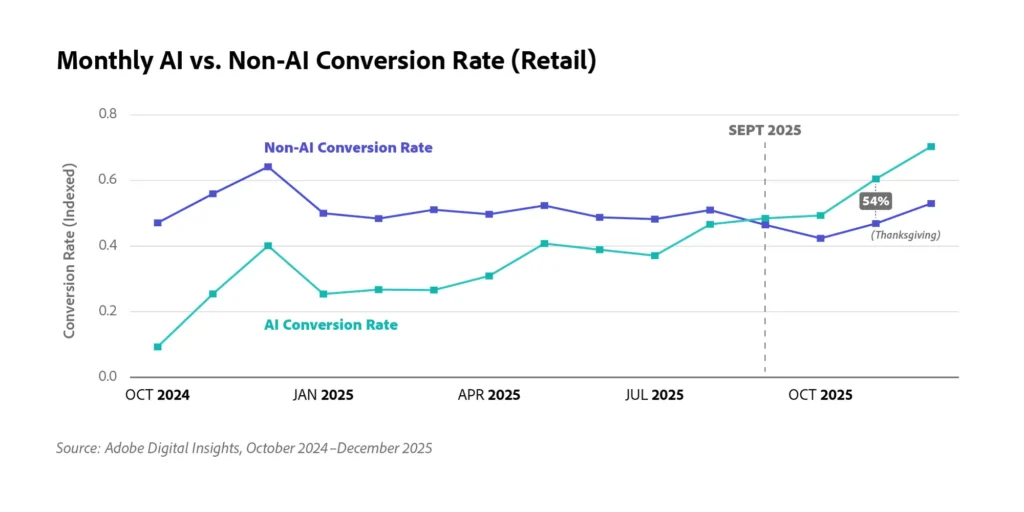
Conversion rate differences between AI and non-AI traffic sources. | Image credit: Adobe Digital Insights
“Things get especially interesting for retailers” once AI sources direct shoppers to retail websites, according to Vivek Pandya, lead analyst at Adobe Digital Insights. Bounce rates improved, with those shoppers 33% less likely to leave retailers’ sites immediately. That’s a 14% improvement since the beginning of 2025, Adobe said. AI referrals “consistently” outperform other traffic sources in terms of bounce rate, according to Pandya.
AI-generated traffic also resulted in shoppers spending 45% more time on retailers’ sites, according to Adobe data. Those shoppers viewed 13% more pages per visit.
“Traffic from tools like ChatGPT, Gemini, and Perplexity is growing rapidly,” Pandya said. “More importantly, it’s high-quality traffic that converts. For retailers and brands, this signals a lasting shift in how consumers discover and evaluate products. Generative AI’s role in commerce isn’t a passing trend. It’s becoming a core part of the digital shopping journey.”
How consumers approach AI tools when online shopping
Adobe consumer data indicates that 81% of shoppers using AI assistants for their online shopping reported that the tools have improved their experiences.
Nearly half of consumers (46%) reported that they trust AI-generated results, according to its holiday 2025 survey data of more than 1,000 U.S. shoppers. Adobe data found that 64% of consumers reported being satisfied with the links that AI platforms suggest. More than 55% said they actively click on those links.
The traffic referrals also help consumers feel more confident about their purchases, according to Adobe. More than two-thirds of consumers (65%) who use AI for online shopping reported that they feel more confident in their purchase because of the tool. Additionally, 68% said they are less likely to return the products they buy when they use AI for the purchase.
Adobe attributed that to a 1.2% decrease in returns from online orders during the 2025 holiday season, which Digital Commerce 360 previously reported.
“As more consumers turn to large language models (LLMs) to research products, compare options, and make decisions, one thing is becoming clear: generative AI is no longer a side channel for commerce discovery,” Pandya said.
Do you rank in our databases?
Submit your data and we’ll see where you fit in our next ranking update.
Sign up
Stay on top of the latest developments in the online retail industry. Sign up for a complimentary subscription to Digital Commerce 360 Retail News. Follow us on LinkedIn, X (formerly Twitter), Facebook and YouTube. Be the first to know when Digital Commerce 360 publishes news content.