Google completed its August 2025 algorithm update a few days ago. The update coincided with Google’s cancellation of the &num=100 query parameter, which lowered impression counts in Search Console.
Thus assessing the impact of the update in Search Console is confusing as the two events occurred more or less concurrently.
Google stated the update focused on spammy web pages. To gauge the impact on your site, view the “Clicks” metric in Search Console’s “Performance” report.
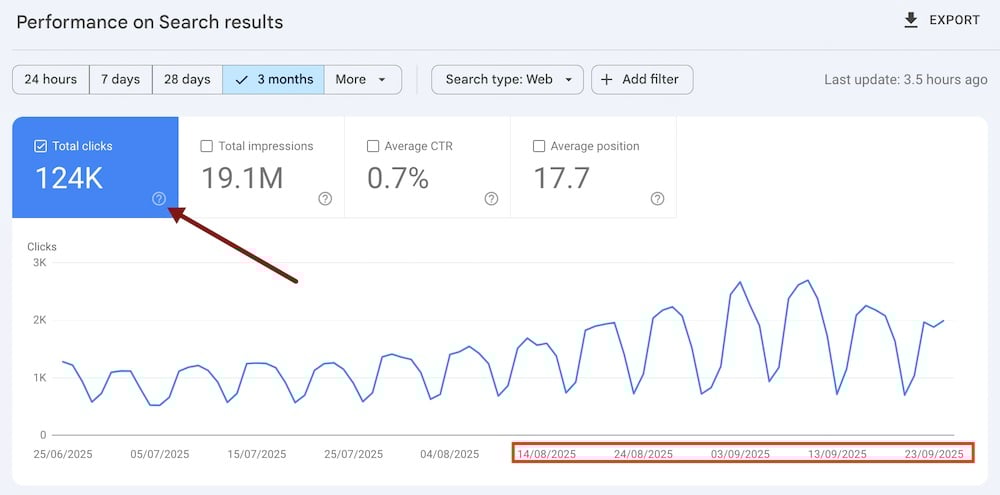
View the “Clicks” metric in Search Console’s “Performance” report to track the algorithm’s impact. Click image to enlarge.
Traffic declines from spam updates are typically drastic. In this case, affected sites would have experienced a steep drop in clicks from August 26 through September 22.
Google’s spam updates:
- Are automated, with no penalty message in Search Console, even if impacted.
- Can only affect sites negatively. Traffic increases result from competitor declines.
- Are usually recoverable after fixing the cause(s). The recovery may take months, although it does not depend on another core update.
- Focus on sites violating its spam policies, and likely pertains only to on-site content. When it targets external backlinks, Google usually includes “link” in the update name. Otherwise, spam updates don’t include backlink signals.
Google’s Spam Policies
Google’s Search Central portal contains the company’s spam policies. Here are my explanations of the key components.
Cloaking or sneaky redirects. When a page (i) shows different content to search engines and users or (ii) redirects for users, but not search engines.
Doorway abuse. When a site has pages targeting similar keywords — a common reason to be hit by a spam update. To recover, cluster keywords by intent and restructure the site to target those groups instead of each word or phrase.
Expired domain abuse. When you buy an expired domain and leverage its authority for elevated rankings. There’s no easy recovery short of moving to a fresh domain. I have not seen declines in sites hosted on expired domains. Perhaps Google now detects that activity and does not rank expired-domain pages to begin with.
Hidden text and link abuse. When you hide words or links from users behind images and font-background color matching, such as white fonts on white backgrounds. I haven’t seen these tactics for years.
Keyword stuffing. When you fill a page with keywords or numbers to manipulate rankings. The policy is subjective, making it difficult to detect. (How many keywords are too many?) In my experience, however, actual keyword stuffing is obvious and rare.
Machine-generated traffic; scaled content abuse. When you deploy artificial intelligence or other automated methods to generate content at scale.
Scraping. When you use automated methods to steal and publish content from other sites.
Site reputation abuse. When you publish irrelevant content (usually whole sections) to benefit from your site’s authority, Google used to target this tactic separately, but may now include it in generic spam updates.
Thin affiliation. When you create an affiliate site by duplicating external product descriptions without adding anything unique or useful.
Misleading functionality. When a page promises one functionality, such as a PDF download, but instead executes something else, such as an ad click.
User-generated spam. When a site’s comments and other user-generated info include excessive promotional or offensive language or links.