

Nearly a third of Colorado households are severely housing cost burdened, a report from Mile High United Way reveals.
“The median single-family-home price in Denver was $699,750 in February 2026, up 2.9% since pre-pandemic,” says Hannah Jones, senior economic research analyst at Realtor.com®. “On a price per square foot basis, single-family homes in Denver have seen prices increase 25.2%, from $302 in February 2020 to $378 in February 2026.”
These rising costs are making homeownership increasingly challenging. “Higher home prices combined with elevated interest rates have made it much tougher for first-time buyers to break into the market,” Tania Carter of Keller Williams in Denver tells Realtor.com.
Therefore, Carter has made it her mission to help get people into more affordable housing.
She’s working with the Elevation Community Land Trust (ECLT), a nonprofit organization dedicated to creating permanently affordable homeownership opportunities across Colorado.
“They operate under a community land trust model, where the land is held by the trust while the home itself is sold to the buyer at a reduced price, making homeownership possible,” says Carter. “Partnering with ECLT has allowed me to align my business with my purpose—since I am helping people not just buy a home, but start building wealth through real estate.”
Carter says programs like ECLT—Colorado’s largest community land trust—give buyers a real opportunity to achieve homeownership, live in quality homes and neighborhoods, and have a monthly payment they can truly afford.
“The community land trust model offers a powerful mechanism for increased affordability by decoupling land value from homeownership, effectively shielding housing stock from the volatile appreciation that often displaces low-to-moderate-income residents,” Jones says.
“However, this stability comes at the cost of traditional wealth-building potential, as the shared-equity resale restrictions limit a homeowner’s ability to capture full market gains in exchange for the lower entry price and long-term community benefit.”
What is a community land trust?
Nonprofit housing organizations known as community land trusts bring together money from both private donors and government sources to purchase residential properties. These groups acquire everything from newly built houses to aging ones in need of renovation, restoring the latter to livable condition.
The model works by separating who owns the structure from who owns the ground beneath it. The organization retains control of the land itself—generally under a 99-year arrangement—which dramatically reduces what a qualified buyer pays for the home sitting on top of it.
Residents in these programs occupy a middle ground between renter and traditional homeowner. They pay a $100 monthly land-lease fee, bear full responsibility for day-to-day maintenance, and have broad autonomy over their living space. Larger structural changes, however, require sign-off from the trust, and any rental of the property comes with its own set of rules.
The trade-off at the heart of the arrangement involves future profits. Before taking ownership, buyers agree to a formula that limits how much of a home’s increased value they can pocket when they eventually sell. The remainder stays tied to the property, ensuring that subsequent buyers face the same reduced prices—keeping affordability baked in permanently rather than treating it as a one-time benefit.
Who qualifies?
ECLT’s income-restricted programs are aimed at buyers earning up to 80% of the Area Median Income. “This structure ensures homes remain affordable not only for current buyers but also for future homeowners, thanks to the program’s resale restrictions,” says Carter.
Participants must qualify with approved lenders experienced in the ECLT process and complete a homebuyer education course, which walks them through the program’s requirements and benefits.
“Since this is a community land trust model, there are resale restrictions to ensure the home remains affordable for future buyers,” Carter explains. “It’s important for buyers to understand both the benefits and the long-term structure of the program.”
In 2025, 127 people moved into ECLT homes.
Studios offered at bargain-basement prices
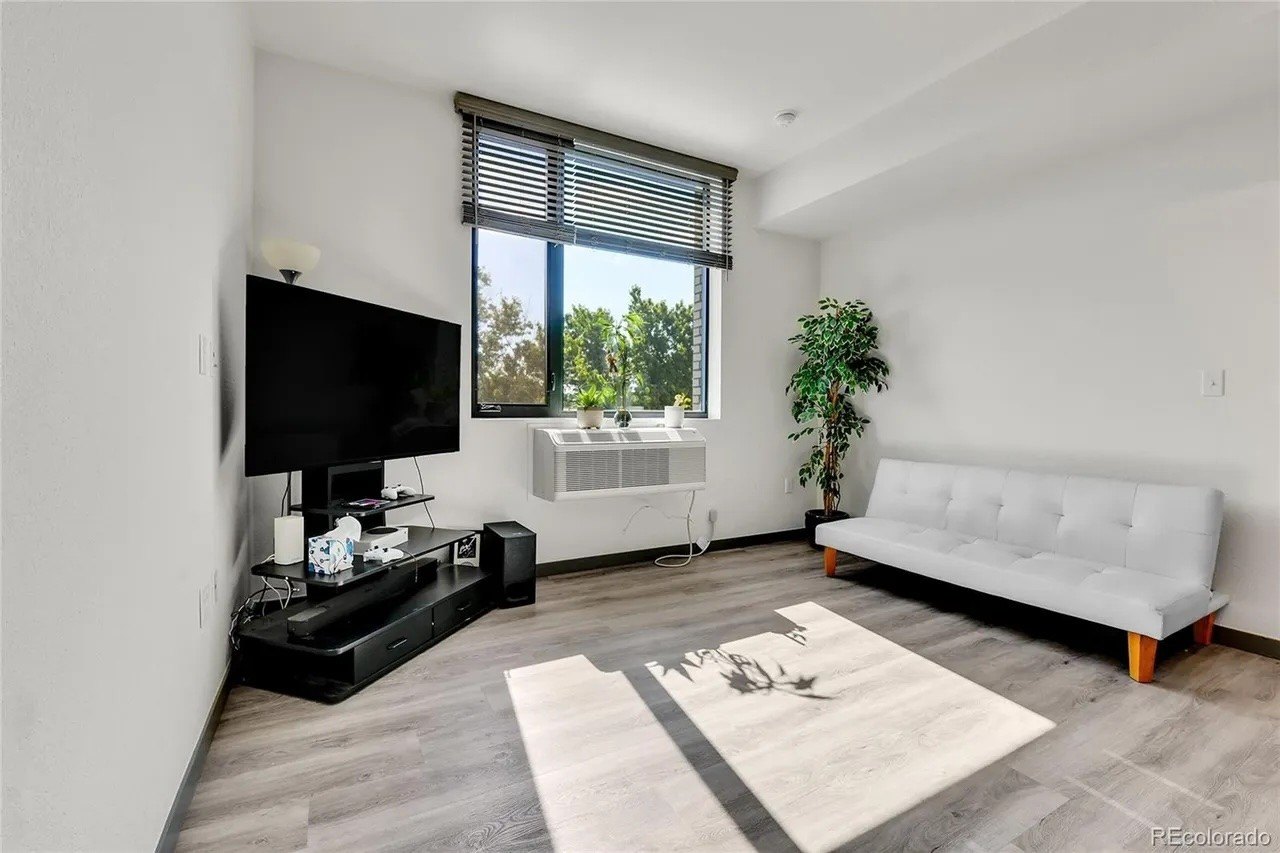
Carter says she is currently selling studio units priced around $158,000 near downtown Denver in the Santa Fe Art District. “These homes were originally built in 2020, and the units currently on the market are resales from the original owners,” she says. “At the moment, there are about nine studios available, with prices ranging from approximately $150,000 to $159,000.”
These studios come equipped with a full-size washer and dryer, a Murphy bed, and bike storage in the lobby area.


According to Carter, this price point is extremely rare in today’s market, especially given the location.
“The monthly payment is approximately $939.96, based on estimates from one of my preferred lenders—which includes property taxes and HOA fees. You cannot even rent a room for that price in downtown Denver.”
Carter says that’s what makes these studios such a great option for many renters in the area.
“Buyers have the opportunity to own instead of rent, often for the same or even lower monthly cost,” she says. “Buyers can get into these studios with as little as $1,000 down and around $2,000 in reserves. Additionally, lenders may help cover closing costs.”
Carter says that when you compare that to renting—where tenants usually have to pay first month’s rent plus a security deposit upfront—homeownership through this program becomes a very accessible and attractive option.
According to Carter, many would-be buyers are skeptical.
“Sometimes, I get calls from buyers relocating to Denver and they feel that is too good to be true,” she says. “Unfortunately, some of them think that this program is a scam.”
Carter says that, due to the land lease model, buyers are not required to pay PMI, which helps keep monthly payments even more affordable. “In addition, many of the approved lenders offer very competitive rates for these units. One bank I work with is offering 5.375% to qualified buyers.”
‘Doors to Opportunity’ program
ECLT also offers a program called Doors to Opportunity that enables qualified buyers to purchase a home at a higher market price while financing only a portion of it. The program provides $50,000 or more in down payment assistance, helping buyers secure a home on the open market.
“For example, I recently worked with a client who went through a divorce and had to sell her home due to a court order,” says Carter. “She applied for the program and was approved for $160,000. Through Doors to Opportunity, she was able to purchase a home valued at $380,000 and get $220,000 in subsidies, with a monthly payment of around $1,800.”
This program can also be used for new construction.
“I had another client who purchased a home with Lennar in Watkins, CO,” says Carter. “In essence, buyers can live in a $380,000 home while only financing about $160,000, which makes homeownership significantly more accessible. It’s a powerful and very attractive option for many buyers in today’s market.”
Although Carter earns a flat fee that is lower than a typical commission on these ECLT homes, she says the reward of helping someone achieve homeownership far outweighs the financial aspect of the transaction.
“I truly believe that homeownership changes lives,” she says. “It creates stability, builds generational wealth, and strengthens communities. Being able to guide someone through that journey, especially when they thought it wasn’t possible, is incredibly rewarding. That’s what drives me every day.”