



Picking up dog poop probably isn’t the first business idea that comes to mind when you think about making extra money. But once you learn how a pet waste removal business works, it starts to make a lot of sense. It’s a simple local service that people gladly pay for, it can be set up…
Picking up dog poop probably isn’t the first business idea that comes to mind when you think about making extra money. But once you learn how a pet waste removal business works, it starts to make a lot of sense.
It’s a simple local service that people gladly pay for, it can be set up with low startup costs, and it can bring in recurring monthly income.
In today’s interview, I’m talking with William Milliken, who runs a pet waste removal company that has grown way beyond a small side hustle. He originally thought this would be a way to make around $1,000 a month, but it quickly turned into something much bigger.
In his first calendar year (2021), his company brought in over $260,000 in scooping revenue and had over 300 recurring customers. And in 2026, they hit their first month with over $400,000 in scooping revenue in a single month, and now service over 2,500 recurring clients across multiple states.
Here’s what you’ll learn in this interview:
- What a pet waste removal business is and why people pay for it
- How much you can realistically earn in the first 6–12 months
- The best ways to get your first 10 customers
- What you need to buy to get started (and what you can skip)
- How to price your services and avoid common beginner mistakes
- A step-by-step plan to start this month
I also recommend checking out Poop Scoop Millionaire. If you like William’s step-by-step approach, this is where he teaches the exact systems behind starting and growing a pet waste removal business – pricing, getting your first customers, billing, and building routes so you’re not wasting time driving all over town. It’s a good fit if you want a clear plan (and support) instead of piecing everything together yourself. You can learn more here: Poop Scoop Millionaire
How To Start a Pet Waste Removal Business
If you want to learn how to start a pooper scooper business, this interview is a great place to get started!
1. Tell us your story! Who are you, and how did you get started in the dog waste removal business? What made you decide to try it?
I didn’t grow up dreaming about scooping dog poop. My background is in digital marketing, specifically marketing for home service companies.
I would partner with operators like electricians and garage door companies, own the business alongside them, and focus on getting the phone to ring and building the systems to scale quickly. Over time, we developed a repeatable playbook for turning local service businesses into structured, scalable operations.
My friend Levi, who I’ve known since elementary school, saw the success we were having and asked if we could start something together. The challenge was that he didn’t have a specific trade or construction background, so we needed a business model that didn’t require years of technical training.
Around that same time, my wife hired a dog waste removal company because I was busy with work and we had a baby on the way. The experience wasn’t great. Service was inconsistent, communication was weak, and billing felt disorganized.
That’s when it clicked.
The business itself was simple to start, it had recurring revenue, and the competition was not very sophisticated. I realized this wasn’t really about scooping dog poop. It was about building a professional, systemized, subscription-based home service in an industry that hadn’t matured yet.
Honestly, I did not have high expectations at the beginning. I thought maybe it would turn into an extra $1,000 per month on the side and give us something simple to run together.
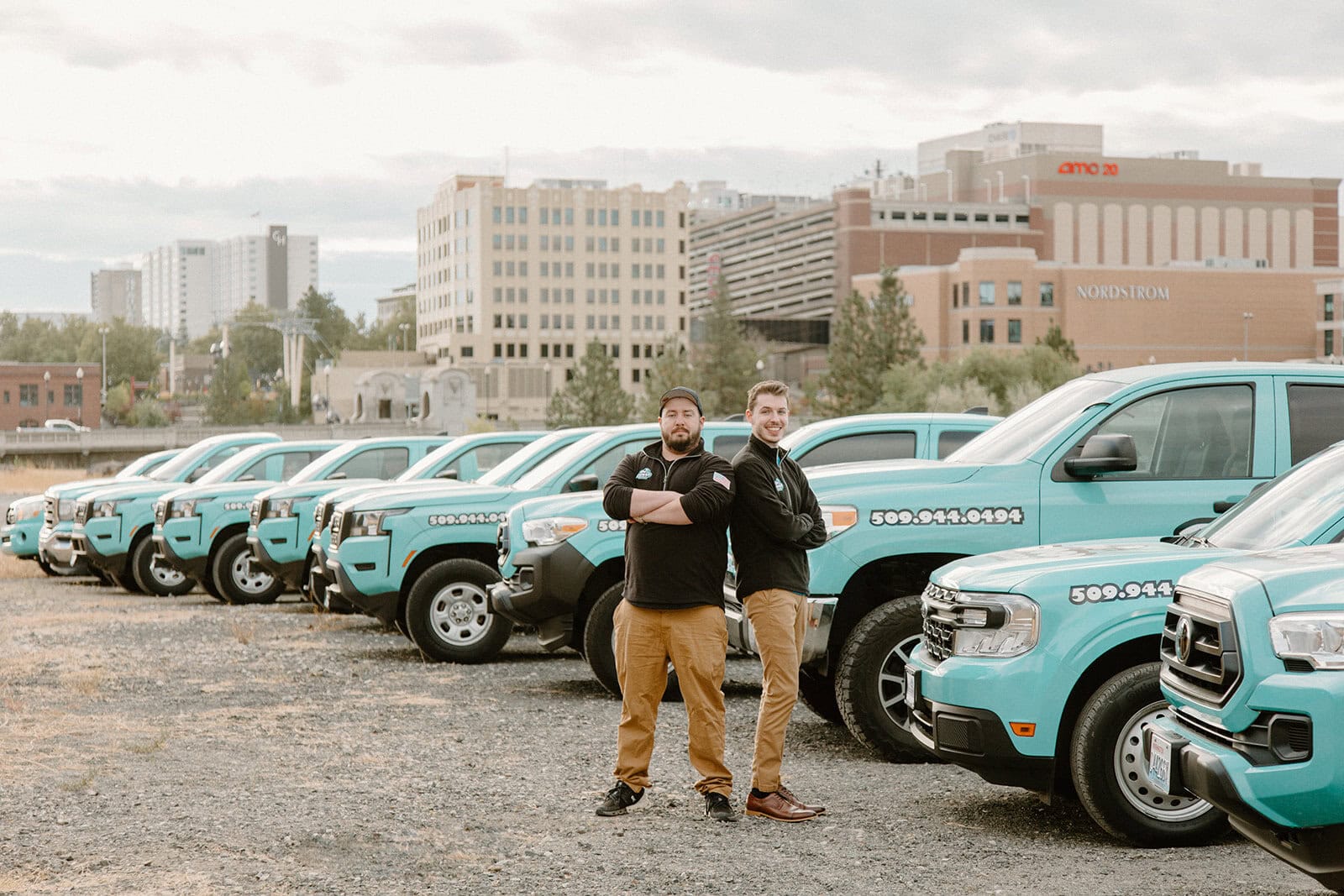
But before I knew it, we were buying trucks, hiring employees, and realizing this was much bigger than a side project.
2. What is a dog waste removal business (pooper scooper business)? Can you explain what the service is, what customers pay for, and who usually pays for this type of service? Why do people pay for this service?
A pooper scooper business is a recurring home service where we visit customers’ homes on a set schedule, typically weekly or bi-weekly, remove the dog waste from the yard, dispose of it properly, and move on to the next property.
It is straightforward by design. The value is in consistency and reliability.
Our average customer pays a little over $110 per month. Pricing is based on the number of dogs, yard size, and how often we visit. Some customers prefer once per week, others every other week, and some choose multiple visits per week if they have several dogs.
Our client base is surprisingly broad. We serve elderly homeowners, disabled individuals, dual-income households, busy parents, and professionals who simply do not want to spend their limited free time doing a chore they dislike.
At the end of the day, people pay for this service because picking up dog poop is arguably one of the most hated chores of all time. It is recurring, messy, and easy to procrastinate. We remove that problem entirely so customers can enjoy their yard without thinking about it.

3. How much money can you make with a dog waste removal business? If you’re comfortable sharing, what has your income looked like (or what is realistic for a beginner in the first 6-12 months)?
A solo operator can typically handle between 125 and 150 recurring accounts depending on route density and efficiency. With that many customers on weekly service, it is very realistic to build a six-figure business working alone.
For someone in their first 6 to 12 months, income depends heavily on marketing consistency and execution, but many operators can realistically build to 50 to 100 recurring customers within that timeframe if they treat it like a real business and not a side hobby. From there, it compounds because it is recurring revenue.
What makes the model appealing is the simplicity. Compared to other home service trades, overhead is low. You are not buying construction materials or carrying large equipment. The main consumables are bags and basic supplies. That keeps margins strong and operations straightforward.
You can also choose to scale beyond being a solo operator, which is what we did.
In our first calendar year in 2021, we generated over $260,000 in scooping revenue and had over 300 recurring customers. Fast forward to 2026, and we had our first month with over $400,000 in scooping revenue in a single month. Today, we service over 2,500 recurring clients across multiple states with full teams in place.
The opportunity exists on both ends of the spectrum. You can build a strong six-figure lifestyle business, or you can build infrastructure and scale into something much larger.
4. What does a typical day or week look like in this business? What tasks take the most time (driving, scooping, customer service, billing, marketing, etc.)?
A typical day looks very different depending on the size of the company.
In the beginning, when you are a solo operator, most of your day is spent in the field. You are driving between homes, cleaning yards, responding to customer messages, handling billing questions, and promoting your business whenever you can. Marketing and route density become extremely important because driving time can eat up your margins if you are not careful.
In that stage, scooping and driving take the majority of your time. Customer communication and marketing usually fill the rest of your day, especially in the evenings.
As the company grows, the role shifts.
Today, my day-to-day looks very different because we have department managers who run the core functions of the business. We have an operations manager, marketing manager, office manager, location supervisors, and sales reps, customer service reps, and so on. My time is spent more on strategy, expansion, financial oversight, and leadership rather than field work.
The business can start as a hands-on, physical service job, but if built with systems, it can evolve into a management and leadership role.

5. How did you get your very first paying customers? What are the best ways to get your first 10 customers today?
We got our very first customers through local Facebook groups and simple door hangers.
In the early days, we would post in neighborhood groups offering weekly dog waste removal and respond quickly to anyone who showed interest. At the same time, we walked neighborhoods with a high concentration of dogs and left door hangers introducing the service. It was simple, direct, and effective.
Facebook groups are still one of the best ways to get your first 10 customers today. They cost nothing, and they allow you to tap directly into local communities. The key is not being spammy. You want to introduce yourself professionally, explain the service clearly, and respond fast.
Another strong strategy is what I call the “free trial” method. Offer a few people in your personal network a free cleanup in exchange for honest feedback and a review. That builds social proof quickly, which makes it much easier to convert future customers.
If you have some budget to invest in your business, our top three marketing channels today are Meta Ads, Google Ads combined with strong SEO, and truck wraps. Meta allows us to create demand and reach local dog owners directly. Google captures high-intent customers actively searching for the service. And truck wraps act as rolling billboards that build brand recognition in the neighborhoods we already serve.
We have also tested marketing ideas that completely flopped. At one point, we partnered with Pizza Hut and printed our ad on thousands of pizza boxes. On paper, it sounded perfect. Local families, high visibility, strong household reach.
We spent over $5,000 on the campaign and received zero calls. In hindsight, maybe dog poop and pizza were not the ideal marketing combination.
6. Is there still room for new people to start this business now? Why do you think this is a good opportunity for the future?
Yes, there is still a massive opportunity in this space.
In our first location, there are maybe 10 dedicated dog waste removal companies compared to more than 700 lawn care companies. That gap alone shows how underserved the market still is. It is a relatively young industry compared to other home services.
At the same time, consumer behavior is shifting. People are spending more money on their pets than ever before. Dogs are treated like family members, and pet-related services continue to grow year over year. We have also seen search volume for dog waste removal increase significantly over the past several years, which tells us demand is rising.
What makes this opportunity attractive is that it is simple, recurring, and scalable. It does not require licensing like many trades, startup costs are relatively low, and the service solves a problem that never goes away.
Every dog produces waste every day. That creates built-in recurring demand.
I always joke that the business would be too good to be true if you did not actually have to pick up dog poop.
7. Can this be started as a side hustle while someone still has a full-time job? If yes, what’s the best way to do that?
Yes, this business can absolutely be started as a side hustle.
One of the advantages is that you can build your route around your availability. Many operators start by servicing customers in the evenings or on weekends while keeping their full-time job.
The key is structuring your service area properly. I like to take the overall territory and break it into five smaller regions, assigning each region to a specific day of the week. That keeps route density tight and reduces drive time, which is critical for profitability.
If someone only has weekends available, they can start with one or two concentrated areas and stack those customers together. As the route grows and income becomes predictable, they can gradually expand availability and eventually transition full-time if they choose.
The most important thing is to treat it like a real business from the beginning. Clear scheduling, consistent billing, and professional communication matter just as much at 10 customers as they do at 1,000.
8. What are the startup costs for a dog waste removal business? What do you actually need to spend money on at the beginning, and what can beginners skip? What do you do with all of the poop that is picked up?
Startup costs for a dog waste removal business are relatively low compared to most home service trades.
The minimum equipment you need to get started is a corona garden rake, a sturdy lobby dustpan, disposal bags, kennel grade disinfectant, reliable transportation, and a smartphone for scheduling and communication. If you already have a vehicle, you can realistically launch for a few hundred dollars.
When it comes to what beginners should skip, it is important to understand the difference between required and optional investments. You can absolutely accelerate growth with larger marketing spend on platforms like Google or Meta, truck wraps, and stronger branding. We have used all of those strategies to scale quickly.
However, none of that is required in the beginning. It is often smarter to test your market first, validate demand, and make sure the model works for you before dropping thousands of dollars into advertising. Start lean, prove it works, then reinvest profits into growth.
As for disposal, there are two common approaches, and we have tried both.
One option is hauling the waste away and disposing of it through a garbage company such as Waste Management. We have 4-6 yard dumpsters, fill them with collected waste, and have Waste Management pick them up on a schedule.
The other option, which we now use in all new locations, is double-bagging the waste with scented bags and placing it in the customer’s trash bin. In our experience, most customers do not care which method you use. They simply do not want to pick it up themselves. We saw nearly identical growth whether we hauled it away or left it in the customer’s bin.
9. Do you need any licenses, permits, insurance, or other legal setup to get started?
In most areas, there are no special trade licenses required to start a dog waste removal business beyond your standard business registration and local city or county business licenses.
That said, I always recommend setting the business up properly from day one. Form your entity correctly, obtain any required local business licenses, and carry a solid general liability insurance policy. Even though the service is simple, you are entering private property regularly, and insurance protects you if something unexpected happens.
Where things can change is if you decide to offer additional upsells like certain types of odor control or sanitation services. Depending on the products used and how they are applied, some areas may require additional licensing or regulatory compliance. It is important to check local regulations before adding those services.
For basic dog waste removal, however, the legal setup is typically straightforward.
10. How do you price your services? What do most people charge for weekly service, and what pricing mistakes do beginners make?
Pricing in this business is typically based on three main factors: the number of dogs, the size of the property, and how often you service the yard.
Most companies charge more for multiple dogs and larger yards, and they offer weekly or bi-weekly service options. Our average customer pays a little over $110 per month, but pricing varies by market.
One mistake beginners often make is underpricing. In the early stages, it is tempting to charge too little just to win customers. That usually leads to burnout and low margins. Pricing should reflect travel time, route density, and long-term sustainability.
Another tip that has helped our conversion rates is presenting pricing clearly. When customers see a per-visit price compared to a monthly total, they tend to focus on the lower per-visit number, which often increases signups.
Billing structure also matters more than most people realize. If you bill customers on longer intervals such as monthly, quarterly, or annually, you will typically see fewer cancellations. The less often someone is reminded of a payment, the less friction there is around it. Annual billing in particular can dramatically improve retention and cash flow.
Pricing is not just about what you charge. It is about how you structure and present it.
11. What do you like most about this business? And what are the parts people may not realize are challenging?
What I like most about this business is the consistency.
When you build a large base of recurring customers, you have predictable revenue. We generally know what the upcoming month will look like financially, which removes a lot of stress compared to project-based trades where you are constantly chasing the next big job.
That recurring structure allows you to focus on improving operations, customer experience, and growth rather than scrambling for sales every week.
And if I am being honest, it is also fun telling people we run a multi-million dollar business picking up dog poop. It always gets a reaction.
The challenges are usually operational.
It is a people-heavy business, which means you must have strong hiring, training, and retention systems in place. As you scale, the quality of your team directly impacts customer experience and churn. Without solid leadership and clear systems, growth can create problems instead of profits.
Demand can also be heavily influenced by the weather. In colder climates, for example, when snow melts in the spring, demand can spike dramatically because waste accumulates over the winter. (We call this peak poop pain season) Managing those seasonal surges while keeping staffing balanced takes planning.
From the outside, it looks simple. And operationally, it is. But building it into a multi-million dollar company still requires discipline, structure, and leadership.
12. What advice would you give to someone who feels nervous or embarrassed about starting this kind of business, but really wants to try it?
Starting any business can be nerve-racking. The good news with this one is that the financial risk is relatively low. You can start with minimal overhead, validate demand, and scale from there. That lowers the pressure compared to businesses that require a large upfront investment.
As far as feeling embarrassed about the type of work, you might be surprised how many people genuinely love this business. There is something satisfying about building recurring revenue, running efficient routes, and creating something simple that works.
Of course, there will always be people who look down on it. That is true of almost any blue-collar or service business. I remember attending a business conference filled with doctors, lawyers, and other entrepreneurs. When conversations turned to revenue, our “simple” dog waste removal company was outperforming many of the more traditionally respected professions in the room.
That experience reinforced something for me. Income, freedom, and ownership matter more than status. If the numbers work and you are solving a real problem, the opinion of outsiders becomes much less important.
13. Can you list the step-by-step process of starting a dog waste removal business?
At a high level, starting a dog waste removal business follows a clear sequence.
First, set up the business properly. Form your entity, obtain your local business licenses, and secure general liability insurance. Even though the service is simple, professionalism from day one matters. It is also important for your own psychology. When you make the business legally legitimate, it stops feeling like a hobby and starts feeling real. That shift changes how you show up.
Second, purchase the minimum equipment needed to operate efficiently. A quality rake, lobby dustpan, disposal bags, kennel grade disinfectant, reliable transportation, and a smartphone are enough to begin.
Third, define your service structure. Decide how often you will offer service, how you will price based on dogs and yard size, and how billing will work. A clear structure prevents confusion later.
Fourth, choose and divide your service area. Break your territory into smaller route zones assigned to specific days. Route density is one of the biggest drivers of profitability.
Fifth, begin acquiring customers. Start lean, validate demand, focus on strong communication, and build early reviews. Recurring revenue compounds quickly once you secure your first base of customers.
Sixth, build systems. Scheduling, billing, route optimization, hiring processes, and customer communication systems are what turn a small operation into a scalable company.
Seventh, decide your growth path. Some operators stay solo and build a high six-figure lifestyle business. Others hire teams, expand into new territories, and scale into multi-location operations like we did.
The process itself is not complicated. What separates successful operators is consistency, pricing discipline, and systems.
For those who want a much deeper walkthrough, including exact equipment lists, pricing models, marketing strategies, software recommendations, and sales scripts, we teach the full framework inside the Poop Scoop Millionaire community.

14. Can you tell us more about Scoop Start and your paid community membership? Who is it best for, and what can someone expect to learn?
Poop Scoop Millionaire is our paid membership community built specifically for dog waste removal business owners.
It is designed for two types of people: those who want to start correctly from day one, and existing operators who want to scale.
Inside the community, we have over 30 hours of structured courses covering business setup, equipment, pricing strategy, routing, software, marketing systems, sales scripts, hiring, retention, and scaling. Everything is based on what we have actually implemented while growing to thousands of recurring customers.
We also host two live training calls every single week where members can ask experienced operators direct questions about real challenges they are facing. Those conversations often go deep into marketing strategy, hiring issues, and scaling decisions.
With over 700 active members, the community has also developed real negotiating power within the industry. We have secured exclusive discounts on software, equipment, and key services that can often offset a significant portion of the membership cost. That buying power is something individual operators typically would not have on their own.
Beyond the training, the biggest value is the network. Members share wins, mistakes, marketing results, and financial benchmarks openly. It has become one of the most collaborative and transparent communities in the industry.
It is best for someone who wants to treat this like a serious business and dramatically shorten the learning curve.
Please click here to learn more about Poop Scoop Millionaire.
Would you try a “non-glamorous” business if it could make $100,000 a year?
Recommended reading: