

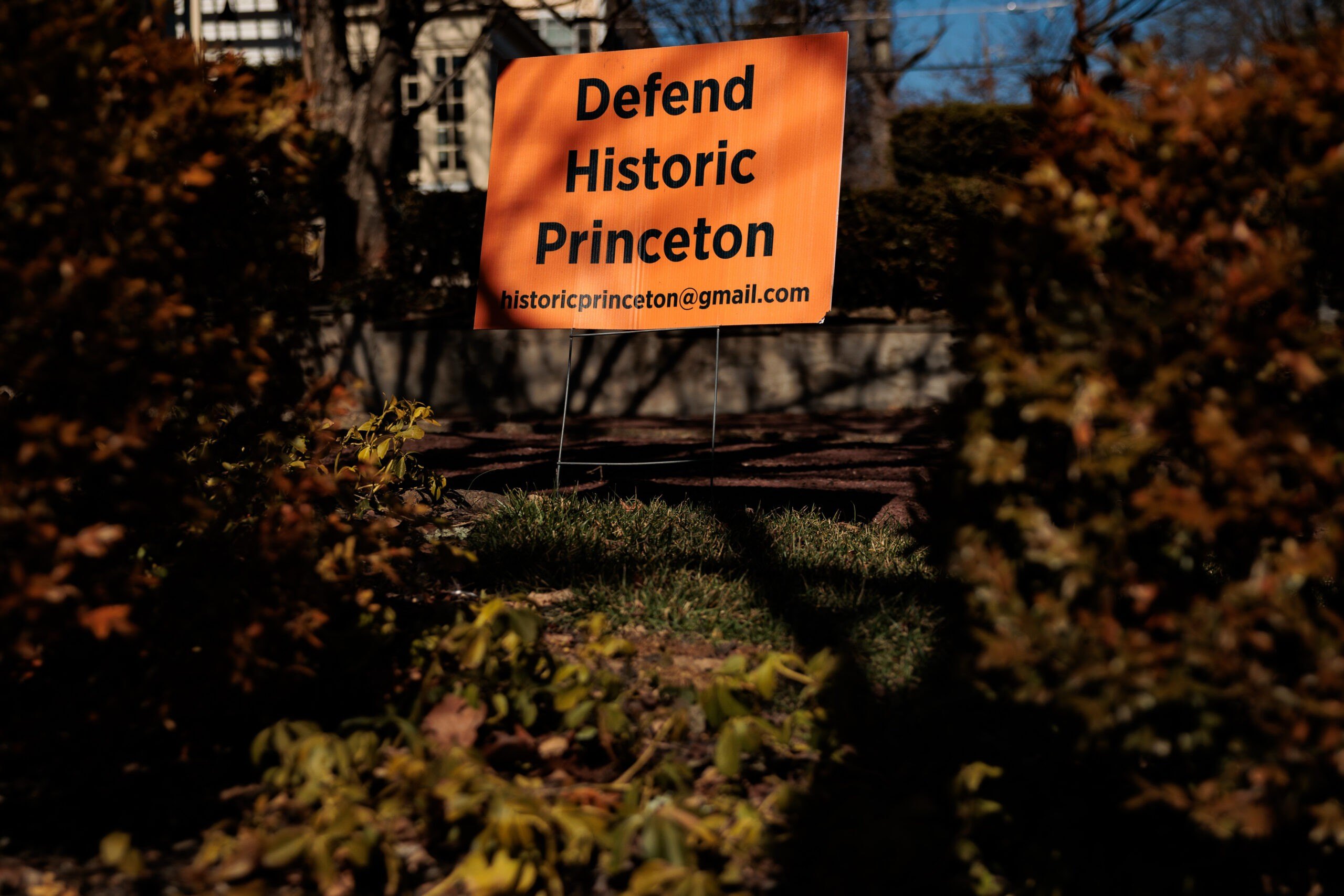
A battle is brewing over affordable housing in an Ivy League town, where officials are trying to figure out how to meet housing requirements without destroying land whose history dates back hundreds of years.
Municipality of Princeton, NJ, council member Mia Sacks tells Realtor.com® that people in the suburbs can feel threatened by apartment buildings, which has been a point of contention.
At issue: a proposed development on nearly 5 acres of land where the Princeton Theological Seminary’s former Tennent Roberts Campus sits. The former seminary was established in the early 1800s.
The planned development calls for a 238-unit apartment complex with a swimming pool and rooftop deck—no more than four stories high. Projected rents are expected to run $3,536 for a one-bedroom to $4,992 for a two-bedroom with den.
“There is no lack of familiarity in Princeton with the town’s rich history. It’s what makes the town distinct. That goes especially for this neighborhood, which lies in the heart of the Princeton Historic District, long listed on the National and State Registries of Historic Places,” Sean Wilentz, Princeton University history professor, tells Realtor.com.


The concern lies around the density of the development and whether the current road infrastructure can handle the influx of traffic.
Others feel this development isn’t going to provide enough low-income housing despite state laws requiring at least 20% of apartment units be set aside for low earners (in this case, about 48 units are planned to be allocated).
“Princeton is, as a whole, very committed to the value of having affordable housing,” Sacks says. “Most people in Princeton want to live in a racially and economically diverse community. We’re already an international community because we have the university here.”
Sacks adds that officials have been focused on integrating new units into the town using a “smart growth paradigm.”
“This means identifying sites in the center of town that can be adaptively reused or redeveloped in order to utilize already existing municipal infrastructure, sewer, roads, electricity, etc,” she says.
Wilentz argues, “As far as this particular project, alongside gestures to ‘smart growth,’ the municipality presents the project to the public as a gigantic affordable housing initiative, saying nothing about the 80% luxury units. ‘It’s all about affordable housing, see?!’ I have met Princetonians who sincerely believe that the Stockton Street proposal consists of 238 affordable units.”
Taxpayer cost is also a concern.
Wilentz says that developers will require a Payment in Lieu of Taxes agreement (PILOT).
“The PILOT for the Stockton Street project is a $30 million windfall to the developer, at the direct expense of the taxpayers of Princeton, and most of all, the poorer towns in Mercer County,” he says.
However, Princeton officials say that the proposed project could not be developed to these standards without the assistance of a PILOT.
Princeton’s financial adviser estimates that Princeton will net more than $48 million over the life of the PILOT, whereas the property has historically been tax exempt with no payment to Princeton, the county or Princeton Public Schools, according to an attorney who prepared a fact sheet for the project on behalf of the Princeton council members.
“We cannot solve the housing crisis just through single-family-zoned lots,” Sacks says. “There needs to be zoning changes that allow for more duplexes, triplexes, smaller lots with more units, and, yes, larger multifamily apartment buildings.”
The council is trying to come up with a compromise on large apartment buildings. Sacks says the answer isn’t necessarily acquiring and building on farmland, but rather building close to downtown. (The location of the Stockton project is about a five minute walk to the train station and downtown.)
“Foot traffic is essential. The mom and pop shops on our Main Street can’t compete in an Amazon economy unless there is more foot traffic,” says Sacks.
10-year plan
March 15 marked a deadline in New Jersey in which each of the state’s municipalities are required to share a 10-year plan for creating affordable housing. It’s part of the Mount Laurel Doctrine that was put into law in 1975.
The New Jersey Supreme Court says municipalities cannot use zoning laws to exclude low- and moderate-income families from living within their borders.
Every decade, New Jersey’s municipalities are expected to share their plan to build enough affordable housing. Many times, private developers will come in, purchase land, and build apartment complexes where 20% of units are set aside for low-income families.
But not everyone is happy about the requirements. Several towns and cities in the Garden State have taken their argument all the way to the U.S. Supreme Court only to be denied, most recently, by the high court.
“The problem becomes that nobody actually wants it in their neighborhood. They want it in theory, but not in practice, and the other issue is a misunderstanding of the economics of how housing gets built,” says Sacks.
She explains that since 2021, approximately 700 units have been constructed and are occupied. She adds that some are 100% affordable and some of them are inclusionary, meaning the residential project includes a percentage of units set aside for low to moderate income families.