


WRITING PRODUCTIVITY
Stop Waiting for “The Muse.” Use These Three Bootstrapping Principles to Treat Your Writing Like a High-Efficiency Product.

When I started writing seriously, I was convinced the process demanded suffering. I’d write a beautiful, polished opening paragraph, immediately hate it, edit it for three hours, and then quit for the day with 180 finished words. My desk looked like a battlefield of half-finished drafts and guilt. I was a perfectionist, and my output was zero.
This cycle isn’t unique, but it’s the enemy of any writer who wants to finish a piece. I realized that my writing approach — waiting for divine inspiration and demanding perfection — was fundamentally broken. The fix didn’t come from reading more literary theory; it came from applying my experience as a startup founder to my writing process.
Here is the blueprint I used to stop agonizing over the first draft and start shipping finished, polished articles.
The First Bootstrapping Rule: Ship the Ugly Draft
In the business world, a bootstrapped founder knows resources are scarce. You don’t build the final product; you build a Minimum Viable Product (MVP) — the ugliest thing that still performs the core function. Writing demands the same mindset.
The lie we tell ourselves is that the first draft must be beautiful. This forces the creator and the editor to fight for control, resulting in paralyzing gridlock.
I implemented one rule: My first draft is an Ugly Draft. Its only job is to exist.
- No Backspacing: I physically disabled my backspace key (or used a writing app that tracks momentum) for the first hour of writing. My mind knew the goal was quantity, not quality.
- The 500-Word Rule: I committed to writing at least 500 words of “utter garbage” every session. I treated the draft like cheap clay: malleable and disposable. This freed my internal editor, and I found that “garbage” often contained one or two gold sentences I could refine later.
This pivot — moving from a perfectionist editor to a messy creator — was the hardest part. It hurt to write a flawed sentence. But by treating the draft as a prototype, I started finishing pieces, not just starting them. Completion is the greatest motivator.
The $0 Feedback Loop: Validation is Gold

When launching a software prototype, you don’t spend thousands on market research; you hand it to users and watch what they do. Writers need the same external validation without spending money on expensive editors for early drafts.
This became my actionable 3-Step Feedback Strategy:
Step 1: Find the “Critical Reader”
I stopped asking my spouse or close friends for feedback. They only offered encouragement, not critique. I needed a Critical Reader: someone I trusted who specialized in being blunt and focusing on structure. I found two: one who focuses on technical clarity, and one who focuses on narrative flow.
Step 2: Ask the Right Questions
Asking, “Did you like it?” is useless. I now give my Critical Readers three specific, prototype-style questions focused on efficiency and usability:
- Where did you lose interest? (This identifies points where the narrative or clarity failed.)
- What is the clearest takeaway? (This ensures my thesis survived the draft.)
- What section could be cut entirely? (This forces lean writing and resource efficiency.)
Step 3: Use Feedback to Kill Features
Just like I cut the invoicing module in my startup, I learned to kill the features (sentences, paragraphs, metaphors) that don’t serve the reader. If both Critical Readers flagged a section as confusing or unnecessary, I deleted it, no matter how much I loved the prose. This process forces the final piece to be lean, targeted, and powerful.
My Three-Tiered System for Managing Writing Energy
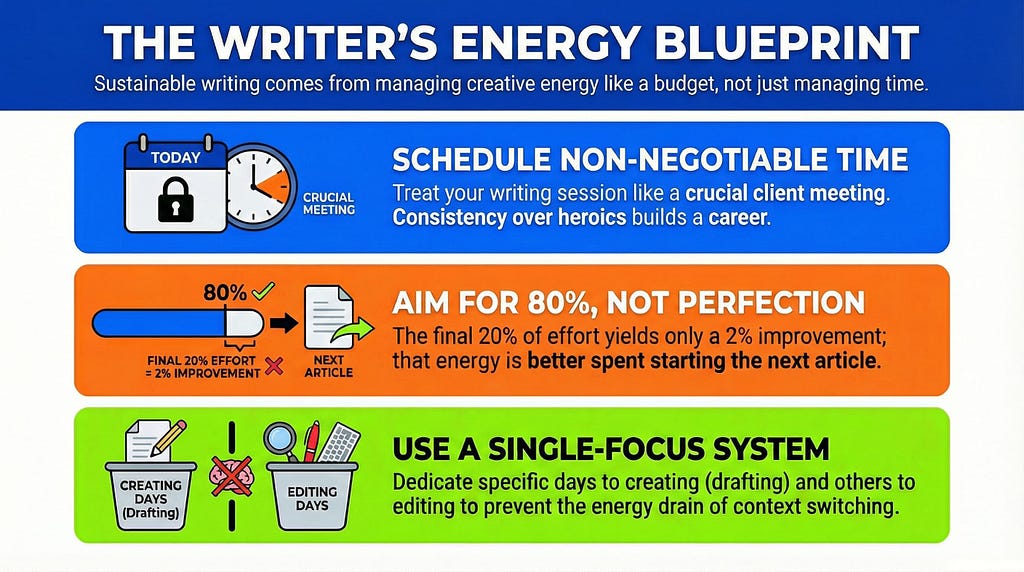
Treating writing like a startup means managing your energy like a limited budget. You can’t afford burnout or wasted time. My goal wasn’t just to write; it was to write consistently and sustainably.
These rules govern my output:
- The Non-Negotiable Time Block: I stopped waiting for “free time” to appear. I scheduled my writing sessions for 6:00 AM to 7:30 AM every weekday. I treat this time block with the same respect I treat a crucial client meeting. If I miss it, I don’t try to catch up that day; I protect the next day’s block. Consistency, not heroics, builds a writing career.
- Define Done Differently: Perfectionism requires infinite hours. I assigned a Quality Threshold of 80% to my own work. Once the article hits the Completion stage (all sections written) and the Feedback stage (all critical notes addressed), I accept that the final 20% of effort yields only 2% improvement. That 20% of effort is better spent starting the next article.
- The Single Focus Principle: I strictly forbid myself from engaging in multiple editing tasks at once. I dedicated Mondays and Wednesdays to Creation (Ugly Drafts). I dedicated Fridays to Editing and Feedback Integration. This compartmentalization prevents context switching, which is the ultimate drain on creative energy.
Your Blueprint for High-Efficiency Writing
If you are struggling under the weight of perfectionism, remember this: your goal as a writer is to complete a valuable transaction with the reader. They exchange their time for your insight. Your job is to deliver that insight cleanly and consistently.
- Adopt the Ugly Draft Mindset: Your first draft is an MVP. Force yourself to complete it before you attempt to correct it.
- Seek Critical Validation: Stop asking friends for praise. Seek out readers who will identify where you lose interest or where your argument is confusing.
- Manage Energy, Not Minutes: Use strict time blocks and define an 80% Quality Threshold. Your most valuable resource isn’t your talent; it’s your discipline.
- Kill Your Darlings: If user feedback identifies a section that doesn’t serve the reader, delete it without hesitation. Lean writing is powerful writing.
- Focus on the Process: The writing life isn’t about magical inspiration; it’s about building a robust, repeatable system. Start your system today.
What is the one non-negotiable writing habit you use to guarantee output? Share it in the comments below!
The Prototype Writer: How I Cut Perfectionism to 80% and Doubled My Output was originally published in The Startup on Medium, where people are continuing the conversation by highlighting and responding to this story.