



Production delays, excess inventory and inconsistent workflows can quickly reduce output and increase operating costs. The right lean manufacturing tools and techniques help manufacturers standardize processes, reduce waste, improve quality control and maintain steady production across assembly lines, warehouses and maintenance operations.
1. Kanban Board
A kanban board is a visual workflow management tool used to track tasks, inventory movement and production stages. It is commonly used in manufacturing environments to control work-in-progress inventory, improve production flow and identify bottlenecks across assembly lines, warehouses and maintenance operations.
Factories handling repetitive production tasks, custom orders or shared workstations benefit heavily from kanban systems. Production managers can quickly identify stalled work, overloaded teams or material shortages before they interrupt manufacturing schedules. It is especially useful in environments where multiple departments depend on synchronized workflows and continuous material replenishment.
- Provides real-time visibility into production status
- Reduces excess work-in-progress inventory
- Helps identify production bottlenecks faster
- Improves coordination between production teams
- Supports pull-based inventory replenishment systems
If you’re looking for kanban board software, try ProjectManager. ProjectManager is award-winning project management software that gives manufacturers the tools they need to ensure projects are completed on time, within budget and within scope. It allows project managers to make detailed project schedules, estimate costs, allocate resources, set budgets, track progress and compare planned versus actual project outcomes using real-time dashboards and reports to identify delays or cost overruns quickly. Get started with ProjectManager for free today.
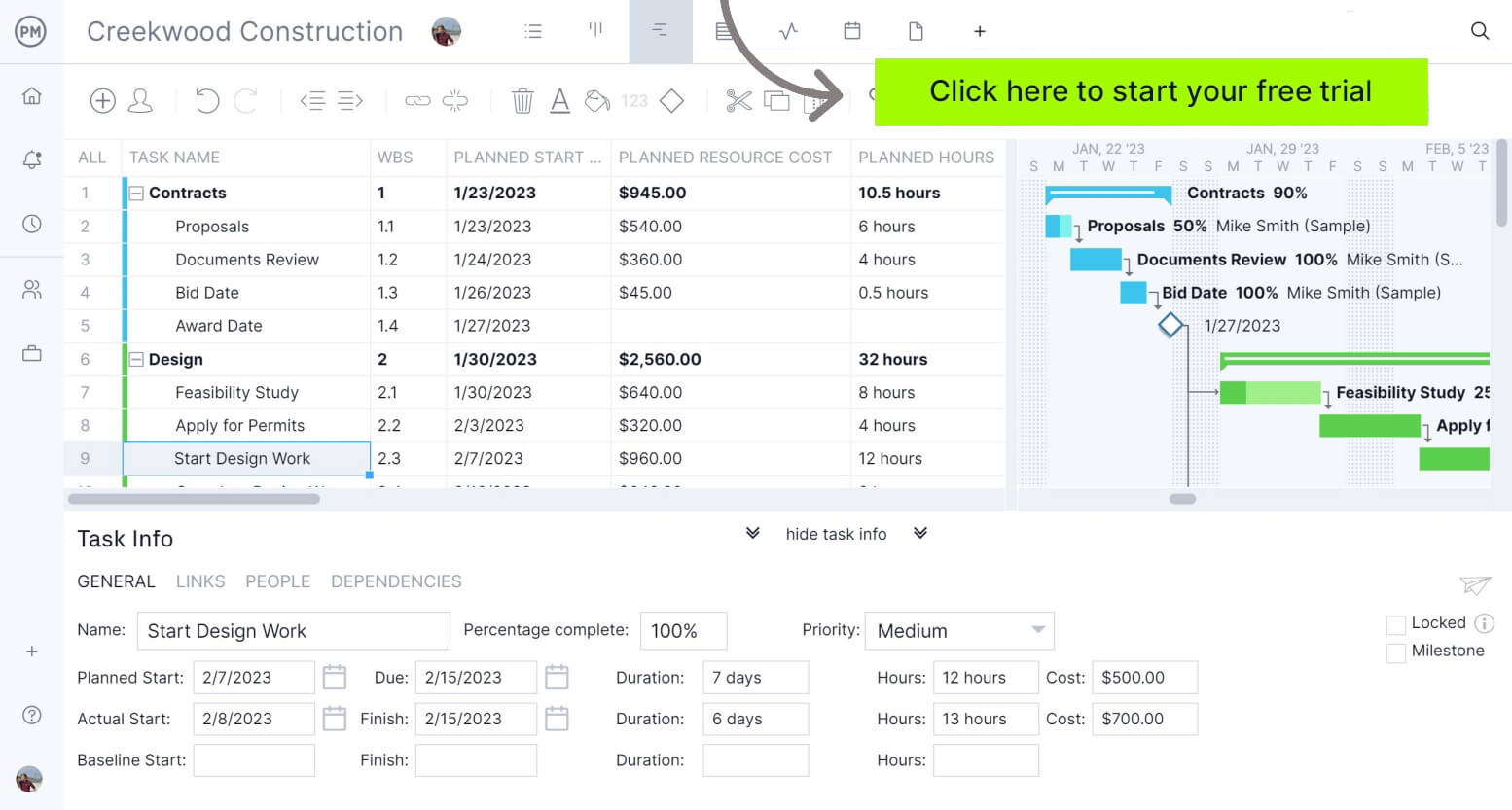
2. Just-in-Time Manufacturing
Just-in-time manufacturing is an inventory management approach used to produce goods only when customer demand requires it. It is commonly used in automotive, electronics and consumer goods manufacturing to reduce storage costs, minimize excess inventory and maintain efficient production scheduling.
Manufacturers operating with expensive raw materials, limited storage space or fluctuating customer demand often rely on just-in-time production. The approach works best when suppliers deliver materials consistently and production schedules remain stable. Companies use it to avoid overproduction while maintaining faster inventory turnover and leaner operations.
- Lowers inventory holding and storage costs
- Reduces waste caused by overproduction
- Improves inventory turnover rates
- Creates more warehouse space for operations
- Encourages stronger supplier coordination
3. Heijunka
Heijunka is a production leveling technique used to balance manufacturing workloads over time. It is commonly used in lean manufacturing systems to reduce uneven production schedules, stabilize labor demands and maintain consistent output across production lines.

Production facilities experiencing sharp demand swings, uneven workloads or recurring overtime issues use heijunka to smooth scheduling. Instead of producing products in large batches, manufacturers distribute production evenly throughout shifts or weeks. This approach becomes especially valuable when equipment utilization and labor stability directly affect operational performance.
- Reduces production schedule fluctuations
- Helps stabilize staffing and machine utilization
- Minimizes overtime and production stress
- Improves predictability in manufacturing operations
- Supports more consistent inventory management
4. Andon Board
An andon board is a visual alert system used to notify manufacturing teams about equipment failures, quality problems or production delays. It is commonly used on factory floors to improve response times, maintain production flow and support immediate problem resolution.
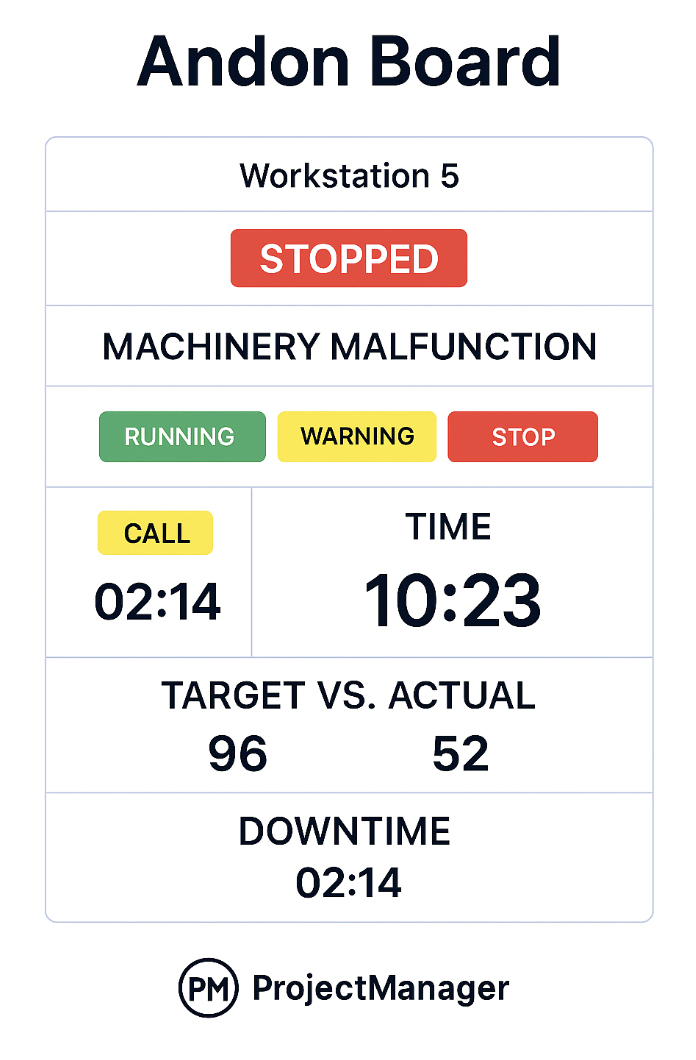
Fast-paced manufacturing environments with automated machinery, strict quality standards or high production targets depend on andon systems to surface issues immediately. Operators can signal maintenance teams, supervisors or quality inspectors without stopping communication chains. This tool becomes especially valuable when downtime, defects or delays can quickly disrupt downstream operations.
- Speeds up response to production problems
- Improves communication across manufacturing teams
- Reduces downtime caused by equipment failures
- Supports faster quality issue resolution
- Increases visibility into production line performance
5. Gemba Walk
A gemba walk is a management practice used to observe manufacturing processes directly on the production floor. It is commonly used in lean manufacturing environments to identify operational inefficiencies, monitor workflows and improve communication between supervisors, operators and maintenance teams.
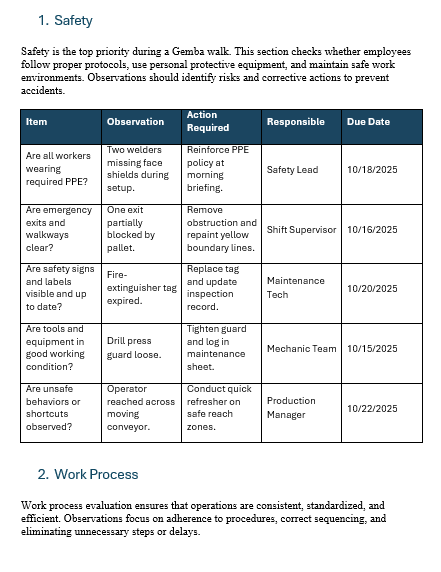
Manufacturing leaders use gemba walks when recurring delays, quality issues or workflow disruptions cannot be fully understood through reports alone. Walking the production floor allows supervisors to observe machine conditions, employee movements and material handling in real operating conditions. This approach is especially useful during process improvement initiatives and operational audits.
- Improves visibility into daily manufacturing operations
- Helps identify process inefficiencies directly at the source
- Strengthens communication with production employees
- Supports faster problem identification and resolution
- Encourages continuous operational improvement
6. 5S Audit Checklist
A 5S audit checklist is a workplace organization tool used to evaluate cleanliness, standardization and safety within manufacturing facilities. It is commonly used in factories, warehouses and maintenance areas to maintain organized workspaces and support efficient production operations.

Production environments with shared tools, heavy equipment or strict safety requirements rely on 5S audits to maintain operational discipline. Supervisors use these checklists to inspect storage areas, workstations and maintenance zones for clutter, misplaced materials or unsafe conditions. The process becomes especially important in facilities focused on reducing downtime and improving workflow consistency.
- Improves workplace organization and cleanliness
- Reduces time spent locating tools and materials
- Supports safer manufacturing environments
- Helps standardize and optimize production work areas
- Encourages long-term operational discipline
7. Kaizen Board
A kaizen board is a visual improvement management tool used to track employee suggestions, process improvements and operational issues. It is commonly used in lean manufacturing facilities to support continuous improvement initiatives and encourage team participation in problem-solving activities.
Manufacturers implementing ongoing process improvement programs use kaizen boards to organize improvement ideas and monitor corrective actions. Teams can document recurring production issues, assign responsibilities and track implementation progress in one centralized location. This approach works especially well in facilities seeking incremental operational improvements instead of large-scale process overhauls.
- Encourages employee involvement in process improvement
- Creates visibility into ongoing improvement initiatives
- Helps track corrective actions and follow-ups
- Supports continuous operational optimization
- Improves accountability across manufacturing teams
8. Kamishibai Board
A kamishibai board is a visual control system used to manage audits, inspections and standardized work verification tasks. It is commonly used in manufacturing facilities to ensure production procedures, safety checks and maintenance activities are completed consistently.

Factories with strict operational standards, recurring inspection routines or compliance requirements use kamishibai boards to verify critical activities. Supervisors and team leaders can quickly confirm whether safety inspections, machine checks or cleaning tasks have been completed. The system becomes particularly useful when maintaining consistency across multiple shifts or production lines.
- Improves consistency in operational audits and inspections
- Supports compliance with standardized work procedures
- Increases visibility into completed and pending checks
- Helps reduce missed inspection activities
- Strengthens accountability across production shifts
9. Poka-Yoke
Poka-yoke is an error-proofing technique used to prevent manufacturing mistakes before they create defects. It is commonly used in production lines, assembly operations and quality control systems to reduce human error and improve product consistency.
Manufacturers producing high-volume products, safety-critical components or repetitive assembly tasks often implement poka-yoke systems to reduce costly defects. Devices, sensors or workflow controls are added to prevent incorrect assembly steps, missing components or machine setup errors. This approach becomes especially valuable when quality failures create rework, warranty claims or production delays.
- Reduces defects caused by human error
- Improves product quality consistency
- Decreases rework and scrap material costs
- Supports faster production line inspections
- Helps maintain standardized manufacturing processes
10. 5 Whys
The 5 Whys is a root cause analysis technique used to identify the underlying source of operational problems. It is commonly used in manufacturing environments to investigate equipment failures, quality defects and recurring production disruptions.
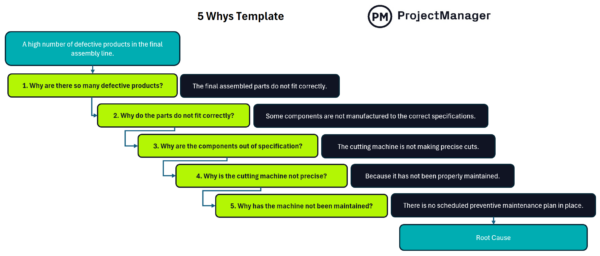
Production teams rely on the 5 Whys method when short-term fixes fail to eliminate recurring issues. Supervisors repeatedly ask why a problem occurred until the operational, procedural or maintenance-related cause becomes clear. The technique works especially well for troubleshooting machine downtime, process inconsistencies and material handling problems on factory floors.
- Helps uncover the root cause of production issues
- Reduces repeated operational problems
- Supports faster corrective action planning
- Improves troubleshooting during equipment failures
- Encourages structured problem-solving discussions
11. Fishbone Diagram
A fishbone diagram is a root cause analysis tool used to organize possible causes of manufacturing problems into categories. It is commonly used in quality management and process improvement initiatives to investigate defects, delays and equipment performance issues.
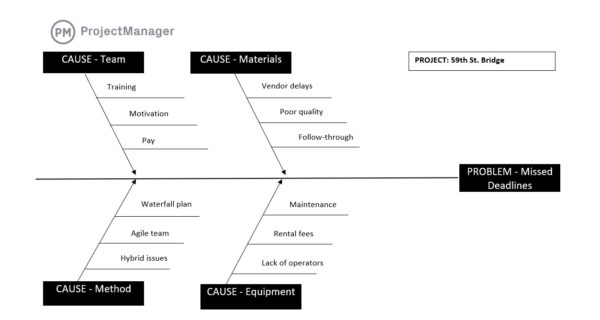
Manufacturing teams use fishbone diagrams when operational problems involve multiple contributing factors across labor, materials, machinery or processes. The visual structure helps teams break down complex issues during quality investigations or production reviews. This approach becomes especially useful when identifying patterns behind recurring defects or inconsistent production output.
- Organizes potential causes of manufacturing problems visually
- Supports structured root cause analysis sessions
- Improves collaboration during troubleshooting activities
- Helps identify process weaknesses more efficiently
- Strengthens quality improvement initiatives
12. Pareto Chart
A Pareto chart is a data visualization tool used to identify the most significant causes of manufacturing problems. It is commonly used in lean manufacturing and quality control programs to prioritize defects, downtime causes and operational inefficiencies based on frequency or impact.
Factories managing multiple production issues simultaneously use Pareto charts to focus improvement efforts where they will produce the greatest operational gains. Quality teams can compare defect categories, equipment failures or customer complaints to identify the problems causing the largest disruptions. This method is especially valuable when resources for corrective actions are limited.
- Helps prioritize the most critical production issues
- Improves decision-making using operational data
- Supports targeted quality improvement initiatives
- Reduces wasted effort on low-impact problems
- Provides clear visual reporting for manufacturing teams
13. SIPOC Diagram
A SIPOC diagram is a process mapping tool used to identify suppliers, inputs, processes, outputs and customers within a manufacturing workflow. It is commonly used in lean manufacturing and process improvement initiatives to define operational boundaries and clarify production activities.
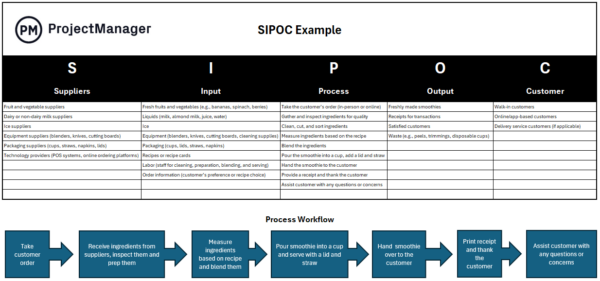
Manufacturing teams use SIPOC diagrams when launching process improvement projects, troubleshooting workflow issues or documenting manufacturing procedures. The framework helps departments understand how materials, information and outputs move through operations. It becomes especially useful when multiple suppliers, production stages or customer requirements affect manufacturing performance and coordination.
- Provides a high-level view of manufacturing workflows
- Improves understanding of process dependencies
- Helps identify gaps in production operations
- Supports process improvement and standardization initiatives
- Strengthens communication between manufacturing departments
14. Hoshin Kanri
Hoshin Kanri is a strategic planning method used to align manufacturing goals with daily operational activities. It is commonly used in lean manufacturing organizations to coordinate long-term business objectives, production KPIs and continuous improvement initiatives.
Manufacturers managing large facilities, multiple departments or company-wide improvement programs use Hoshin Kanri to keep operational priorities aligned. Leadership teams can translate strategic goals into measurable production activities and departmental responsibilities. The method becomes especially valuable when organizations need consistent execution across engineering, production, maintenance and quality management teams.
- Aligns production activities with business objectives
- Improves coordination between manufacturing departments
- Supports long-term operational planning
- Creates accountability for strategic initiatives
- Helps track progress toward manufacturing goals
15. Yamazumi Chart
A Yamazumi chart is a workload balancing tool used to compare task times across manufacturing operations. It is commonly used on assembly lines to identify uneven workloads, reduce production bottlenecks and improve labor distribution between workstations.
Assembly operations with repetitive tasks, cycle-time targets or labor imbalances benefit heavily from Yamazumi analysis. Supervisors can visualize how work is distributed across operators and identify stations causing delays or idle time. This technique becomes especially useful when manufacturers need to improve throughput without adding additional labor or equipment.
- Helps balance workloads across production stations
- Reduces bottlenecks and idle production time
- Improves labor utilization on assembly lines
- Supports cycle-time optimization initiatives
- Increases overall production efficiency
16. Assembly Line Balancing
Assembly line balancing is a production optimization technique used to distribute tasks evenly across manufacturing workstations. It is commonly used in high-volume manufacturing environments to reduce delays, improve throughput and maintain consistent production flow.
Manufacturers experiencing bottlenecks, inconsistent cycle times or uneven labor demands often apply assembly line balancing to stabilize operations. Production managers analyze task durations, workstation capacity and labor availability to improve workflow distribution. This approach becomes especially valuable when production targets increase without corresponding increases in staffing or equipment capacity.
- Improves production flow across assembly operations
- Reduces workstation bottlenecks and waiting time
- Helps maximize labor and equipment utilization
- Supports higher production throughput
- Improves consistency in manufacturing cycle times
How ProjectManager Helps Manufacturing Businesses
Keeping production on schedule while managing resources, costs and changing priorities requires more than spreadsheets or disconnected tools. Manufacturing project management becomes easier when teams can plan, track and adjust work in one centralized system. ProjectManager brings together production scheduling, resource planning and performance tracking so production teams can stay aligned and make faster decisions on the shop floor.
With interactive Gantt charts, manufacturing teams can build detailed production schedules, map task dependencies, identify milestones and adjust timelines as conditions change. Resource management tools allow managers to assign labor, equipment and materials efficiently, while monitoring resource availability and avoiding bottlenecks. Real-time dashboards and reports provide instant visibility into progress, costs and workload, helping teams identify issues early and maintain control over production performance.
Teams can also collaborate more effectively using kanban boards and task lists that track work at every stage of the manufacturing process. Thanks to these and other tools and features, ProjectManager helps manufacturing businesses improve efficiency, reduce delays and deliver consistent results. Watch the video below to learn more!
If you need a tool to help you manage projects, then sign up for our software now at ProjectManager. Our online software helps teams across industries plan, track and oversee projects as they unfold. Sign up for a free 30-day trial today!