


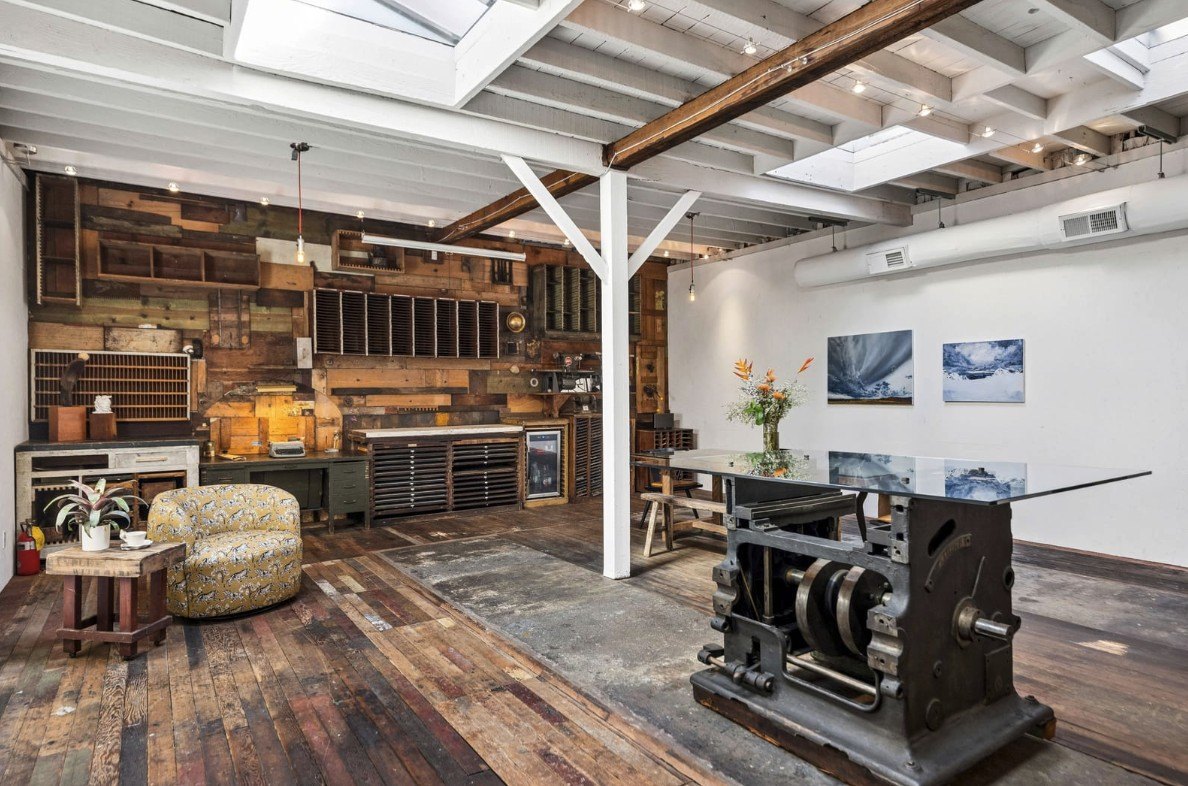
It’s rare to find a property that is not only a pristine private residence, but also a living work of art that stands as a tribute to times gone by and serves as a “sanctuary in the heart of the city.” And it’s almost unheard of to find such a dwelling in a thriving neighborhood in San Francisco—all for under $1.3 million.
Yet that is exactly what is on offer by prominent artist Jamie Emerick in the form of her meticulously restored dwelling, which, for years, served as a thriving printing press business and today perfectly merges that legacy with an elegant and modern aesthetic.
Known as the “Letterpress,” the property is located in San Francisco’s revitalized Mission District, where Emerick has spent the last 10 years living inside the unique abode, spending several of them dedicated to transforming it into the one-of-a-kind “micro compound” that is now on the market for $1.29 million.
Emerick is an acclaimed painter who has studied in Florence, Italy, South Africa, and the U.S. She graduated with an MFA from the California College of the Arts, and her work has been exhibited throughout the Bay Area and is held in private collections.
So it’s safe to say she knows a thing or two about aesthetics and design—knowledge that came in very handy in the renovations of 1315 Minna St.
The proof though, as they say, is in the pudding, which, in this case, comes in the form of a solid offer submitted to Emerick and her agent within days of going on the market. Less than two weeks later, the property is already “pending” sale.


The rare “micro-compound” was developed in 1938 to serve as the home of the McCoy Printing Service, which flourished from the 1930s to the 1980s. The building was owned by the family of a World War II ambulance driver for more than 80 years.
When Emerick happened upon it in 2016, that printing business had all but been abandoned, left to rot. Yet she realized the unlimited potential in the property and purchased it for $1.38 million.
Where others might have been put off by the rusty, disorganized remnants of the printing business that were scattered throughout the dwelling, to Emerick they were priceless treasures.
“On our first visit to the property, we were captivated by the piles of broken press pieces, monstrous marble slabs darkened with decades of ink, the tiny metal letters scattered between the floorboards and wood that had been used, and then reused for the last 80 years,” she recounted.
“It was all in a pile to be taken to the dump, but we saw it as gold. The fragments of many stories were captivating; the auras of lives previously lived in the space, literal scraps of printed party invitations, ‘While You Were Out’ pads, pineapple tin labels, abstract rust on metal shelving trays, ink of every color saturating the wood.
“As a painter and mixed media sculptor, the assemblage of parts felt limitless, and the prospect of adding my chapter to the story of the property was exciting.”
Emerick and her family renovated and moved into the sunny three-bedroom living space above the printing room, restoring the wood floors, bay windows, and a large deck. They remodeled the layout to give it three bedrooms, a spacious great room, a modern, wide open kitchen, and a marble tiled bath.
They also set to work on the more than 1,000 square foot ground floor rooms, adding skylights, a sleek bathroom, and open space where artistic and community magic happened.
“Many paintings and sculptures were made, and the space became a welcoming spot for many others to collaborate,” Emerick said.
“We hosted events, dinners, and volunteer build weekends. My daughter’s school community built Chinese New Year costumes and props annually in the space, scattering green glitter that one can no doubt find traces of still!”


But the space gave Emerick something of its own in return: artistic inspiration.
“As an artist who draws inspiration from the spirit of provenance, patina of everyday life habits and the increasing preciousness of old wood and stone, the richness of this space fed directly into my studio practice. I built furniture from the old wood in the studio, but also many sculptures balanced precariously on both the literal and metaphorical legs of history.”
Examples of that can be found in the tables Emerick crafted from reclaimed on-site scraps of wood, and what looks like part of a printing press.
And, most surprising of all, almost all of the unique and irreplaceable, repurposed printing press assets are included in the sale, if the buyer wants to keep them.
“All of the furniture, printing supplies, antique object and ephemera are solely from the family that lived and worked in the building. It feels right to leave it with the property if the new owners are interested,” Emerick said.
But Emerick isn’t without fond regrets.
“Some of my favorite details that I will miss are the floorboards, the press table, the defunct telephone pole with rusted bike frame standing off the back deck like a monolith to childhood absurdity, the friendships with Mike and George who run the corner store, the light coming through the skylights,” she recounted.
Emerick and listing agent Naomi Lempert of Coldwell Banker Realty agree that the community is among the property’s most valuable selling points.
“The Mission has become a vibrant, historic San Francisco neighborhood known for its cultural richness and energy,” Lempert notes. “Rather than a single definition, it reflects a distinctly urban mix where you’ll hear Spanish, Chinese, Tagalog, and many other languages spoken alongside English.”
It’s also become a mecca for foodies, shoppers, and nightlife enthusiasts, according to Lempert.


“The food scene is equally diverse—from street tacos, paletas, hot dogs, and fresh fruit with tajín, to lively bars, independent boutiques, and Michelin‑starred restaurants,” she said.
“With its sunny microclimate, central location, and excellent access to public transportation and major freeways, the Mission offers a dynamic combination of ownership and rental housing that contributes to its layered, authentic neighborhood fabric.”
In addition, there is a rare amount of freedom in what the new owners can do with the property, in a city where restrictions are rampant.
The Letterpress benefits from the coveted RTO-M zoning designation, which opens doors to numerous possibilities. Dense housing development, community use, live/work configuration—even multiunit conversion and expansion are all possibilities.
“Expansion for more units would be allowed, as is use as a child care and community facility,” explained Lempert. “There are so many ways one could use the space—move right in and do nothing, or build it out, modify it to suit their needs. It’s basically a blank canvas.”
With so many existing assets, such extraordinary renovation, and so much potential, you can’t help but wonder about the relatively modest list price.
“The pricing [was] to bring folks in, ideally to generate multiple offers,” Lempert revealed candidly—a tactic that appears to have paid off.
“It is a sanctuary in the heart of the city,” she went on. “The upstairs is tastefully done and so peaceful, the rear deck is sunny and lovely. The downstairs studio space is magical, with great volume and light and historical gravitas—you just feel like cool things can happen here.”
Emerick and her family appear to have created a veritable paradise in this part of the city, so why would they even toy with the idea of leaving it?
“For me, the place is no different from any other art piece. When something is being worked on, of course the work comes from the heart and the spirit, but then, when it’s done, the next work is to release it into the world,” she said.
“I am grateful for the lessons learned about the history of printing presses in San Francisco, and also for the new stories that I put together standing at the foot of the press bed turned counter table. And now it’s time to move on and find a fresh canvas.”