


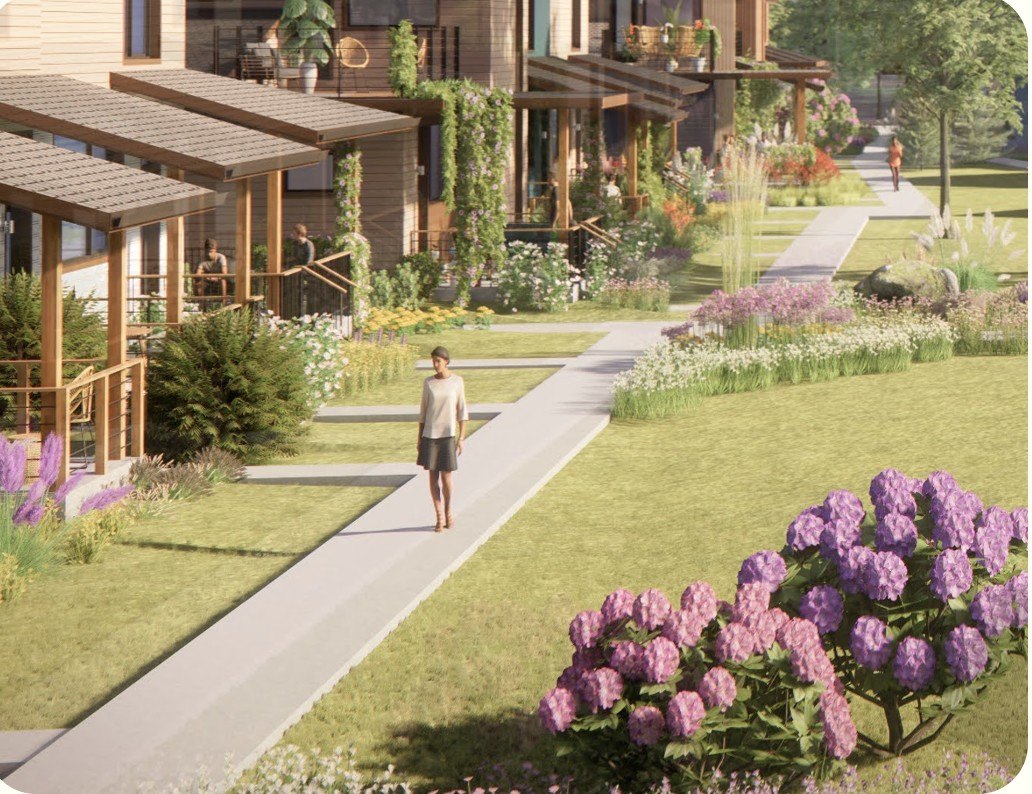
A handful of nature lovers are staking everything on building a farm preservation village on 240 acres of lush farmland an hour outside Seattle.
Fifteen households have committed to buying a home in the Rooted Northwest co-housing community near Arlington, WA.
In 2020, this band of land preservationists pooled their money, secured a loan, and purchased the expansive acreage from an elderly farmer.
“We said, ‘Holy smokes, this is one of the last non-flood plain farms of this size in Snohomish County,'” project manager and community cofounder Dave Boehnlein, 48, tells Realtor.com®. “We can’t afford to lose it. We have to help save it.'”
Since the farmland was actually zoned residential and not agricultural, Boehnlein, a passionate advocate for regenerative agricultural farming and permaculture, knew the land would be snapped up by developers.


So he and some friends came up with a plan for a co-housing community. It would feature 70 tightly configured homes, but an astounding 93% of the surrounding acreage would be set aside for gardens, forest, and farmland.
“We’re going back to the old-school rural village,” says Boehnlein. “If you look at how people occupied rural land throughout history, the model hasn’t been, ‘Here’s a house, and then you drive five minutes before you see the next house.'”

“People occupied rural landscapes in a village format: a cluster of homes that are together for safety, sharing resources, and helping each other,” he says. “And then the gardens and farms and all that radiating out from the nodes where people live. That’s what we’re creating.”
The planning commission and county council liked the idea but had to pass an ordinance to allow it, as the area was zoned for single-family homes on 5-acre plots. If the co-housing community works, then the county may allow more of them.
“If they see a bunch of happy folks, and productive farms, and us starting to budge the needle on food securities, I imagine that would be part of the county’s metrics [for success],” says Boehnlein.
What is co-housing?
Inspired by concepts that originated in Denmark, but that can be found globally, a co-housing community is “where people live in private homes formed around shared spaces and values,” according to the Rooted Northwest website.
While the homes are privately owned, there are plenty of communal spaces such as gardens, common houses, and other gathering places. They’ll also operate under a type of self-governance known as “sociocracy.”

Loosely explained, that means residents will all have a say in how the community operates, but they will also—to a certain extent—stay in their own “lanes.”
Committees—known as “circles”—will form around particular topics relevant to the village and, ideally, members of each circle will have expertise or knowledge in those topics.
For example, members with skills in forestry will be in the “forest stewardship circle” and make decisions about that aspect of the community. Those who know nothing about forestry will likely not get any say in whether a tree is cut down.
“There’s a lot of nuance there,” says Boehnlein. “Everyone can ‘weigh in’ on anything they want. If we look at the forest stewardship circle, they get to make forestry decisions. However, if their decisions are constantly an upsetting surprise to everyone else, then they’re not doing it right.”

The neighborhoods
As planned, there will be 70 homes spread over two neighborhoods, with homes designed by sustainable architecture firm Caddis Collaborative, with input from the community, and starting at $875,000. The median listing price in the Seattle metro area is $754,950.
Members will own their house and the plot of land it sits on, but they will also belong to two HOAs, which will own and manage the farm acreage and common areas.
The homes aren’t yet built, but everything from floor plans to approved permits is ready to go, with the community needing about 15 more committed households for construction to start.
Those interested can join an informational period ranging from 30 to 90 days, in which potential and current members can liaise to see if everyone is a good match.
Kim Mulligan, 66, a local real estate agent who specializes in “green homes” and will retire in the community, notes that the setup would be perfect for overstressed families needing more support.
Since there will be a voluntary rotation of communal meals, “you may not have to cook dinner for two months,” she says.

“If you’ve had a long day at work, picked up two kids from after-school activities, and you’re too tired to make dinner, then pile them into the common house and a lovely meal is waiting for you. Then you get to hang out and have an adult conversation while your kids run off to the kids’ room to play.”
The common houses will include a kitchen and dining area, a pantry, laundry room, and smaller shared spaces for movie nights, book club meetings, yoga classes, and the like.
“I could go buy into an expensive 55-plus senior community, have the tennis and pickleball courts and all that, but I’d rather be out in nature and put my money towards something I believe in,” she says.
Farming in the community
Currently, six small farmers lease plots on the land, but eventually, it will be many more. Boehnlein says it remains to be seen how many there will be and what they will produce. Farmers who lease land don’t need to live in the community, and the people who live in the community aren’t required to farm.
The leased farms come with infrastructure such as a greenhouse, a tractor, an irrigation system, a tool shed, and more.
“By sharing [the infrastructure], we take that huge hurdle out of the way,” Boehnlein says, adding that there’s no profit sharing with the farmers.
The farmers don’t need to be certified organic, but they must follow regenerative agricultural techniques.
“They can’t be spraying or applying anything that wouldn’t pass organic standards,” he says.
Paradise found?
While a village based on healthy living and shared values sounds idyllic, the members acknowledge that everything might not be perpetually rosy.
“There will probably be someone in the neighborhood I don’t like, and that’s OK,” says Boehnlein. “You don’t have to love everybody and yet still can be on the same page with the same values.”
“People tend to self-select,” says Mulligan. “I’m sure some people will just opt out if we’re not their people.”
The plan is to have the farmland preserved forever, and to that end, the group is considering what further future protections might be needed, such as aligning with or forming a conservation land trust.
“We will do everything we can to protect this property in perpetuity,” says Boehnlein.