

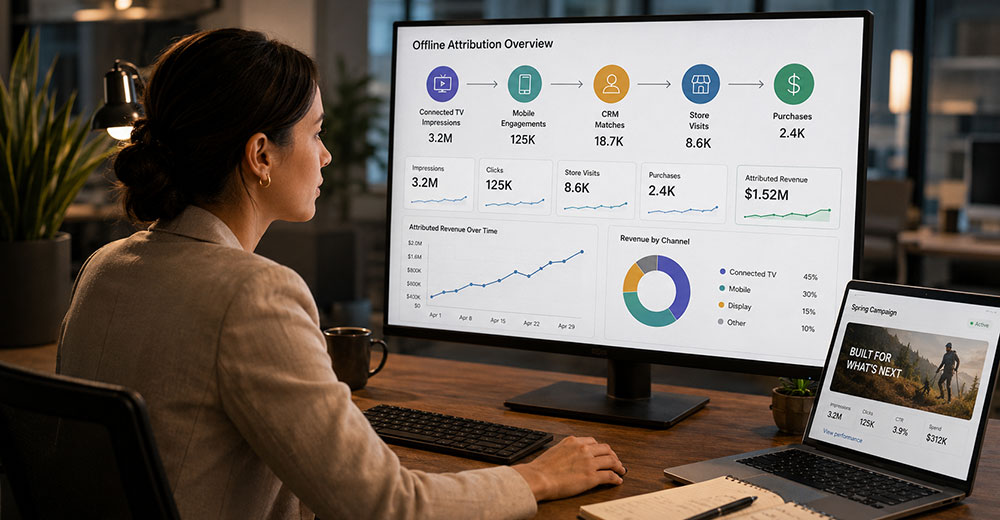
Digital advertising can track nearly every click, but connecting ad exposure to real-world sales remains difficult. Even in an era defined by big data, many businesses still cannot reliably measure when digital campaigns lead to store visits, appointments, or offline purchases.
Adtaxi is helping brands connect media exposure to real-world outcomes through advanced measurement and offline attribution. It helps advertisers determine which digital interactions actually lead to store visits or service appointments.
Brian Kroll, VP of strategic accounts at Adtaxi, says counting clicks while ignoring the cash register is a classic marketing dilemma. Bridging the gap between digital impressions and physical transactions remains one of marketing’s toughest measurement challenges, especially when so much of the customer journey happens offline.
Adtaxi combines campaign management with attribution tools designed to connect ad exposure to measurable business outcomes. It works across leading platforms, including Google, The Trade Desk, Meta, and TikTok, using market intelligence, category research, and first-party data to uncover high-value audiences and guide smarter investment decisions.
Data is finally addressing John Wanamaker’s famous quote: “Half the money I spend on advertising is wasted; the trouble is, I don’t know which half.”
“Definitive proof of ROI is still really hard to measure — even with modern data integrations — due to persistent difficulty related to advanced measurement concepts like incrementality because there will always be parts of a customer’s journey that will never be measurable,” Kroll told CRM Buyer.
Rethinking Ad Attribution
Solving ad waste requires both better tracking technology and a broader view of how different stages of the customer journey contribute to sales. Technology can improve tracking, but businesses also need to rethink how they evaluate marketing performance.
Marketers long prioritized clicks and online conversions because they were easier to measure, even when most sales happened offline, Kroll noted. Today’s attribution models encourage businesses to value the entire customer journey, including awareness channels that influence purchase decisions but don’t generate an immediate digital action.
For considered purchases with longer sales cycles, the attribution window between the first interaction and the final transaction can span weeks or months. Without a patient mindset, you’d ignore those interactions if they fail to fit your standard model.
Time-decay modeling can help marketers assign value to earlier brand interactions that influence subsequent conversions.
“My personal opinion is that branding investments that you can’t prove eventually pay off are not great investments,” Kroll said.
How Connected TV Ads Link to CRM Data
Connecting a streaming ad impression to a CRM purchase record depends heavily on the demand-side platform (DSP) serving the ads.
“This is absolutely key, because some have decidedly better handshakes than others,” Kroll advised.
He explained that the DSP used by Adtaxi connects to a household identity graph that associates devices within the same household. Any device connected to the household Wi-Fi is part of that graph. When users log in to those devices, their logins are converted into a Universal ID (UID2.0), which is interoperable across most publishers, such as Peacock and Disney+, and platforms, like Samsung TV and Roku.

For connected TV (CTV) specifically, most streaming services require someone in the household to log in using that email or phone number (or both). As ads reach those devices, the record includes the UID and the impression timestamp.
The data is uploaded to a clean room, where the email and phone are converted to the UID2.0 and then passed to the DSP’s log files. The Adtaxi platform provides this information to a business CRM. If the transaction’s UID matches the UID of a preceding ad impression, it counts as a conversion, and the handshake is complete.
Why Digital-Only Measurement Falls Short
According to industry reports, there is a 70% gap in digital-only measurement conversion rates. Why? That standard ignores the majority of the actual business a company does.
In-home services like plumbing and HVAC often have long sales cycles. Adtaxi helps these businesses attribute a lead generated today to a service call completed three weeks from now.
Kroll noted that long sales cycles are a perfect example of why digital-only methods fail. Adtaxi connects lead data, call tracking, and CRM records over time, enabling the system to recognize delayed conversions.
“Instead of crediting only the last click, businesses can see which earlier exposures influenced the eventual service appointment. That longer feedback window helps marketers optimize toward revenue, not just immediate lead volume,” he said.
Many brick-and-mortar brands discover that only 20% to 30% of engagement shows up in online analytics. The remaining majority happens through in-store purchases, phone calls, and appointments.
“When businesses rely solely on digital metrics, they overlook what’s really driving foot traffic and ultimately, their revenue. We can now optimize what’s getting people into stores,” he said.
When Metrics Mislead Marketers
Ignoring this 70% gap leads to poor budget allocation. Businesses inadvertently starve their most profitable channels because they do not look successful on a digital dashboard.
Kroll explained that if marketers optimize only for visible online signals, they may shift spend away from channels that actually generate the most revenue. They often undervalue highly influential media because it fails to generate clicks.

“Offline attribution reveals which channels truly drive sales, helping brands reinvest in performance rather than perception,” he said.
For instance, you may be an appliance or furniture retailer where 95% or more of your customers buy in-store. You might be reluctant to run a Google Shopping campaign for this reason.
“But once you connect store sales data and pass those purchases back into the bidding equation, you’ll know the true impact of that channel, plus have exceptional visibility into how to optimize your product catalog further,” Kroll said.
CRM Systems Move Toward Closed-Loop Attribution
Kroll sees the marketing industry moving toward closed-loop attribution embedded within CRM ecosystems. But expertise will still matter.
“Every business has different sales cycles, segmentation needs, and success signals, so technology alone isn’t enough. The most effective model will combine integrated platforms with strategic guidance from marketing and data specialists who know how to interpret and act on the insights,” he said.
Kroll suggested these tips for marketing managers:
- Focus on revenue-based outcomes, such as verified store visits, qualified leads, completed sales, customer acquisition cost tied to lifetime value, and return on ad spend connected to actual transactions.
- Shift from asking, “Did someone click?” to “Did marketing grow the business?” That’s the KPI framework that aligns marketing with executive priorities.
- Invest in your first-party data strategy. Businesses that maintain strong CRM systems and regularly share conversion data can continue measuring performance even as third-party tracking declines.
For CRM-driven businesses, the next phase of advertising measurement may depend less on collecting more data and more on connecting existing customer, sales, and media signals into a clearer view of what actually drives revenue.