


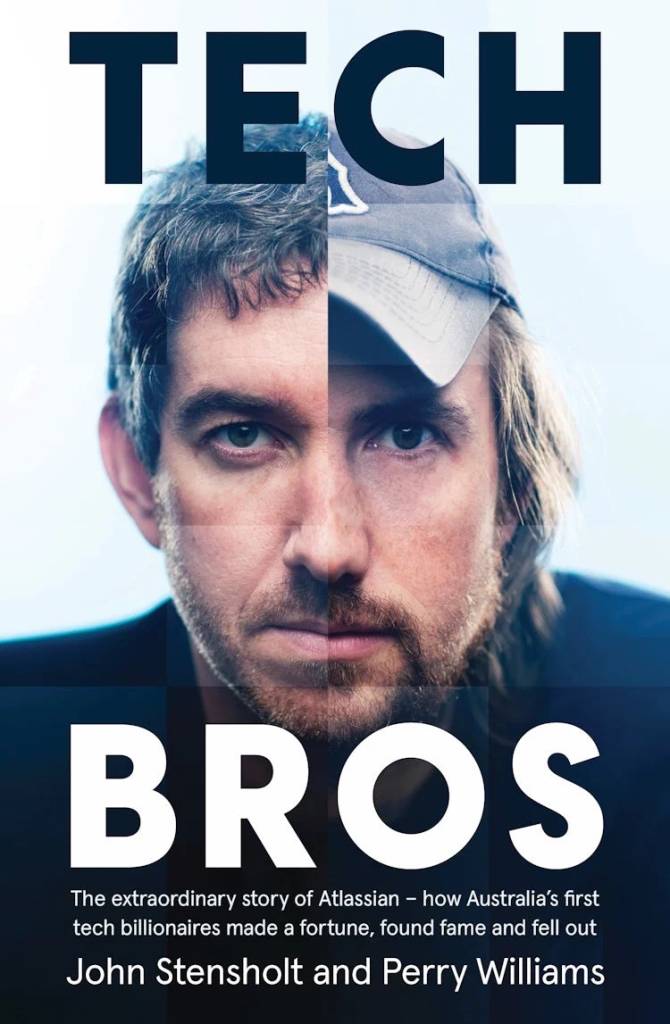
Tech Bros – The Extraordinary Story of Atlassian (HarperCollins, $36.99) is a solid account of the rise of one of Australia’s most successful global businesses and the eventual falling out between the founders.
But if you’re looking for startup inspiration, then this may not be the book for you.
Ahead of the review, I admit I approached John Stensholt’s and Perry Williams’ book with a touch of unease, worrying the book would be a hit job on the Atlassian founders as part of their employer’s culture wars due to Mike Cannon-Brookes and Scott Farquhar’s climate activism.
Fortunately, the authors largely resist that temptation and have written a comprehensive description of the company’s rise to become Australia’s top startup success and the founders’ falling out in recent years.
Atlassian’s rise deserves more colour
The book’s downfall, though, is its straightforward recital of the company’s growth – if you’re a business owner or founder looking to find inspiration from Atlassian’s growth, or insight into the task of building a business, then this book won’t deliver.
Similarly, although much of its promotion, particularly in its serialisation in The Australian, has focused on the falling out between the two founders, even here the story is largely third-hand and a little lifeless, and suffers from being written in The Australian’s stolid house style.
No doubt part of the disconnect is due to neither Mike Cannon-Brookes nor Scott Farquhar cooperating with the authors, something noted in the acknowledgments, but the failure to portray the times of the company’s founding and growth leaves the reader feeling they have missed something.
Atlassian’s 2002 founding came at a pivotal time for the technology and startup sectors as the industry crawled out from under the debris of the dot-com bust and, unknown to any of us at the time, would see extraordinary growth over the next twenty years.
Like Shopify, ServiceNow and Workday, which were all founded around that time, Atlassian stepped into the enterprise space and, along with survivors of the tech wreck such as Amazon, Google and Salesforce, grew exponentially.
Here in Australia, we also saw a huge change in the local scene as the tiny startup communities of the mid-2000s grew into the vibrant and vocal sector we have today.
Yet little of that atmosphere is captured in the book, with the early parts being too bogged down in the minutiae of the Sydney property market and the founders’ purchases of various houses and apartments.
It’s not unusual for founders to get bored as their companies grow, particularly given the minutiae of managing a global NASDAQ-listed corporation with its myriad of complex compliance and reporting rules. It’s just not fun compared to running a lean, mean startup.
One gets the sense – not articulated by the authors – that Cannon-Brookes and Farquhar’s property sprees and later ventures were more due to their boredom with running a sprawling enterprise, and missing that hurts the book.
We also miss the opportunity for some more colour about Cannon-Brookes, Farquhar and the city they call home.
Fundamental to that Sydney story are the founders’ different backgrounds from opposite sides of town and very different social strata, which is a thread through the book that never seems to come to life, despite an amusing anecdote about Mike Cannon-Brookes switching his rugby league allegiances from the dowdy Easts to the much more fashionable South Sydney Rabbitohs.
Lowlights as the highlight
Where the book does shine is in the internal politics of the fallout between the two founders. Both authors reported comprehensively on the saga at The Australian, the Financial Review and Bloomberg, and their sources allow them to provide a detailed account of the roles of senior staff and friends as the relationship soured.
Another strength of the book is the deep dive into Mike Cannon-Brookes’ ultimately successful bid to take control of AGL and the abortive SunCable venture with Twiggy Forrest, which is understandable given John Stensholt led the reporting of both corporate sagas in The Australian.
Both ventures add to the impression that Cannon-Brookes was looking for something more interesting than running a global software company, as also seen with Scott Farquhar’s ventures, where the book’s authors do indulge a justified News Corp pot-shot at him for his views on copyright at his disastrous speech to the National Press Club last year.
One key takeaway from the book was probably unintended by the authors in their account of the SunCable fight between Cannon-Brookes and Twiggy Forrest.
Describing the difference between Forrest and Cannon-Brookes as one being a technologist and the other an industrialist raises an interesting thought about what we’re now seeing with the AI boom as software companies find themselves confronting the hard, industrial engineering of building massive data centres.
Indeed, this difference between ‘technologists’ and ‘industrialists’ could tell us much about the future of the software industry, including Atlassian as the AI-driven ‘SaaS-pocalypse’ story continues to evolve.
A useful history, light on inspiration
Despite its lack of colour, the book is a good resource for understanding the rise of Atlassian and its market position as we enter the heady days of the late AI bubble.
For students of history, it will be a worthy reference regardless of how the fortunes of Mike and Scott stand up in coming years.
But, for those looking for an insight into building a business, there’s not a great deal in the way of lessons.
Indeed, one of the few management lessons in the book is the difficulty of importing the cut-throat US West Coast tech industry executive culture into a business like Atlassian that had been built on a laconic Australian philosophy of ‘don’t hire arseholes’ – something that probably drove many of the tip-offs the two authors received in their newsroom over the past five years.
For startup founders, if you’re after a genuine insight into the psyche of Mike Cannon-Brookes and Scott Farquhar, along with the challenges of building a global tech business, then the podcasts and interviews referred to in the index, particularly the 2021 Guy Raz How I Built This interview, will give you a better insight.
Overall, this is a good book if you’re looking for a straightforward account of how two young guys built one of Australia’s most successful global businesses, then gradually drifted apart as the company grew.
But if you’re after insight or inspiration on the challenges and successes of one of Australia’s most successful startups, then Tech Bros doesn’t quite hit the mark.
- Paul Wallbank is a communications expert, business journalist, and technology writer.