



Project governance is an important part of project management processes – even if it’s not the most exciting part of getting work done.
As a project manager, part of your role is shepherding the work through the project lifecycle. That means moving it on from idea to done and keeping it all on track as you go. Governance is a key part of that, and gate reviews are part of navigating through the project.
Gate reviews, or stage reviews are part of the PRINCE2® process, and also part of the UK Government’s National Infrastructure and Service Transformation Authority (NISTA) Project assurance review toolkit. Decision gates are part of empowering decision-making and ensuring the right people make the call as to whether a project progresses (or is closed).
They don’t really make an appearance in the PMBOK® Guide, although obviously it’s good practice to use a structured method of moving between phases.
What is a gate review?
A gate review is a control point that acts as a go/no go decision point for the work. It’s a formal governance step which provides assurance on the project that the required processes and tasks have been completed, and that it is worth continuing with the project.
Unlike a normal project status meeting, the purpose of a gate review is to make a decision. The reviewers should be working from agreed criteria and evidence, rather than simply hearing a progress update. If nothing (or no one) could realistically cause the project to stop, pause or change course, it isn’t much of a gate.
It’s the point where all stakeholders reaffirm their commitment to the work and approve the project to be moved forward into the next stage of work.
The ‘gate’ is the boundary between one project stage and another. Stage gates are most strongly associated with predictive lifecycles, where stages have clear boundaries. Agile approaches have ceremonies, norms and processes for moving work on and securing approvals to continue, but you can also use decision gates in agile and hybrid environments.
The difference is that you are normally authorizing investment, release, readiness or continued delivery rather than approving completion of a traditional waterfall phase. The NISTA assurance framework, for example, includes specific guidance for applying assurance reviews to agile digital delivery including that you need agile people on the review team (phew!).
You might hear them called stage gates, decision gates, toll gates, phase gates, gateway reviews, or just gates. For simplicity, and because the UK government uses the terminology of gate review, that’s what I’m going with in this article.
5 Benefits of gate reviews
The benefit of a stage gate is to make sure that the right projects are being worked on. It confirms that in-flight projects are:
- Still aligned to organizational strategy
- On track to deliver the forecasted benefits
- Still required by the business
- Still due to complete with the allocated funding
- Following good governance processes with adequate oversight.
The gate process also has other benefits for everyone involved:
1. Shorter planning horizon
It’s hard to predict the future. When you plan in project phases, you gain the benefit of only needing to do detailed plans for the next stage.
2. Risk management
Project risk can be re-evaluated, and that can provide useful information for the program or portfolio team. Risk levels input into the decision about whether the project should continue, and given that some teams are not as on top of project risk management as they should be, it serves as a handy reminder to focus on risks.
3. Stakeholder engagement
Getting people together to talk about the project is a way of reaffirming commitment, making sure they are still involved in the ways they want to be and keeping lines of communication open.
4. Expectation management
It serves as another point to reiterate what the project will do. For the project team, that’s a good way of identifying potential sources of conflict and making sure that everyone is on the same page. For example, highlighting if there is additional work required.
5. Increased confidence in delivery
I feel that the main benefit of gate reviews – having been involved in some in my time as a project manager – is that it increases everyone’s confidence that the project is going to be delivered successfully. As part of the project control processes, gate reviews should lead to a higher likelihood of project success.
The fact that there is some oversight and governance, plus project teams being held accountable for the delivery, seems to help structure projects and put some rigour around delivery. It makes phase transitions easier.
The stage gate process explained
Let’s say you work in a predictive environment and you have a defined project lifecycle with key decision points. There are gate reviews to jump through in order to keep your project moving, and your project sponsor very much wants that to happen. No one wants bureaucracy to slow their project down.
If your project is facing a gate review, then it’s highly likely you will also have a set of documents or expectations to complete in order to kick off the process and move the work on to the next stage.
The key here is the stages. You need to know what stages make up your project lifecycle. The gates open the door to each new stage.
The project lifecycle and stages
PRINCE2® requires at least two management stages: one to initiate the project and then however many you need after that to do the rest of the work. Your lifecycle might look a bit different.
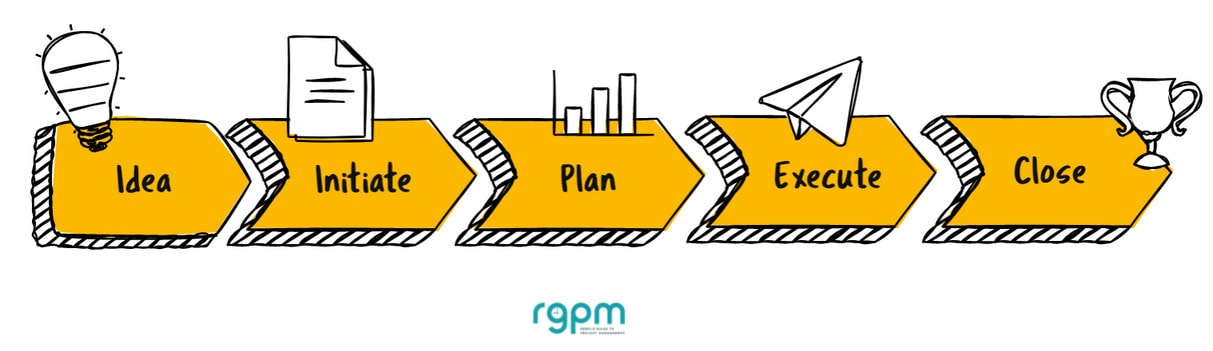
The phases of a typical predictive lifecycle are:
- Idea or concept phase
- Initiate
- Plan
- Execute
- Close
You might call them different things (some of our projects have a development phase, for example).
Gates allow you to transition between stages in a controlled way. In the diagram below, you can see that there’s a stage gate required to move to each new phase of the project.
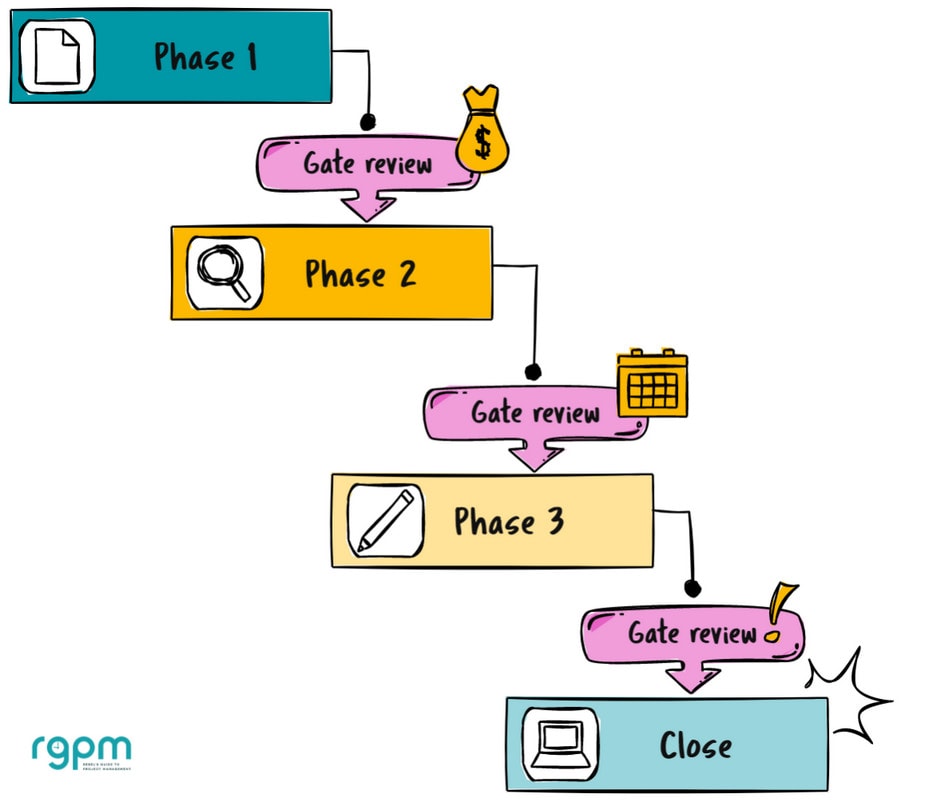
You might not need project gates to move between each stage. For example, on large projects, you would expect a certain amount of governance and rigor, especially considering the amount of money tied up in the work.
NISTA has the following gateway review stages, aligned to the requirements for larger, government-backed projects:
- Gate 0: Strategic Assessment
- Gate 1: Business Justification
- Gate 2: Delivery Strategy
- Gate 3: Investment Decision
- Gate 4: Readiness for Service
- Gate 5: Operations Review and Benefits Realisation.
But for smaller projects, you wouldn’t necessarily benefit from introducing gates for every point – it would feel like you’re in review meetings all the time.
As an example of a gate review process in action, for one of the projects I am running at the time I’m writing this, we have a governance point after the Business Case phase. That basically approves the business case and allows the team to move into kick off and planning. Then we don’t have another review point until we’re about to close.
Essentially, our gate process only requires approval to get the funding, commitment, resources etc, and after that the team can run with it. Obviously there are regular project board meetings and other governance checks, but the practical implication is that we have freedom of action for low value initiatives that are low risk and things we’ve done before.
So you can see that you can have different processes for different types of projects, as you see fit. The PMO will specify the route your project has to follow.
What are gate review criteria?
A useful gate should have criteria agreed before the meeting. Otherwise, the decision risks becoming subjective.
Entry criteria tell you whether the project is ready to come to the gate. For example, the business case has been completed, the latest forecast is available and significant risks have owners.
Exit criteria define what needs to be true before the project can progress. For example, funding is approved (or will be approved), resources are committed and the sponsor accepts the residual risks.
If the entry criteria are not met, consider postponing the review rather than holding a meeting simply to agree that the project isn’t ready.
Let’s look at what it looks like to prepare for a stage boundary (to use a PRINCE2® term) and take your project through the process.
Who attends a gate review?
The project manager normally prepares the evidence, so while you might attend, decision-making, as is normal at this level of approval in project management, sits above you. Depending on your governance structure, the decision-maker might be the sponsor, project board, portfolio board, investment committee or a PMO governance group.
- The project manager provides evidence/recommendation
- The sponsor owns the business justification
- The governance body makes or ratifies the decision.
Subject matter experts can attend to answer questions, but keep the decision-making group small enough to actually make a decision. In my experience, the PMO team will book the meeting and invite who they want, so you might be asked to advise on attendees but the invite will come from someone else’s calendar.
Example stage gate process
Each organization may implement a slightly different take on the stage gate approval process depending on your internal best practices. If you are new to the idea or thinking about implementing one for your PMO, here is an example so you can see how it works.
This is a sample gate process that could be followed at every gate point.
Step 1: Create decision-led documentation
The stage gate process is effectively a governance process, so that includes paperwork! The project manager will draft the necessary papers. These include the evidence the decision-makers to approve/deny the project passing through the gate, such as:
- A summary of progress to date
- A summary of expected progress/actions for the next stage
- The financial calculations required to back up any requests for funding for the next phase.
The evidence should answer the ‘exam question’ that the gate is testing, and some examples are in the table below.
| Question | Useful evidence |
|---|---|
| Is the project still worth doing? | Current business case, costs, benefits, strategic alignment |
| Can we deliver the next stage? | Schedule, resource commitments, dependencies |
| Is the risk acceptable? | Top risks, mitigations, residual risk |
| Are we ready to proceed? | Required approvals, deliverables and acceptance evidence |
| Has anything materially changed? | Scope changes, assumptions, external changes |
In other words, the project manager is asking for approval to continue with the project and asking for approval for the budget and resources to be made available.
The PMO will normally have a gate review template or checklist for this, whether that is a document or slide deck or some other format. Ideally, each project being taken through the stage gate process will use the same template for standardization. NISTA’s Gate 1, for example, includes a lot of evidence and questions around business case and strategic fit, as you’d expect from a project asking for approval to move into delivery.
You should also make sure that the rest of your project management documentation is up-to-date including:
- Project plan
- Business case
- Change requests that relate to the stage you have just finished
- Risk log
- Issue log
- Quality register.
Check what specific criteria are required to get the gate decision you want, which is normally, to ‘pass through the gate’.
Step 2: First document approval
The project manager shares the documentation with the rest of the project team, the project sponsor and any other key stakeholders who might have a say.
This is what you would normally do with project documents that are being sent up the chain for approval. No project sponsor wants to see a deck presented for the first time during a big meeting, and they want to know what is being said about their project (and, of course, it’s their project so they have a right to know!).
Step 3: Second document approval
Next, your internal authorization process kicks in. For example, this step could be that your project board or steering group formally confirms that the work has been completed as documented in the gate review papers.
This check ensures that the project doesn’t reach the gate review process too early – before the project has finished all the tasks from the last stage.
Step 4: Final decision
With confirmation of project progress and approved gate review documentation in hand, the project can go to whatever final, formal governance body will make the decision to move the project into the next stage. Or not, depending on the situation.
- This group could be:
- The PMO or Portfolio office
- A business strategy team
- An internal senior leadership forum supported by additional approvers
- Or any other group set up for the purpose.
This group will probably meet regularly to discuss several projects at once. They are not a project-specific group, but a forum that oversees project governance across the organization.
Step 5: Decision enacted
Finally, the project team acts on the decision that has been taken.
The outcomes from a gate review are:
- Go: The project proceeds to the next stage or phase
- Go with conditions: The project proceeds but is bound to complete certain actions or meet conditions e.g. approved but contingency funding line is stripped from the budget and the team must submit new forecast figures without the contingency (real example!)
- Hold/Return for review: The project is delayed or put on hold until some specified criteria are met e.g. a new schedule being produced, input gathered from another stakeholder etc, when it returns to the forum to try again. This could also include the project is changed in some way to better fit business needs or available funds e.g. scope items are removed or added.
- Stop: The project is moved to a premature close and effectively cancelled.
That may mean carrying on, raising purchase orders for the next set of spending, reviewing or redoing work if necessary before coming back to try to get through the gate again, or trying to salvage what you can before you close the project.
Ultimately, the point of the gate review in project management is to provide assurance that the project can and should continue to the next stage. If it is not clear that it should, this is the point to have conversations about what can be done to rescue the project or to close it.
What to cover in a gate review meeting
A stage gate review meeting can be quick and informal or a more formal process, depending on what is being approved and the level of governance required.
For a small, relatively easy project, the meeting might involve a short presentation from the project manager that confirms the latest project status, budget position, risks and timeline. The governance board can then approve that the work continues.
A more formal meeting might require more papers produced in advance. It might have to discuss changes to scope, time or budget and what impact that has on the viability of the project. More people may need to contribute to the conversation or provide approval, depending on which areas of the organization are affected by the change.
Either way, the gate review meeting should provide confirmation that:
- Continuing the project is the right thing to do
- The project is being run in the ‘right’ way (whatever that looks like for you)
- Resources are still available and committed (at least for the next stage)
- The organization is ready for the project to move to the next stage
- If things have changed, the review committee is happy that those impacts have been adequately considered.
How to implement the gate review process
So, you want to implement this approach within your PMO? Get the PMO leaders together and agree on your expectations and what project teams need to do.
Then, communicate it.
Honestly, it’s not difficult to put together a simple process and a checklist of things you want to see in order to release the project into the next phase. The hard part is in changing the culture of the organization to want to work this way, but as someone skilled in
When gate reviews don’t work (advice for PMOs!)
A gate adds little value if the decision has effectively been made before the meeting. If every project passes every gate, regardless of the evidence, you’ve created an administration checkpoint rather than a governance control.
Equally, don’t turn a gate into a document-completeness exercise. The question isn’t, “Have we filled in every template?” It is “Do we have enough evidence to make a sensible decision about continued investment?”
Your next steps
In this article, you’ve learned about what a gate review is, why we’d use it, how it fits into the project lifecycle, and how to get your project through the gate.
Things to do now:
- Read about why your project board isn’t working.
- Talk to your team about your internal gate process so you understand the specifics of how it works in your organization.
- Read the NISTA guidance on governance or check out what PRINCE2® has to say about managing stage boundaries.