



Google Ads will change its bidding system on August 17 to provide, it says, a more predictable performance. In fact, the changes could cause unpredictable swings.
Here is what’s changing and how to prepare.
When using target-based bidding — cost per acquisition or target return on ad spend — actual performance will now be closer to the goal. For example, Google will strive to hit an advertiser’s tROAS of 300% even if actual performance is 500%. A target bid strategy was supposed to always work in that manner. Google now states that hitting the goal is the priority.
Google says the change will impact only budget-limited campaigns, but I’m reviewing all of them.
Impact on Advertisers
Advertisers must first establish their own performance preferences.
Decide:
- Are targets for the entire account or individual campaigns?
- Are the targets absolute? Is a tROAS of 400% essential or only a best effort?
- Will individual campaign budgets change with the new bidding system?
To help with the transition, Google introduced a bid target adjustment tool that shows the current targets and recent performance.
In the example tool below, the target ROAS for the last campaign was 130.00%, but performance was 145.74%. The campaign is performing better than the target and, absent changes, will optimize downward to the 130.00% goal.
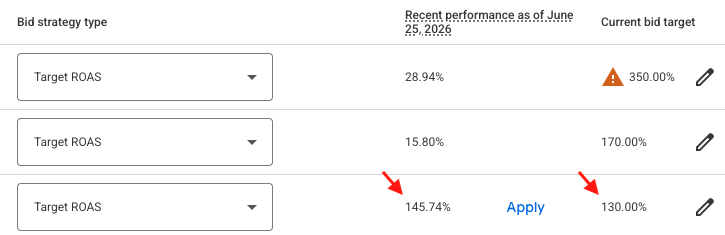
Google’s new bid target adjustment tool shows the current targets and recent performance. Click image to enlarge.
Google Ads suggests four options for advertisers.
Keep the target as is
Advertisers who accept the 145.74% ROAS declining to 130.00% require no action.
Maintain recent performance
Advertisers can increase the target if actual performance has exceeded it. This will align performance with targets. However, gradually increase the target if performance exceeds it by 20%. For example, if the recent ROAS is 200%, change the 130% target to no more than 156%. After two weeks, increase again, and so on. Experiment with the new system to learn.
Keep overall account performance in mind. An account-level ROAS goal could suffer if individual campaign targets remain as is. For example, a single campaign achieving a 500% return against a 300% goal will reduce the overall account ROAS after the system changes.
Adjust the custom target
A custom adjustment enables a specific target. A 300% target may be too low if 400% is a realistic performance. That scenario requires not a gradual change but a new 400% target.
Switch to maximize strategy
Switching strategy to maximize conversions or conversion value makes sense if the aim is to generate as many conversions or as much revenue as possible within a budget. Volume would likely increase as efficiency declines.