


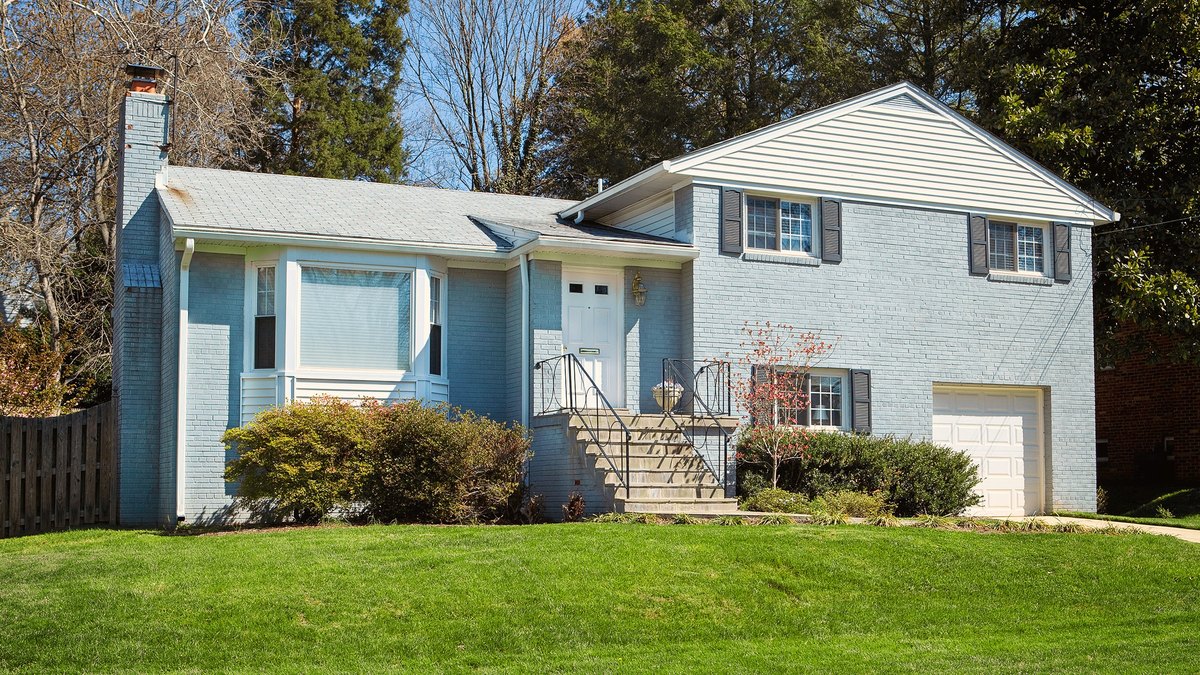
Those who grew up in a suburban neighborhood most likely have childhood memories where a split-level house serves as the backdrop.
Whether your family lived in one, you regularly visited a friend’s, or you simply watched enough episodes of “The Brady Bunch” to develop a positive association with half-staircases and sunken living rooms, this architectural choice is still a mainstay in many older, residential areas.
While this style of home may seem retro to some, modern life can also draw renewed interest in split-levels.
“Buyers want defined, separate spaces for remote work and school,” says Realtor.com® senior economist Hannah Jones.
“Their half-flight design naturally creates that separation, and their generally older age means they may be located in established, family-friendly neighborhoods and could be at a relative discount to newer builds.”
With that said, “Split-levels remain far from dominant, and their stairs and dated facades could still turn off some buyers,” Jones continues.
What are the most distinctive features of a split-level home?
While there are a few types of split-level homes, the most distinctive feature of this architectural style is a layout with at least three levels connected by short flights of stairs—rather than two or more standard stories with a full flight of stairs in between.
The number of levels—as well as the way in which they are visible from the outside—can vary.
Three or four levels creates a standard split-level, while five or six stories would be considered a stacked split-level.
In a side-split home, the levels can be seen from the front.
In a back-split home, the levels are obvious only when viewing from the side of the property. The front appears to be a single story, while the back reveals the additional levels.
In most cases, the front door will open to a landing or foyer, with easy accessibility to the formal dining and living spaces on the main floor. The kitchen is typically located on this level, as well.
The upper level holds the bedrooms and bathrooms, while the lowest level may house a casual living space, finished basement, utilities, or even an additional bedroom or den. If the home connects to a garage space, the entrance will likely be located here, too.
The unique layouts of these homes are also commonly accompanied by other design elements, such as visually interesting asymmetrical silhouettes and low-pitched roofs. The exterior facades may combine a variety of materials such as wood siding mixed with stone or brick.
Split-level homes also tend to boast bay windows or wide picture windows to fill the main floor with natural light, while the upper and lower levels may include apertures in assorted sizes.
When was the first split-level home designed?
Frank Lloyd Wright’s 1923 Storer Mansion is often regarded as the first split-level American home. Wright’s 1908 Isabel Roberts house is also sometimes considered to be the first.
The Storer Mansion was designed with half-staircases and staggered stories to work around the uneven plot of land it was built on.
But the Mayan-revival Hollywood Hills estate—constructed of concrete textile blocks and commissioned by Dr. John Storer—looks very different from the suburban split-level houses that most families are familiar with today.
The style gained traction during the post-World War II housing boom of the 1950s and 1970s, serving as a cost-efficient way to offer more space and build on lots that might otherwise need a costly excavation.
Where are the best places to find split-level homes?
For homebuyers on the search for split-level homes, suburban towns—particularly in locations that experienced rapid postwar growth—are a great place to look.
How have split-level homes changed over the years?
After soaring in popularity, split-level homes lost appeal in the 1970s and 1980s, when homeowners began to opt for sprawling open-concept homes.
Popular renovations of split-level homes may include kitchen remodels to make the space feel larger and more connected to other areas in the home, or additions to the upper story to create a larger primary suite.
Why do people buy split-level homes?
Split-level homes are a fantastic way to save money by working around a sloped property, or including more square footage than a lot may allow for with a traditionally leveled home.
Even those who do not wish to build a split-level from the ground up will find that this style of home may come with a lower price tag.
This architecture style is particularly useful for large or multigenerational families, as it offers separation between living spaces. The bedrooms are typically located on a quieter, more private upper level, while the chaos of everyday living tends to be contained to the dens and casual spaces down below.
Because both emerged in the postwar era, split-level and midcentury modern homes share a similar style, and the latter remains a highly sought-after aesthetic to this day.
Get real estate news in your inbox