


Construction costs are one of many metrics that a construction firm has to keep an eye on when executing projects. There are others, of course, such as the schedule, quality, safety and much more. But if the construction cost goes over budget, that’s coming out of the contractor’s pocket, putting profitability margins at risk.
That’s why construction cost management is so important. Knowing exactly what construction cost management means and what construction costs are there can be the difference between project success or failure. We’ll go over those definitions and explain the construction cost management process so you can manage projects better.
What Is a Construction Cost?
A construction cost is any expense required to plan, build and deliver a construction project. It includes direct costs such as labor, materials and equipment, along with subcontractor fees and contractor overhead. Construction costs also cover systems and components like structural work, interior finishes, plumbing, electrical and mechanical installations. In practice, construction costs represent the total financial resources needed to complete the physical scope of work.
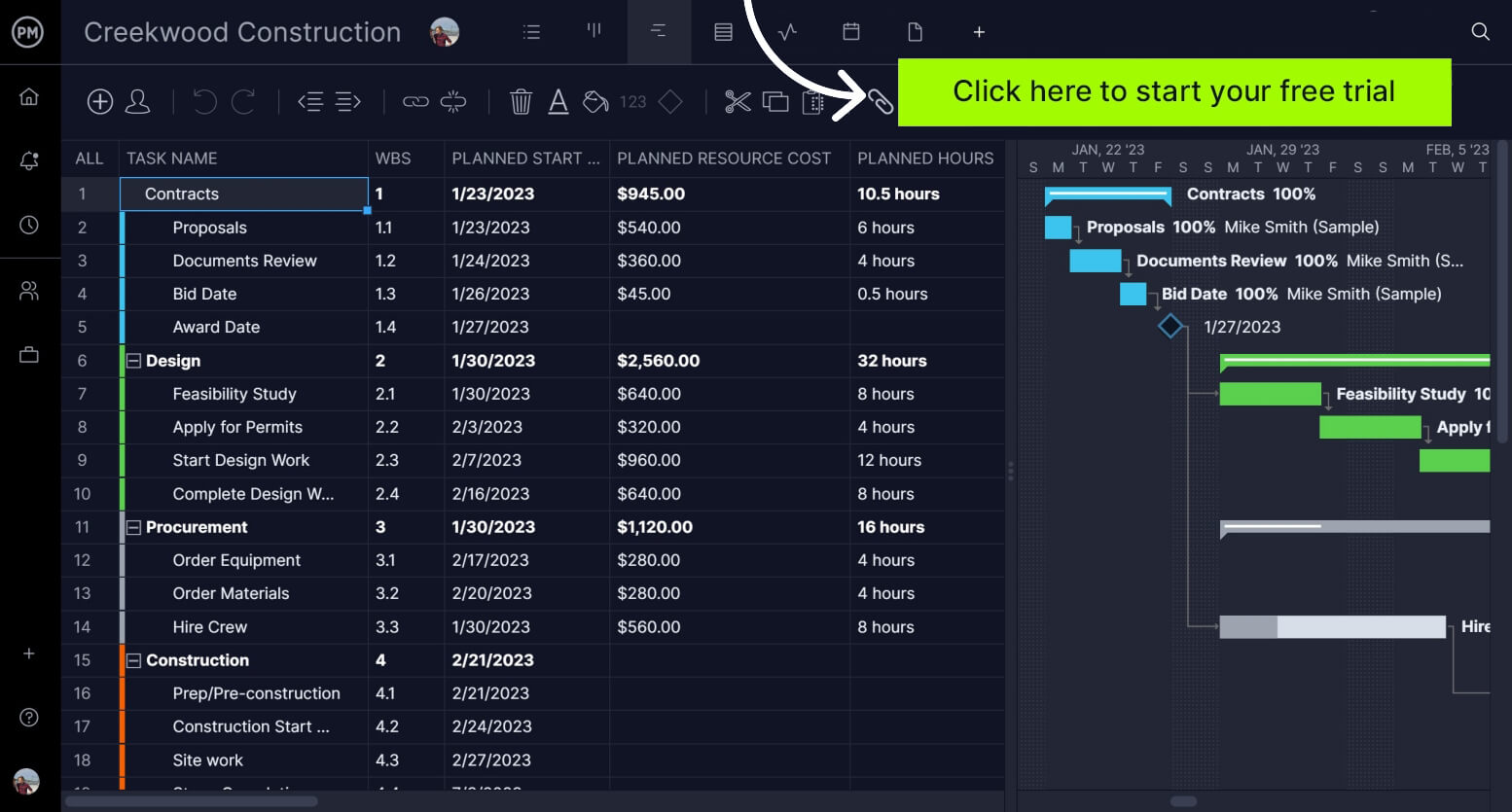
ProjectManager is award-winning construction project management software that gives construction companies the tools they need to ensure that the projects are completed on time, under budget and within scope. Get all construction costs accounted for when planning with our powerful Gantt chart. You can allocate project resources, estimate costs, set a cost baseline and then track your planned costs against your actual costs with real-time dashboards and reports to quickly catch any overspending. Get started with ProjectManager today for free.
What Is Construction Cost Management?
Construction cost management is the process of keeping projects on budget by estimating construction costs, establishing a cost baseline and a construction budget, monitoring and forecasting costs as projects unfold and reporting on spending to internal and external project stakeholders.
In addition to these core construction cost management steps, ensuring the project is executed as planned is also a way of controlling costs for construction firms, because in the vast majority of cases delays cause overcosts from resource utilization and also from contractual dispute fees.
Why Is Construction Cost Management Important?
For both the general contractor and the project owner, construction cost management directly determines whether a project becomes financially successful or painfully over budget. Contractors rely on construction cost management to protect profit margins, control cost overruns, manage cash flow and keep subcontractor spending aligned with the project budget.
At the same time, owners depend on construction cost management to safeguard their capital investment, validate funding decisions and ensure that total construction costs remain consistent with the approved scope and financial expectations.
From the earliest concept sketches to final closeout, construction cost management influences every phase of a construction project. During preconstruction, it shapes value engineering decisions and aligns the design with the available budget. As procurement begins, it guides subcontractor selection and contract negotiation. Once work starts, it drives cost tracking, change order evaluation and cost forecasting. Even material specifications and sequencing decisions affect construction costs, making construction cost management a continuous discipline rather than a single budgeting exercise.
On top of all of that, good construction cost management will give your company a positive reputation in the industry. Property owners without exception prefer to work with general contractors who are proactive, efficient and accurate with construction cost management.
Who Is Responsible for Construction Cost Management?
On the contractor’s side, the project manager is ultimately responsible for construction cost management during execution. While estimators may prepare the initial pricing, the project manager owns the project budget once work begins. This role is accountable for cost tracking, cost forecasting, change order evaluation and protecting profit margins. If construction costs exceed the approved budget, the project manager is the person expected to explain why and implement corrective action.
On the owner’s side, responsibility typically rests with the owner’s representative, development manager or commercial manager overseeing the capital investment. This role ensures that construction cost management aligns with funding approvals and financial objectives. The owner’s representative reviews cost reports, evaluates change orders and monitors cost forecasts to protect overall return on investment and ensure total construction costs remain consistent with the approved scope and funding structure.
Besides those two key roles who are held accountable on both the contractor’s and the property owner’s sides, there are other roles that also participate in the construction cost management process. Here’s how they’re involved.
- Estimator: The estimator plays a central role during construction takeoff and construction estimating by quantifying scope, applying unit pricing and developing the initial cost estimate that forms the basis of the construction budget.
- Quantity Surveyor (QS): The quantity surveyor supports construction cost management by preparing bills of quantities, validating cost breakdown structures, reviewing subcontractor pricing and assisting with cost forecasting and interim payment evaluations.
- Project Controls Manager: The project controls manager integrates cost tracking, cost forecasting and schedule performance data, ensuring that construction cost reporting reflects accurate projections and measurable financial performance trends.
- Superintendent: The superintendent influences construction cost management during execution by managing labor productivity, sequencing activities efficiently and controlling field decisions that directly affect construction costs and cost variances.
- Procurement Manager: The procurement manager contributes to construction budgeting and cost control by negotiating subcontractor agreements, issuing purchase orders and managing committed costs before they become actual expenditures.
- Controller or Cost Accountant: The controller supports construction cost tracking and reporting by recording actual construction costs, reconciling invoices, maintaining financial records and preparing formal cost reports for stakeholders.
- Architect or Design Engineer: The architect or design engineer influences construction cost management during preconstruction through value engineering decisions, material specifications and scope clarification that directly impact projected construction costs.
Construction Cost Management Process: How to Manage Construction Costs
Now that we’ve defined the concept of construction cost management, let’s dive deeper into each of its major stages for a thorough understanding of this process.
1. Value Engineering
During the development of architectural drawings, blueprints and CAD models, architects and engineers begin influencing construction costs through value engineering. This process evaluates materials, systems and design alternatives to achieve the required performance at the lowest reasonable cost. Within construction cost management, value engineering ensures that design decisions align with the project budget before procurement and construction begin.
2. Construction Takeoff
Construction takeoff is the systematic process of reviewing drawings and specifications to measure and quantify the full project scope. It generates the detailed quantity data used to support pricing, budgeting and cost control. Within construction cost management, construction takeoff ensures that projected construction costs are grounded in verified scope measurements rather than assumptions.
Key construction takeoff tools and deliverables
- Quantity Takeoff: Quantity takeoff is the detailed measurement of all work items shown in the drawings, organized by trade and scope section. By establishing precise counts, areas and volumes, it creates the measurable basis required for reliable pricing and prevents scope gaps in the construction takeoff process.
- Material Takeoff: Material takeoff focuses specifically on calculating the quantities of construction materials required to execute the project as designed. It supports construction takeoff by translating scope measurements into procurement-ready data that improves cost accuracy and reduces waste during purchasing.
- Takeoff Summary Sheet: A takeoff summary sheet consolidates all quantified work items and material quantities into a structured, organized overview. It strengthens construction takeoff by centralizing measured data, enabling estimators to review totals quickly and validate that no scope elements have been overlooked.
3. Construction Estimating
Construction estimating converts quantified scope into projected construction costs using current market pricing, labor productivity assumptions and construction methods. It builds the financial model that defines how much the project is expected to cost before execution begins. Within construction cost management, construction estimating transforms measured data into a structured cost estimate that supports bidding, budgeting and financial approval.
Key construction estimating tools and deliverables
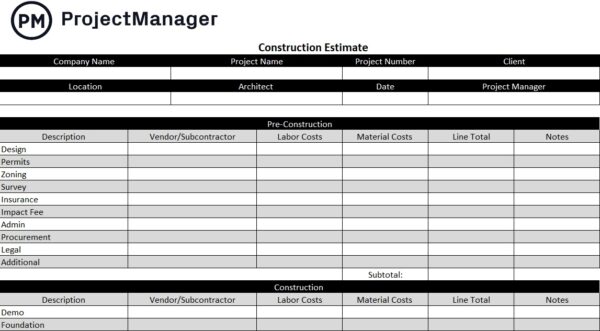
- Detailed Cost Estimate: A detailed cost estimate itemizes projected construction costs by trade, activity or cost code based on quantified scope and pricing assumptions. It contributes to construction estimating by organizing all cost components into a transparent structure that can be reviewed, validated and adjusted before final approval.
- Construction Cost Breakdown Structure (CBS): A construction cost breakdown structure organizes estimated construction costs into hierarchical categories aligned with project scope and cost control requirements. It strengthens construction estimating by structuring data in a way that supports comparison, analysis and future cost tracking during project execution.
- Subcontractor Bid Tabulation: Subcontractor bid tabulation is the structured comparison of submitted trade bids against defined scope requirements and pricing criteria. It supports construction estimating by identifying competitive pricing, scope gaps and qualification differences before contracts are awarded and costs are committed.
- Unit Pricing: Unit pricing assigns a cost per measurable unit of work, such as per square foot, cubic yard or linear foot, based on labor, materials and productivity. It contributes to construction estimating by enabling consistent cost calculations and simplifying adjustments when quantities change.
- Pricing Worksheet: A pricing worksheet is a structured calculation document used to compile labor, material, equipment and subcontractor costs into a consolidated estimate. It enhances construction estimating by documenting assumptions, markups and calculations in a clear format that supports review and verification.
4. Construction Budgeting
Construction budgeting translates the approved cost estimate into an actionable financial plan structured around cost codes, project phases and the project timeline. It allocates projected construction costs to specific trades and activities so spending can be controlled during execution. Within construction cost management, construction budgeting establishes the financial boundaries that guide cost tracking, cost forecasting and overall cost control.
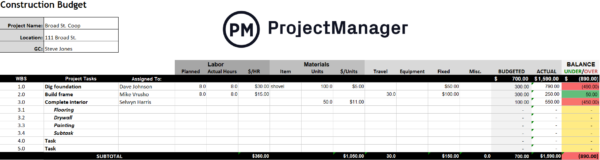
Key construction budgeting tools and deliverables
- Cost Baseline: A cost baseline is the formally approved version of the construction budget that defines planned construction costs across the project timeline. It supports construction budgeting by providing the fixed reference point used to measure cost variances and evaluate financial performance during execution.
- Construction Budget: A construction budget is the structured allocation of projected construction costs across cost codes, trades and phases of work. It contributes to construction budgeting by defining authorized spending limits and aligning financial resources with the approved project scope and schedule.
- Schedule of Values (SOV): A schedule of values is a detailed breakdown of the contract sum into line items that correspond to defined portions of the work. It strengthens construction budgeting by linking budgeted amounts to progress billing, enabling controlled cash flow and accurate payment applications.
- Contingency Allocation: Contingency allocation is the planned distribution of reserved funds set aside to address unforeseen conditions or scope changes. It supports construction budgeting by protecting the project budget from unexpected cost impacts while maintaining financial flexibility.
- Cash Flow Forecast: A cash flow forecast projects when construction costs will be incurred and paid throughout the project timeline. It enhances construction budgeting by aligning spending patterns with funding availability and ensuring liquidity during project execution.
5. Construction Cost Tracking
Construction cost tracking records and monitors actual construction costs as work progresses, comparing them against the approved budget and cost baseline. It captures labor, materials, subcontractor invoices and other project expenses at the cost code level. Within construction cost management, construction cost tracking provides the financial data needed to identify cost variances, protect profit margins and maintain control over total construction costs.
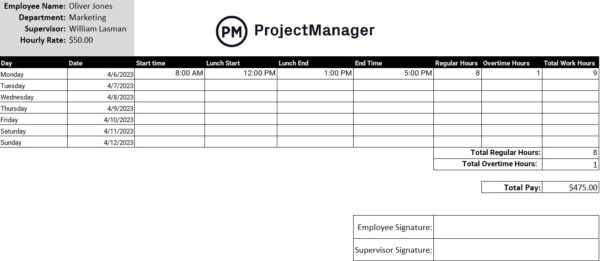
Key construction cost tracking tools and deliverables
- Timesheets: Construction timesheets document labor hours worked by employees and crews on specific cost codes and activities. They support construction cost tracking by linking payroll expenses to defined scope items, enabling accurate labor cost allocation and productivity analysis.
- Construction Retainage: Construction retainage is a portion of contract payments withheld until defined project milestones or completion requirements are met. It contributes to construction cost tracking by managing cash flow, documenting withheld amounts and reflecting accurate payable balances throughout execution.
- Cost Variance Analysis: Cost variance analysis compares actual construction costs to budgeted amounts at the cost code or phase level. It strengthens construction cost tracking by identifying deviations, quantifying overruns or savings and supporting corrective financial decision-making.
- Change Order Log: A change order log is a centralized record of all approved and pending scope modifications that impact construction costs. It enhances construction cost tracking by documenting cost adjustments, tracking financial exposure and maintaining alignment between scope changes and budget revisions.
- Purchase Orders: Purchase orders are formal commitments issued to suppliers or subcontractors specifying scope, pricing and delivery terms. They support construction cost tracking by recording committed construction costs and providing documentation for invoice verification and budget control.
6. Construction Cost Forecasting
Construction cost forecasting projects the expected final construction costs of a project using actual cost data, committed expenditures and the value of remaining work. It analyzes performance trends, cost variances and identified risks to determine the projected cost at completion. Within construction cost management, construction cost forecasting provides forward-looking financial visibility that supports strategic adjustments before cost overruns materialize.
Key construction cost forecasting tools and deliverables
- Earned Value Management Metrics: Earned value management metrics integrate scope, schedule and cost data to measure project performance against the approved cost baseline. They contribute to construction cost forecasting by quantifying cost efficiency and performance trends that inform projections of final construction costs.
- Estimate at Completion (EAC): Estimate at completion represents the projected total construction costs of a project based on current performance and remaining scope. It supports construction cost forecasting by providing a calculated prediction of the final cost outcome used for financial planning and corrective action.
- Cost to Complete (CTC): Cost to complete calculates the remaining construction costs required to finish all outstanding work at current performance rates. It strengthens construction cost forecasting by isolating future spending expectations and refining projections of total cost at completion.
- Trend Analysis: Trend analysis evaluates historical cost performance data to identify patterns in cost growth, productivity or budget variance. It enhances construction cost forecasting by revealing recurring financial behaviors that influence projected construction costs and overall cost stability.
- Margin Forecast: A margin forecast projects the expected profit or loss on a construction project based on forecasted final construction costs and contract value. It contributes to construction cost forecasting by linking cost performance to profitability and informing executive financial decisions.
7. Construction Cost Reporting
Construction cost reporting organizes and presents financial performance data related to construction costs in a structured, consistent format. It compiles budget figures, actual expenditures, cost variances and forecasted outcomes for review by project teams and stakeholders. Within construction cost management, construction cost reporting formalizes financial oversight and ensures that decision-makers understand both current cost performance and projected financial results.
Key construction cost reporting tools and deliverables
- Monthly Cost Report: A monthly cost report summarizes budget status, actual construction costs, cost variances and forecasted totals for a defined reporting period. It supports construction cost reporting by providing recurring financial visibility and documenting performance trends over the project timeline.
- Job Cost Report: A job cost report details construction costs incurred by cost code, trade or work package throughout project execution. It contributes to construction cost reporting by offering granular financial insight that supports variance analysis and cost control decisions.
- Budget vs Actual Report: A budget vs actual report compares planned construction costs against recorded expenditures at the cost code or project level. It strengthens construction cost reporting by clearly identifying deviations and quantifying financial performance against the approved budget.
- Cash Flow Report: A cash flow report tracks the timing of incoming and outgoing project funds relative to construction costs and billing cycles. It enhances construction cost reporting by aligning financial performance with liquidity management and funding requirements.
Types of Construction Costs
Construction projects generate multiple categories of construction costs, each affecting budgeting, cost estimating and overall construction cost management performance in different ways. The primary types are outlined below.
Construction Hard Costs
Construction hard costs represent the expenditures required to physically build the project as defined in the construction drawings and specifications. These costs are directly tied to transforming design documents into a completed structure. In construction cost management, hard costs form the core of the project budget because they reflect the measurable work installed in the field and the tangible progress achieved on the jobsite.
Construction Soft Costs
Unlike hard costs, construction soft costs relate to the planning, coordination and compliance activities necessary to deliver the project but not to physically construct it. They arise from professional services, regulatory requirements and financial arrangements that enable the work to proceed. Within construction cost management, soft costs must be forecasted carefully because they accumulate across the project lifecycle and significantly influence total construction costs.
Claims and Delay Costs
Claims and delay costs arise when a construction project experiences disruptions that extend the project timeline or alter the agreed scope of work, triggering contractual compensation mechanisms. These costs are typically tied to schedule impacts, lost productivity or disputed responsibilities between parties. Within construction cost management, claims and delay costs must be documented, analyzed and evaluated carefully, as they can significantly increase total construction costs and affect project profitability.
Direct Construction Costs
Direct construction costs are expenses that can be clearly assigned to a specific construction activity, work package or cost code within the project budget. They are incurred solely because a defined portion of the scope of work is being executed. Effective construction cost management relies on accurately identifying direct construction costs, since they drive cost tracking, earned value calculations and precise cost control at the task level.
Here are some examples of direct construction costs:
- Labor costs
- Material costs
- Equipment operating costs
- Subcontractor costs
- Specialty contractor services
Indirect Construction Costs
Indirect construction costs support overall project execution but cannot be traced to a single unit of work or specific activity. They enable the jobsite to function as an integrated operation rather than as isolated tasks. From a construction cost management perspective, indirect construction costs require disciplined cost allocation methods to ensure that shared project resources are properly accounted for within total construction costs.
Here are some examples of indirect construction costs:
- Superintendent salary
- Site office trailer costs
- Temporary utilities
- Safety program costs
- Site security
Fixed Construction Costs
Fixed construction costs are expenditures that remain constant over a defined period regardless of production output or work volume. Their value does not fluctuate based on installed quantities or daily progress. In construction cost management, understanding fixed construction costs is essential for accurate cash flow forecasting, since these obligations continue even when productivity slows or project timelines shift.
Here are some examples of fixed construction costs:
- Equipment lease payments
- Builder’s risk insurance
- Performance bond premiums
- Salaried project management staff
- Software subscription costs
Variable Construction Costs
Variable construction costs change in direct relationship to the level of construction activity performed. As project production increases or decreases, these costs rise or fall proportionally. Managing variable construction costs is a central function of construction cost management because they directly impact unit rates, cost forecasting accuracy and the financial outcome of the project as scope quantities evolve.
Here are some examples of variable construction costs:
- Hourly craft labor
- Concrete quantities
- Structural steel tonnage
- Fuel consumption
- Equipment rental by usage
Overhead Construction Costs
Overhead construction costs represent the ongoing operational expenses required to run a construction business that are not attributable to a specific project task. They exist independently of individual contracts but must ultimately be recovered through project pricing. In construction cost management, properly accounting for overhead construction costs ensures that bid estimates, markups and profit margins reflect the full cost structure of the organization.
Here are some examples of overhead construction costs:
- Corporate office rent
- Executive salaries
- Accounting services
- Marketing and business development
- IT infrastructure costs
Construction Cost Management Templates
We’ve created dozens of free construction project management templates for Excel, Word and Google Sheets. Here are some of them that can help with construction cost management.
Cost Breakdown Template
A cost breakdown template organizes project scope, resources and budgeted costs into structured categories, allowing teams to compare estimated and actual expenses, calculate cost variance and maintain clear financial visibility throughout construction cost management.
Schedule of Values Template
A schedule of values template breaks the total contract value into detailed work items, tracking progress, percent complete, retainage and stored materials to support payment applications, cash flow control and accurate construction cost management.
Budget Dashboard Template
A budget dashboard template consolidates material, labor, equipment and overhead construction costs into visual charts and summaries, enabling real-time budget tracking, variance analysis and improved financial decision-making within construction cost management.
ProjectManager Has Construction Cost Management Tools
ProjectManager is award-winning construction project management software that helps you plan, manage and track your construction costs in real time. When you create a project in our software, you can set the budget or set it anytime you want. There are two types of costs, resource costs and general costs, both can be tracked as planned and actual costs. General contractors can plan out their projects on Gantt charts that track costs and resources, setting a baseline to monitor project variance in real time.
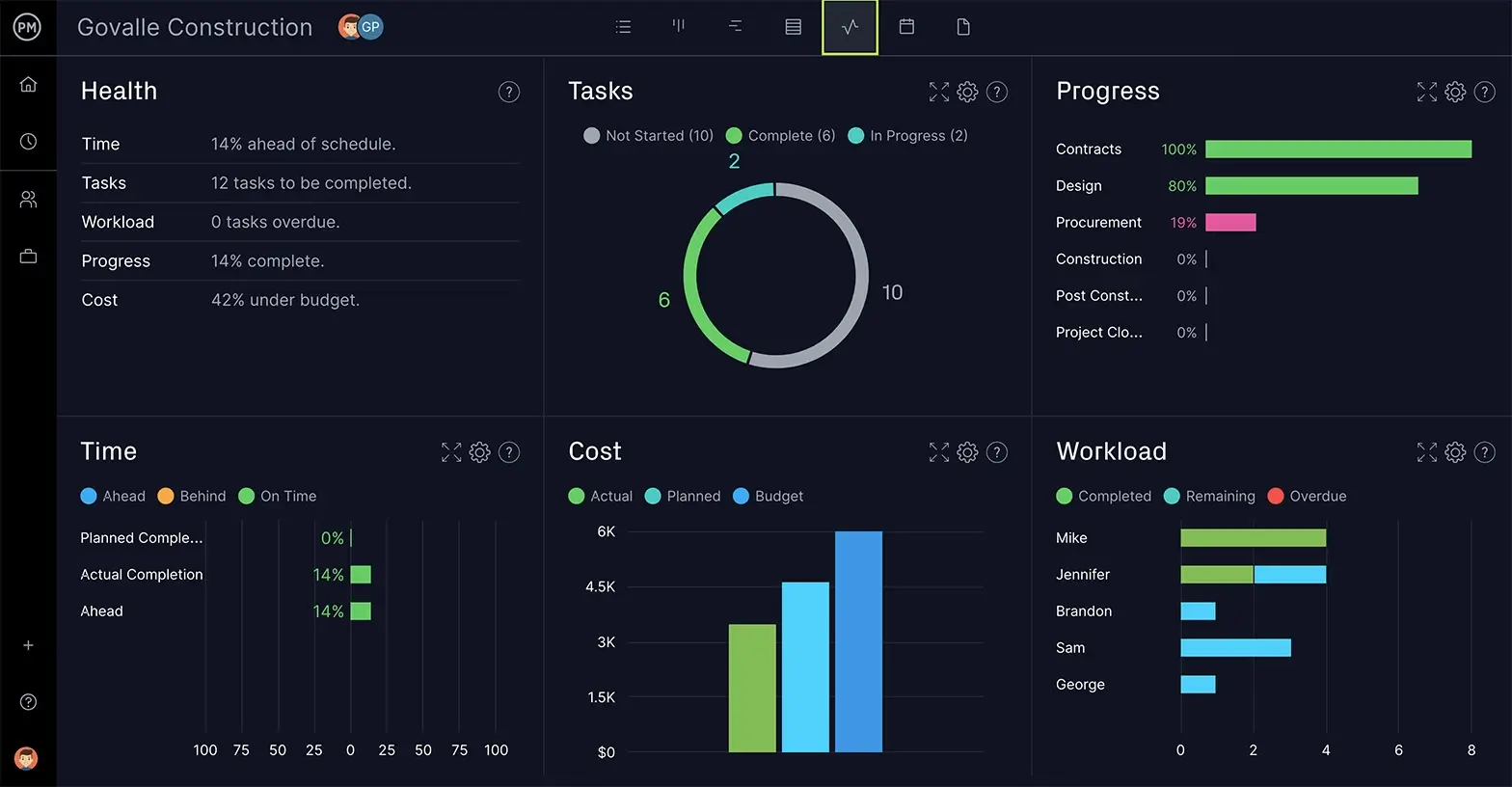
Track Construction Costs With Real-Time Project Dashboards
Once you’ve set a baseline on the Gantt chart, you can track live costs throughout the software. If you want to get a high-level view of the project, just toggle over to the dashboard, which automatically collects real-time data and displays it on easy-to-read graphs and charts. Besides a cost chart that shows live actual and planned costs, there are time, workload and other metrics to keep you updated on progress and performance. Unlike lightweight tools, you don’t have to waste time setting up our dashboard. It’s ready to go when you are.
Use Multiple Reports to Manage Construction Costs
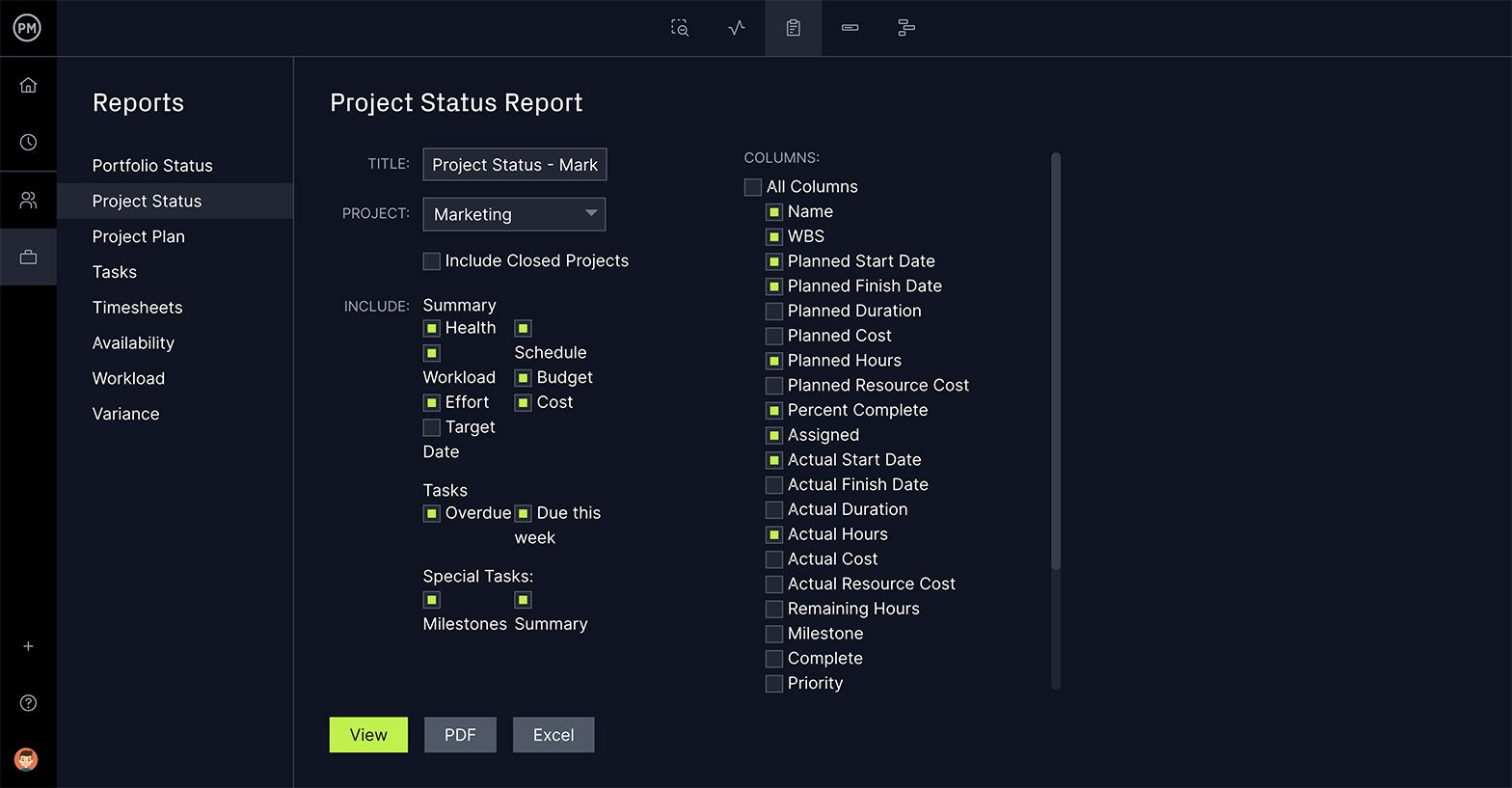
We offer several reports available that help you manage and track construction costs. If you’re managing more than one project, use our portfolio status report, which has a color-coded cost column to see if you’re over or under budget at a glance. Use our project status report for the same cost details for one project. If you want to see tasks about your work breakdown structure (WBS), generate a project plan report to see the budget and costs spent to date. Drill down into specific tasks with our task report and track planned and actual costs and resource costs. There are more reports, and all are customizable to show only the data you want to see. They can be easily shared across platforms and even printed for stakeholder presentations.
Construction cost management is only one part of construction project management. Our software covers all those bases, from task and resource management to keep your crew working at capacity to risk management that identifies and tracks issues until they’re mitigated. We’ll help you deal with project cost, cost planning and project cost control and everything else you need to deliver a successful project.
Related Content
ProjectManager is online construction project management software that empowers teams to plan, manage and track their projects in real time. We connect architects and engineers in the office with your work crew on the job site so they can share files and comments to foster better collaboration. Get started with ProjectManager today for free.