


Welcome to FT Asset Management, our weekly newsletter on the movers and shakers behind a multitrillion-dollar global industry. This article is an on-site version of the newsletter. Subscribers can sign up here to get it delivered every Monday. Explore all of our newsletters here.
Does the format, content and tone work for you? Let me know: harriet.agnew@ft.com
Two scoops to start: Millennium Management is talking with Goldman Sachs’ Petershill Partners to identify potential buyers for a minority equity stake in Millennium’s management company, the latest iteration of the institutionalisation of Izzy Englander’s hedge fund.
And BlackRock, the world’s largest asset manager, is ordering senior managers to return to the office five days a week in another sign that large financial services groups are tightening their flexible working policies.
In today’s newsletter:
-
Milken mission: Trump dispatches Bessent to calm the financial elite
-
Pimco: Investors are misjudging Donald Trump’s resolve on tariffs
-
Rush of copper to US because of tariff threat creates shortages in continental Europe
‘The most self-censored Milken conference . . . ever’
Keeping the titans of Wall Street on side is critical for Donald Trump as he looks to execute his trade agenda.
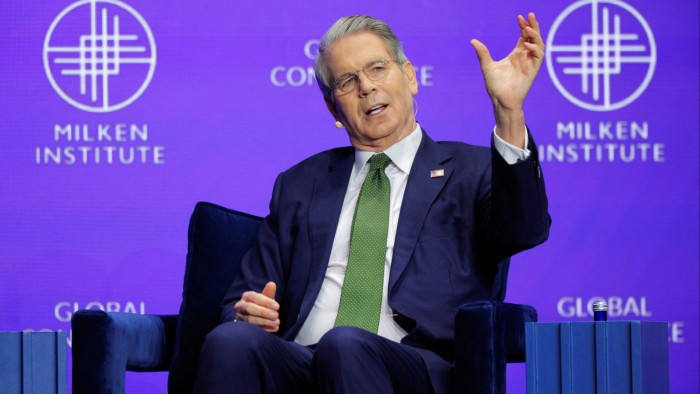
And perhaps nowhere is there a greater concentration of them than at the annual Milken Institute conference in Beverly Hills.
Enter stage left: Scott Bessent. As my colleagues report in this dispatch, the US Treasury secretary was much in evidence at the event last week. His mission? Hammer home to investors that the president and his team had a playbook to jump-start growth and strike new deals with the country’s most important trading partners.
“Scott Bessent is here to tell everyone that everything is fine,” said Mathieu Chabran, co-founder of private investment group Tikehau Capital. “He is aware that there are outflows and foreign investors are not rolling like they used to.”
The reception was not always warm. At a private dinner at Wolfgang Puck’s Spago restaurant, where Bessent was joined by former Treasury secretary Steven Mnuchin, attendees were taken aback when Mnuchin interrupted an investor warning they might pull back from the US if the tariff plans went fully into effect. Mnuchin fired back: where else could they invest with the same opportunities?
In private gatherings, executives hit out at the administration’s approach to trade policy, warning it would hamstring American businesses and fail to deliver on its deficit-reduction targets. In public, however, few would criticise the president, fearful of retribution.
“This is the most self-censored Milken conference I have ever been to,” one asset management executive said.
“It has an unsettled quality to it,” added the founder of a credit investment firm. “People are steeling themselves in a tentative way. Last year the mood was go, baby, go. There’s no go, baby, go this year.”
Meanwhile Wall Street banks say they are seeing signs that investors managing trillions of dollars of assets are starting to trim their US positions, on concerns over erratic policymaking, Trump’s attacks on the Federal Reserve chair and the fallout from the trade war.
The dumping of US assets in favour of Europe’s resurgent markets signals the start of a much longer-term move by pension funds and other big institutional money managers to cut back their huge exposure to dollar investments, say investors.
Why Pimco thinks Wall Street should ‘believe’ the president’s tariff threats
Investors are underestimating Donald Trump’s resolve to restore the steep tariffs that upended markets last month, bond giant Pimco has warned, as its investment chief said recession risks were now the highest in years.
“Believe Trump. He believes in tariffs,” Dan Ivascyn, chief investment officer at Pimco, said in an interview with the Financial Times alongside chief executive Emmanuel Roman.
Trump imposed “reciprocal” levies on many major trading partners at his “liberation day” event on April 2, a move that sent US equities and some corporate debt reeling. The president’s decision a week later to pause the levies on most trading partners for 90 days calmed markets, with the S&P 500 share index reversing the plunge triggered by the announcement.
However, Ivascyn said investors were mistaken to think Trump’s levies would be completely withdrawn or less forceful than previously announced.
“People still believe that there are going to be off-ramps [to tariffs], and that we are going to get back to something that feels a bit more like it did pre-‘liberation day’,” he added. “We’re not so sure.”
Still, Ivascyn noted that “we do think that we’re going to see lower ultimate tariff rates”, saying the $2tn asset manager would look closely at how Trump calibrated his policies based on the reaction of markets and policymakers such as those at the Federal Reserve.
Ivascyn also said the levies could lead to “a more ‘stagflationary’ scenario [with] higher price levels at a time where you see [the economy] slowing”.
“We very well may have a recession,” he added. “The probabilities are the highest they’ve been in a few years.”
Ivascyn’s comments came as the Fed on Wednesday warned that Trump’s policies had increased uncertainty over the outlook for the world’s biggest economy and could increase inflation and unemployment.
Pimco has been cautious about allocating to economically sensitive areas of markets, with Ivascyn noting that in corporate debt there was “a lot of the froth or complacency”.
“We continue to be defensive there,” Ivascyn said.
Chart of the week

The rush to get copper into the US ahead of possible tariffs has created shortages and price dislocations for the red metal in continental Europe, writes Camilla Hodgson in London.
The region’s spot market has been hit by a lack of available copper for immediate delivery, analysts at Argus Media said.
This has pushed premiums to record highs on the continent, which are paid on top of benchmark prices on the London Metal Exchange, Europe’s biggest hub where much of the stocks are stored.
The premium for copper delivered to Germany rose to $250 per tonne, while those to Livorno and Rotterdam hit $180 per tonne at the end of April, according to data group Fastmarkets.
Although markets have calmed since US President Donald Trump’s “liberation day” announcement, the record premiums highlight the persisting distortions caused by the threat of tariffs in a sector vital for industry.
Copper is used in an array of applications from wiring to industrial machinery and electronics.
Stocks in China have also rapidly declined recently because of the flows to the US, where prices and warehouse supplies have soared.
Copper prices on the LME, the world’s benchmark, were trading at about $9,400 per tonne on Friday — about $700 per tonne cheaper than on the US Comex exchange.
LME copper prices jumped to more than $10,000 per tonne in March on tariff fears after Trump introduced a probe into the market that could result in levies on the red metal. The US Comex price, meanwhile, jumped to more than $11,500 per tonne at the same time.
European copper group Aurubis said in its earnings report on Thursday that there was “surplus demand” for copper on the spot market globally. The company added that it was only active in the spot market “to a limited extent” and sold most of its copper in long-term contracts.
Five unmissable stories this week
How Warren Buffett did it is more than great stock picks and insurance premiums, writes our US financial commentator Robert Armstrong. He also looks at how Berkshire Hathaway has changed over the years.
Stefan Hoops, the chief executive of Deutsche Bank’s €1tr asset manager DWS, has argued that US President Donald Trump’s tariff policies have proved a powerful, if uncomfortable, catalyst for long-overdue economic reforms in Europe.
Bill Ackman is assuming effective control of listed real estate development company Howard Hughes and created a new acquisition machine, fulfilling his long-standing aspiration to create a conglomerate in the image of Warren Buffett’s Berkshire Hathaway.
Leading fund managers from the likes of Newton Investment Management, Schroders and M&G Investments have warned the UK government that sentiment towards the London stock market is at “rock bottom” and urged mandating local pension funds to increase their allocations to domestic equities.
Investments by Abu Dhabi’s second-biggest sovereign investor Mubadala surged by a third last year, driven by a jump in deals in North America, private equity and artificial intelligence.
And finally

The National Gallery in London has launched the biggest redisplay of Trafalgar Square’s collection since the Sainsbury Wing opened in 1991. It is a resplendent achievement, writes the FT’s chief visual arts critic Jackie Wullschläger. Confirming the museum as a sanctuary of beauty and learning, it subtly acknowledges, however, in myriad small changes, the museum’s inevitable role in today’s culture wars.
Thanks for reading. If you have friends or colleagues who might enjoy this newsletter, please forward it to them. Sign up here
We would love to hear your feedback and comments about this newsletter. Email me at harriet.agnew@ft.com