

Dropshipping is still very much alive and well in 2026, with a market worth about $543.53 billion, but as always, increased (or even just continued) interest means the competition keeps getting tougher. The best way for businesses to stand out is to choose the right partner.
Spocket and Doba are two popular ones, particularly for companies building a Shopify site. Spocket is all about selectivity, with a curated catalog highlighting trending items usually sourced from suppliers in the US and Europe. Doba has a far larger inventory, with a strong focus on U.S.-based suppliers and U.S.-warehouse products for sellers targeting the American market.
It also gives companies a broader selection of integration options for marketplaces, and an AI agent, Doba Pilot, that now covers a lot more of the day to day work than it used to.
Here’s how I’d compare the two in 2026.
Doba vs. Spocket: Quick Verdict
Doba is the dropshipping platform you should definitely consider if you’re running a larger dropshipping company, targeting a wide range of customers, and branching out into channels from Amazon to TikTok shop. It’s also ideal for cutting down admin work, with automation tools that keep your prices and inventory updated, move listings between channels, add pricing rules, or help to manage a much larger catalog.
The recent Doba Pilot upgrade pushes that further, since the AI agent now runs from market research and sourcing through listing, order fulfillment, and after-sales tasks rather than just helping you find products. If you’re selling into the US, the warehouse-based product options and domestic shipping support are worth a look too.
Spocket is the slightly simpler option for dropshippers who want a place they can browse through curated products, and choose local suppliers straight away. There are fewer features to master here, but you still get plenty of control over pricing, listings, or even your own branded invoices. The biggest downside is that every newly connected store needs a separate subscription.
Doba vs. Spocket: Platform Overview
First, both solutions give you a dropshipping platform, with plenty of product variety. Doba seems to focus on the stage after finding a product has stopped being the main problem. It does give you a huge catalog, but it’s more about keeping the cogs turning with management for imports, stock changes, orders, tracking, product movement across channels, and so on.
That’s probably the clearest way to describe what Doba has turned into. It’s no longer just a supplier directory; it now works more like a central operations hub, bringing product sourcing, supplier management, store integrations, inventory, listings, orders, and fulfillment into one place. It’s also clearly geared toward retailers selling into the US market, with more than a million products in its catalog and US warehouse options for eligible items. That can make a meaningful difference if fast domestic delivery is part of your value proposition.
Spocket concentrates more on helping you make the right choice at the beginning, with its carefully selected range of US and EU suppliers. You move the products you like to an import list, edit them, then publish. It’s as simple as that, which makes it great for smaller stores and beginners.
| Comparison point | Doba | Spocket |
| Best fit | Growing dropshippers or marketplace sellers, especially US-focused ones | Beginners focused on finding the right supplier |
| Monthly starting price | $29.99 | $39.99 |
| Catalog | Over 1 million SKUs, including US warehouse options | Almost 1 million products |
| Store connections | Up to 15, depending on plan | You can have several stores on an account, but need a subscription for each |
| Samples | You can order test orders | Dedicated sample button |
| Branding | Branding and packaging options vary by supplier. | Allows for branded invoices |
| Main channels | Shopify, Amazon, Walmart, eBay, TikTok Shop, WooCommerce, and many others | Shopify, Wix, WooCommerce, BigCommerce, Squarespace, Amazon, and eBay |
| Advanced controls | Doba Pilot AI agent covering research, sourcing, listing, and fulfillment, plus automation, API, FTP, bulk downloads, listing migration | Supplier chat, premium products, bulk checkout on some tiers |
| Biggest drawback | Can have a learning curve, though Pilot takes some of the edge off the start | Expensive for multiple stores |
Doba vs Spocket: Pricing and Total Cost
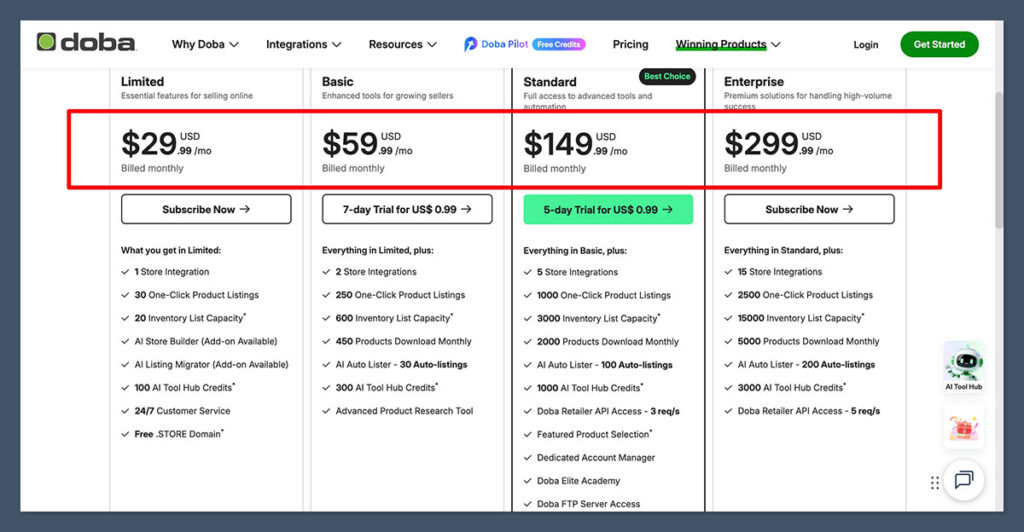
Doba is the cheaper of the two for the entry-level plans at least. The Limited plan costs $29.99 per month (with 5% off paid quarterly, or 15% off paid annually). You get 1 store integration, 30 one-click product listings, 20 inventory list capacity, 100 AI Tool Hub credits and a free .store domain, with AI Store Builder and AI Listing Migrator available as add-ons.
The Basic Plan for $59.99 per month gives 2 store integrations and more credits and capacity. The Standard plan for $149.99 per month ramps up all of your capacity, features, and store integrations, while also giving you API access, featured product selections, a dedicated account manager, FTP server access, and access to the Doba Elite Academy.
Spocket starts at $39.99 per month, though you can get a free eight months off for your first annual subscription. The initial plan offers full access to the catalog, 25 unique products, AliExpress dropshipping, and multi-store management, though you still need an account for each store.

Both are excellent value for money, but Spocket gets a lot more expensive when you consider that every store you’re going to manage needs its own paid subscription, even if you can work on various stores from the same account.
It’s also worth saying that the subscription plans from both companies don’t cover the stock, you still need to pay the base cost for the items you’re selling, too.
Doba vs Spocket: Ease of Use and Onboarding
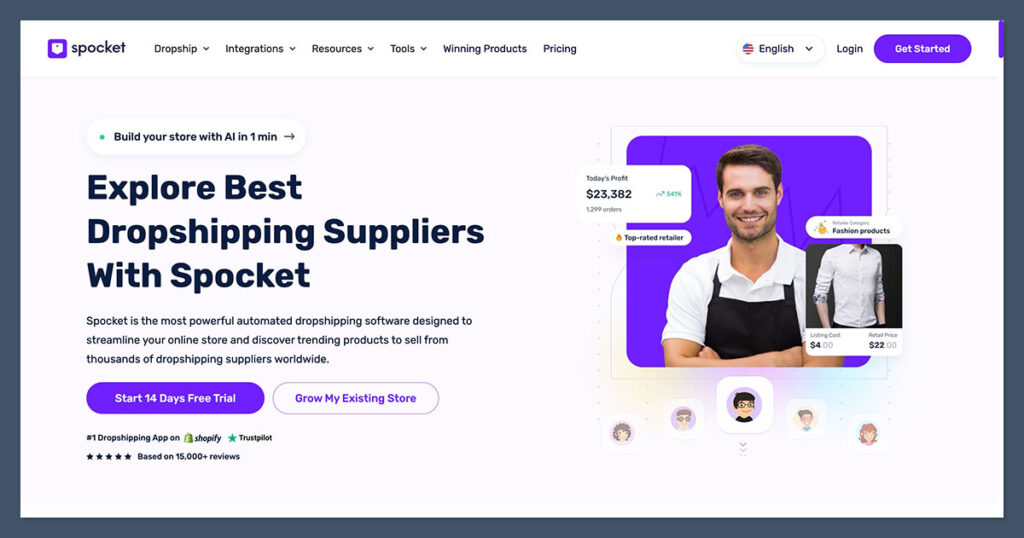
Spocket is the easier option to use for beginners initially, because there aren’t as many features to learn. You browse the curated catalog, add an item you want to your import list, edit the things you want to change, then publish. Worth saying, though, you do need to account for shipping separately.
One slight downside is that products do need to be imported individually. You can publish your import list page in bulk later, but you still have to review every product on the way into your catalog.
Doba is a lot more “feature rich”, it even has its own AI store-builder, so there’s far more to get your head around. For dropshipping, you’ll spend a little time setting up controls, but Doba does give you some useful ways to speed up manual work. The Doba Pilot, its AI dropshipping agent that can help you search for products relevant to your niche or shipping preferences, for example.
Since the Pilot upgrade, that first hour is noticeably gentler than it used to be. You can talk your way through the early steps, finding products, connecting a store, getting the first listings live, instead of hunting around for the right setting. It doesn’t make the platform simple exactly, there’s still a lot of surface area here compared to Spocket, but it does lower the point at which a beginner can get something functional in front of customers.
I should also say that Doba has a very good range of resources online (including an entire Academy that you get access to on the higher tier plan), that’s really useful for dropshippers who want to figure out how to grow or take the next step in their business.
AI, Automation and Product Research Features
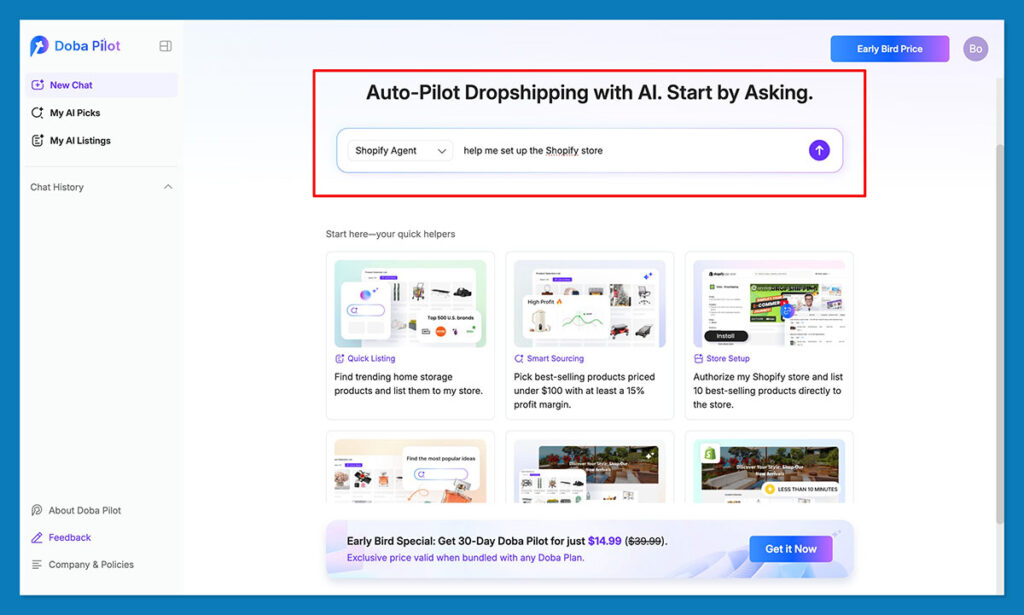
I briefly mentioned AI features there, but Doba has a lot more than just an AI assistant. Doba Pilot has recently had a major upgrade. It used to be mostly a conversational way to search the catalog, and it’s now an all-in-one AI dropshipping agent covering research, sourcing, listing, then fulfillment.
Market Scout handles the research, looking at demand, competition, pricing, and seasonality so you can size up a category before committing money. Smart Sourcing takes a plain description of what you want, category, price range, shipping location, and pulls relevant products for you to review. You’re still deciding what’s worth selling, but it cuts the manual filtering.
Pilot also walks you through connecting a store, and for Shopify it can help build one, themes and banners included. Pilot’s store and listing workflows now extend across Shopify, BigCommerce, Wix, eBay, Walmart, and TikTok. For Walmart and TikTok, the latest upgrade adds AI-assisted product attributes, UPC upload, listing previews, and bulk publishing, expanding Pilot’s multi-channel listing capabilities. Once connected, it helps you to set pricing, write or update up titles and descriptions, and publishes.
Order and fulfillment work sits in the same conversation too. You can check logistics status, review exceptions, follow up on shipments, or handle refund-related actions without switching tools. Pilot has also recently expanded its fulfillment capabilities, with proactive monitoring for logistics exceptions and the ability to attempt to intercept an unshipped purchase order when the corresponding store order is canceled. That gives Doba a bit more of an operational edge than you’d get from a typical AI assistant.
It won’t fix every problem on its own, but it saves a lot of tab switching. You can also schedule recurring jobs like sourcing, auto-listing, or market reports, and ask Pilot about Doba’s policies and suppliers.
The rest of the toolkit is still there, including the AI Pickr, image creation and background removal, auto listing and migration, plus the AI store builder.
One thing worth keeping in mind is that you get different AI credit allowances on each Doba plan. Tools such as AI Store Builder and AI Auto Lister don’t consume standard AI Credits and instead follow their own plan quotas or pricing structures. New Doba users also receive 30 free Doba Pilot Credits upon signup.
As far as I can tell, Spocket isn’t going too far with specific AI tools yet, but it still uses intelligent features for filtering. For instance, you can sort through items by origin, destination, price, supplier, premium, or best-seller status. Spocket does offer shipping time and shipping cost features too, but those are only available to US sellers right now.
Both platforms automate core order workflows. Doba also offers inventory and pricing updates, listing tools, and AI-assisted operational tasks, subject to the capabilities available for each channel.
Product Range, Quality, and Supplier Vetting
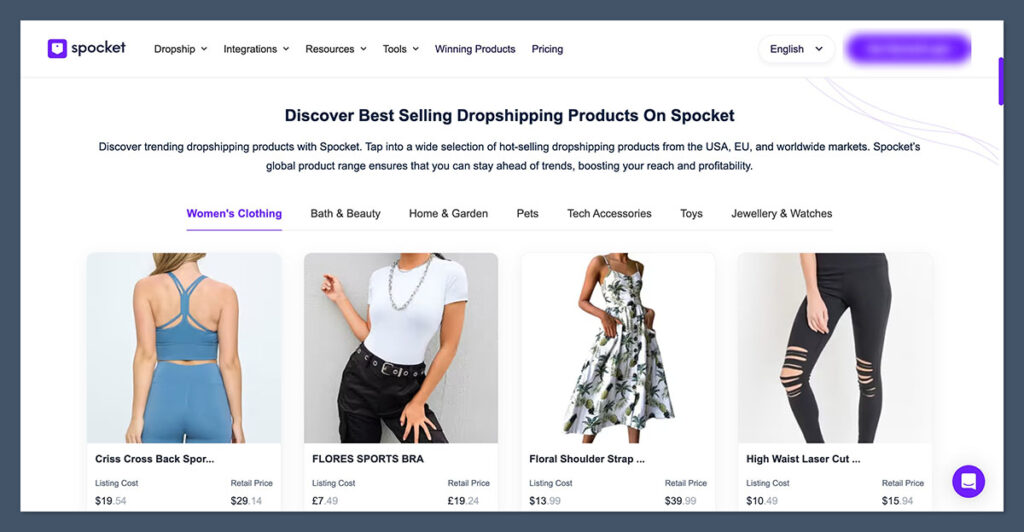
Both dropshipping companies have a similar number of products on offer, although the variety seems a bit broader on Doba. You’ve got a lot of different categories like homeware, beauty, automotive goods, plus other extras you might miss on most dropshipping sites.
The supplier network runs to more than a million SKUs, which is genuinely useful if you’re testing several product angles across different stores rather than committing to one narrow niche. However, it’s worth noting that Doba works with a lot of suppliers, and although it does vet the companies, quality can vary.
Spocket is still more specific about who it lets interact with its dropshippers, though. Even though there’s nearly a million products to choose from, every supplier has to either make or physically hold their own inventory, or they have to give retailers at least 25% off their public pricing.
You’re also almost exclusively dealing with US and EU suppliers on Spocket, but it’s worth remembering that Doba lets you filter by location, too.
Shipping, Fulfillment, and Returns
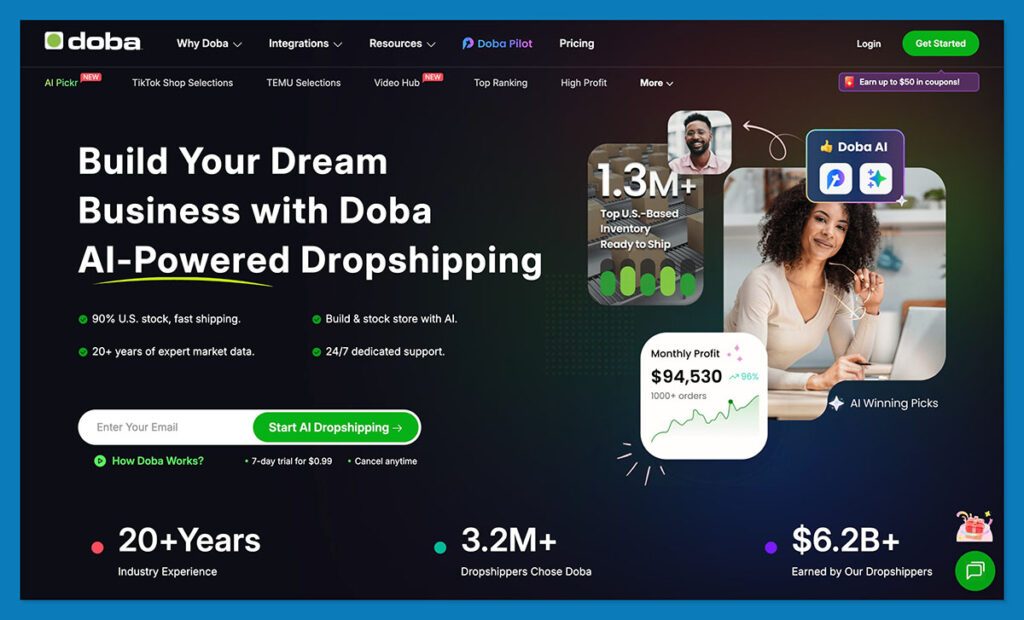
Spocket highlights its US and EU supplier network, which can support relatively fast local delivery. Doba offers a similarly strong U.S.-shipping footprint, with around 90% of products currently shipping from the U.S. For U.S.-focused retailers, delivery times can therefore be comparable, though exact timing still varies by product, supplier, destination, and shipping method.
Doba also flags products that ship from US warehouses, which are worth prioritizing if fast domestic delivery matters to you. They can remove a lot of fulfillment friction, including long transit times, stockout issues, and complaints about late deliveries. Just don’t assume that applies to the entire catalog: plenty of products still ship internationally, and neither platform guarantees a specific delivery window
Both companies set clear rules for what suppliers have to do, too. Doba requires suppliers to refund any order that they don’t dispatch within the processing time they’ve given.
Every damaged item gets a prepaid return label when you submit evidence. Plus, invalid tracking triggers a refund if the supplier can’t correct it, too. Doba also offers optional After-Sales Protection Services for eligible orders. These can help retailers reduce losses from common post-purchase issues such as non-defective remorse returns and orders marked as delivered but not received, with compensation available according to the applicable policy terms.
With Spocket, suppliers have to maintain a 95% order success rate. They have to give you tracking detail and meet their stated delivery window. Also, they’re required to answer questions within 24-47 hours. Still, every supplier can still write their own return policy, and some refuse returns completely.
Both companies give you automation to help speed up the fulfillment to-do list, although I do think most retailers will have to manage some things (like figuring out how to deal with split basket orders) themselves with both partners.
Integrations, Stores, and Scalability
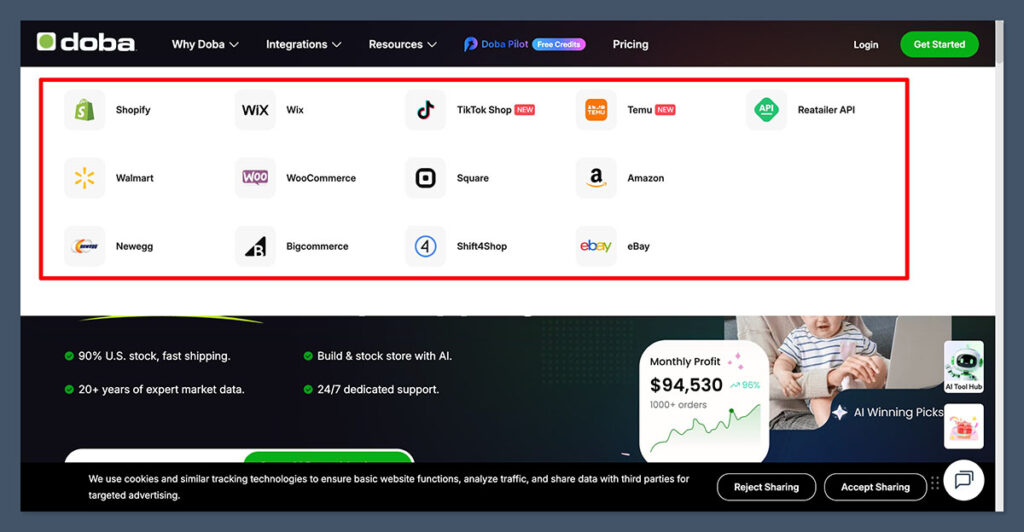
Both Doba and Spocket integrate with most of the ecommerce tools you’d expect like Shopify, WooCommerce, Wix, BigCommerce, or Square, among other well-known ecommerce storefront builders. Beyond that, Doba has a bit more to offer from a marketplace connections perspective.
Doba is more structured than Spocket for diverse external marketplace listings, with its strong multi-channel listing capabilities. It makes it a lot easier to branch sales into things like Temu, TikTok Shop, Amazon, eBay, Walmart, and so on. Although it’s worth saying that Amazon and eBay connections are available from Spocket too.
Doba also takes on much of the centralization once those sales channels are connected. Product, inventory, store, and order data are managed from a single dashboard, while inventory levels and orders sync automatically across channels. That helps prevent two of the biggest headaches for multi-channel sellers: outdated stock counts and mistakes from manually processing orders.
One caveat is worth repeating:,Doba Pilot’s build-in store and listing workflows currently support Shopify, BigCommerce, Wix, Walmart, TikTok Shop and eBay at the moment. So while Doba integrates with a broader range of platforms, Doba Pilot itself doesn’t work across all of them yet.
Both companies also offer API integrations, although Spocket’s API is more for streamlined storefront integration, with automated checkout processing and inventory tracking. Doba’s API is more concentrated on bulk data streaming, multi-channel marketplace syncing, fulfillment routing, plus inventory updates.
Samples, Branding, and Packaging
I always recommend ordering samples whether you’re investing in dropshipping or print on demand, and the good news is that both Doba and Spocket support that. On Spocket, every listing has an “order samples” option, and you can buy up to five units of one item per order. Bulk sampling isn’t available, though. For Doba, sample orders are a bit trickier.
You can request samples, but typically you need to go through individual supplier listings or coordinate them yourself.
Spocket offers branded invoicing on higher-tier plans, while Doba requires blind shipping for marketplace orders, with additional branding or packaging options varying by supplier.
Overall, though, Spocket still wins in this particular category because the sampling and invoice process doesn’t take as much work from the seller.
Doba vs. Spocket: My Verdict
I like both of these tools. Spocket is a great choice if you want local suppliers, a simple setup, easy access to samples, plus branded invoicing. It’s great for beginners in the dropshipping space, particularly if they only have one store to manage.
Doba is better overall for a few reasons, though. It’s not just that it’s cheaper on the starting price, it’s also because it gives you more control over listings, orders, inventory, marketplace connections, and multi-store management. Plus, the AI and automation tools really do help out when your business starts scaling.
The Pilot upgrade also takes some of the sting out of the old complaint about Doba being harder to learn, since you can now be walked through research, sourcing, store setup, and listing conversationally, even if there’s still more platform here than Spocket asks you to deal with. I think it might may offer more functionality than some very small stores initially need, but if your business is starting to scale up and out, it’s easier to grow with Doba.