


Enterprise resource planning (ERP) systems are built to centralize the financial and operational information businesses need to run. Project management software is built to help teams plan, execute and monitor the work that produces those financial results.
Both are important. But when they’re disconnected, project teams may be spending significant time moving information between systems instead of managing the work itself.
ProjectManager surveyed 142 project management professionals to understand how organizations currently manage project financials and which data connections would be most valuable. The results reveal a clear gap between the information businesses have and the visibility they need.
ERPs Manage Financials, Project Teams Manage the Work
Modern ERP systems can provide a broad range of financial and operational capabilities, including accounting, budgeting, purchasing, time and expense tracking, project accounting and financial reporting. However, project execution requires another set of capabilities.
Project managers need to build schedules, assign resources, manage dependencies, track progress and understand how changes to the work affect deadlines and costs. They also need a practical way to connect planned work with actual project performance.
This creates a distinction between financial management and project execution. An ERP can tell a business what a project has cost. A project management platform can show what work is being performed, who is performing it, when it is expected to be completed and how the project is progressing. The challenge comes when those two views aren’t connected.
Disconnected Systems Create a Reconciliation Problem
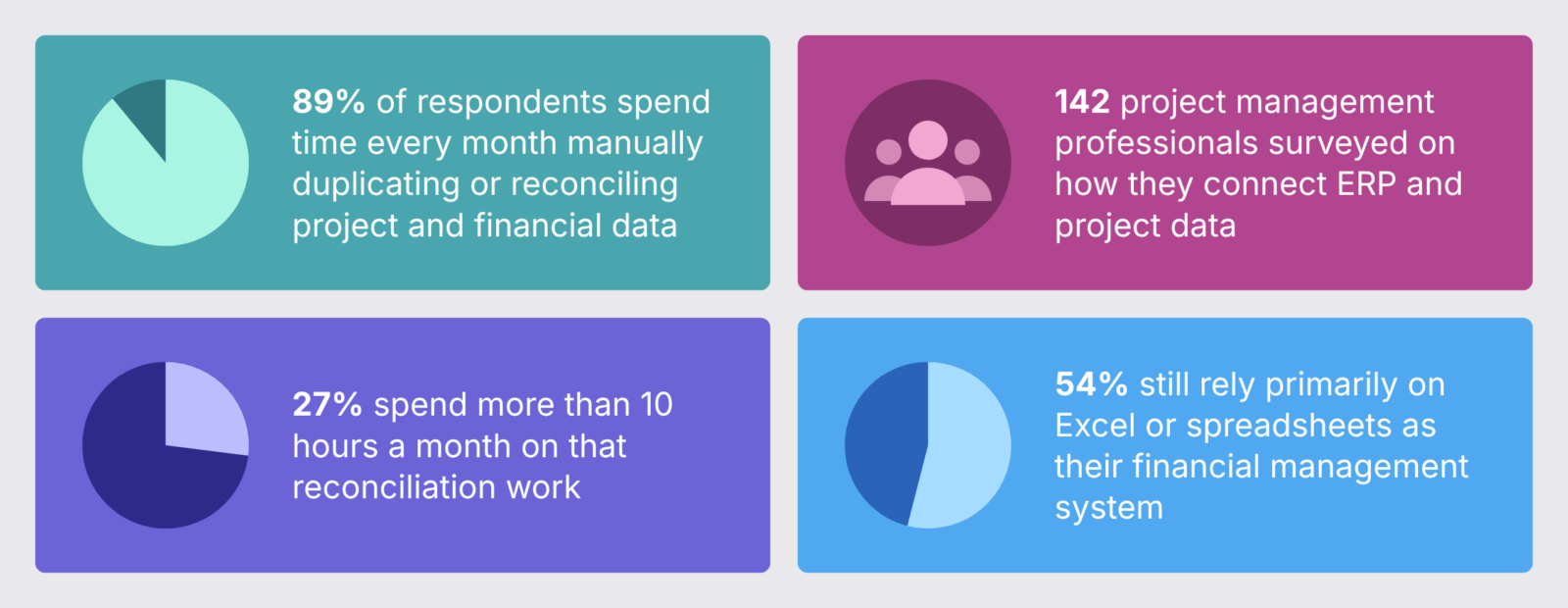
The ProjectManager survey found that 89% of respondents spend at least some time each month manually duplicating or reconciling project and financial data.
For 27% of respondents, that work takes over 10 hours per month.
That’s more than an inconvenience. It’s a recurring operational cost created by having information distributed across different systems.
The survey also found that 54% of respondents still rely primarily on Excel or spreadsheets as their financial management system.
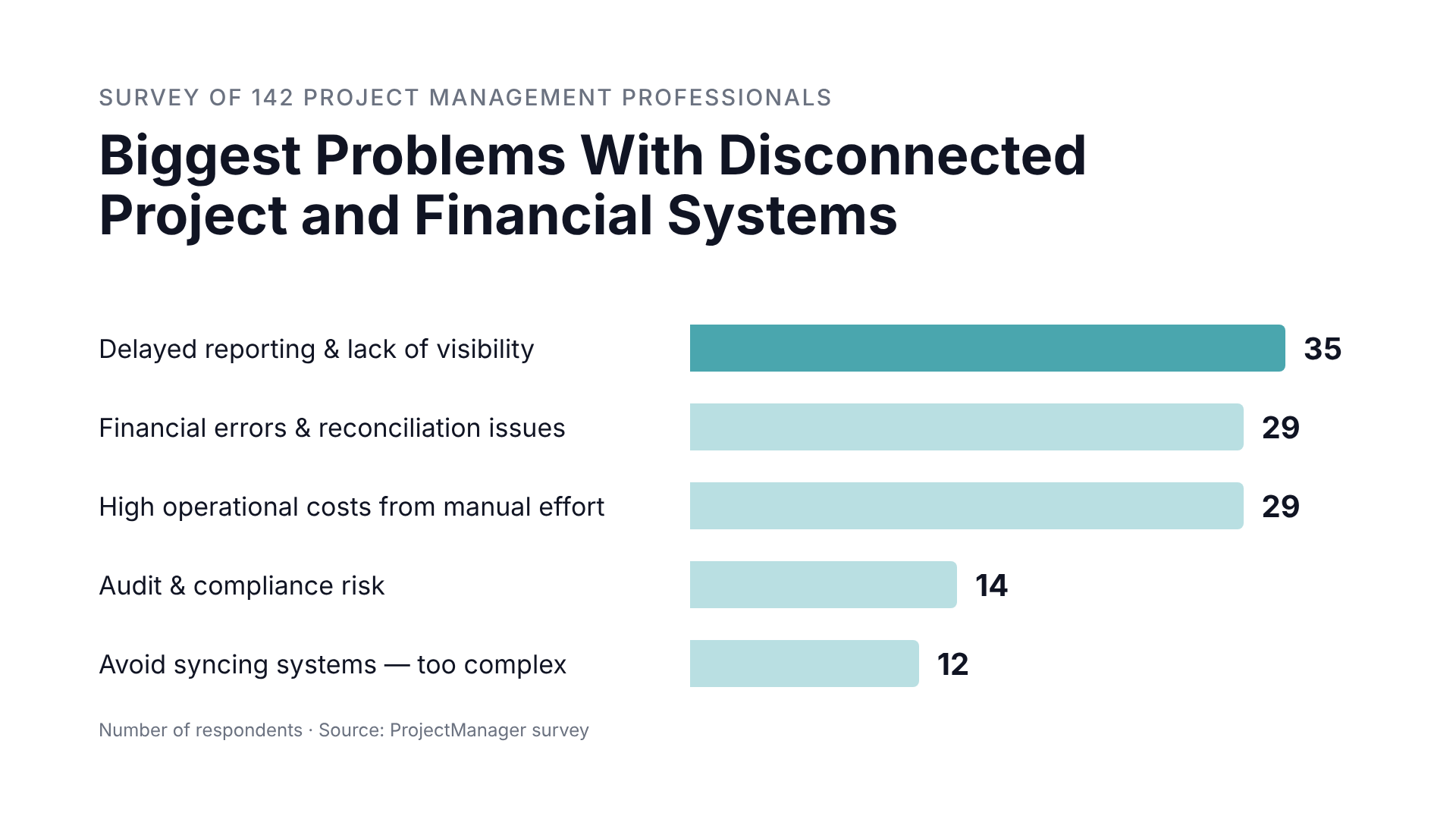
The consequences extend beyond data entry. When respondents were asked about the biggest problem with their current financial management process:
- 35 respondents identified delayed reporting and lack of visibility as their biggest problem.
- 29 respondents cited financial errors and reconciliation issues.
- 29 respondents cited high operational costs from manual effort.
- 14 respondents identified audit and compliance risk.
- 12 respondents said they avoid syncing systems because the process is too complex.
The numbers point to the same underlying issue: organizations may have financial data and project data, but they don’t always have those data sets connected in a way that provides timely visibility.
What Do Project Teams Actually Want From Integration?
The survey also asked respondents which data connections would be most valuable in a project management integration.
The results are revealing because respondents weren’t simply asking for accounting features to be copied into their project management software. They wanted connections that would help them understand project performance in financial terms.
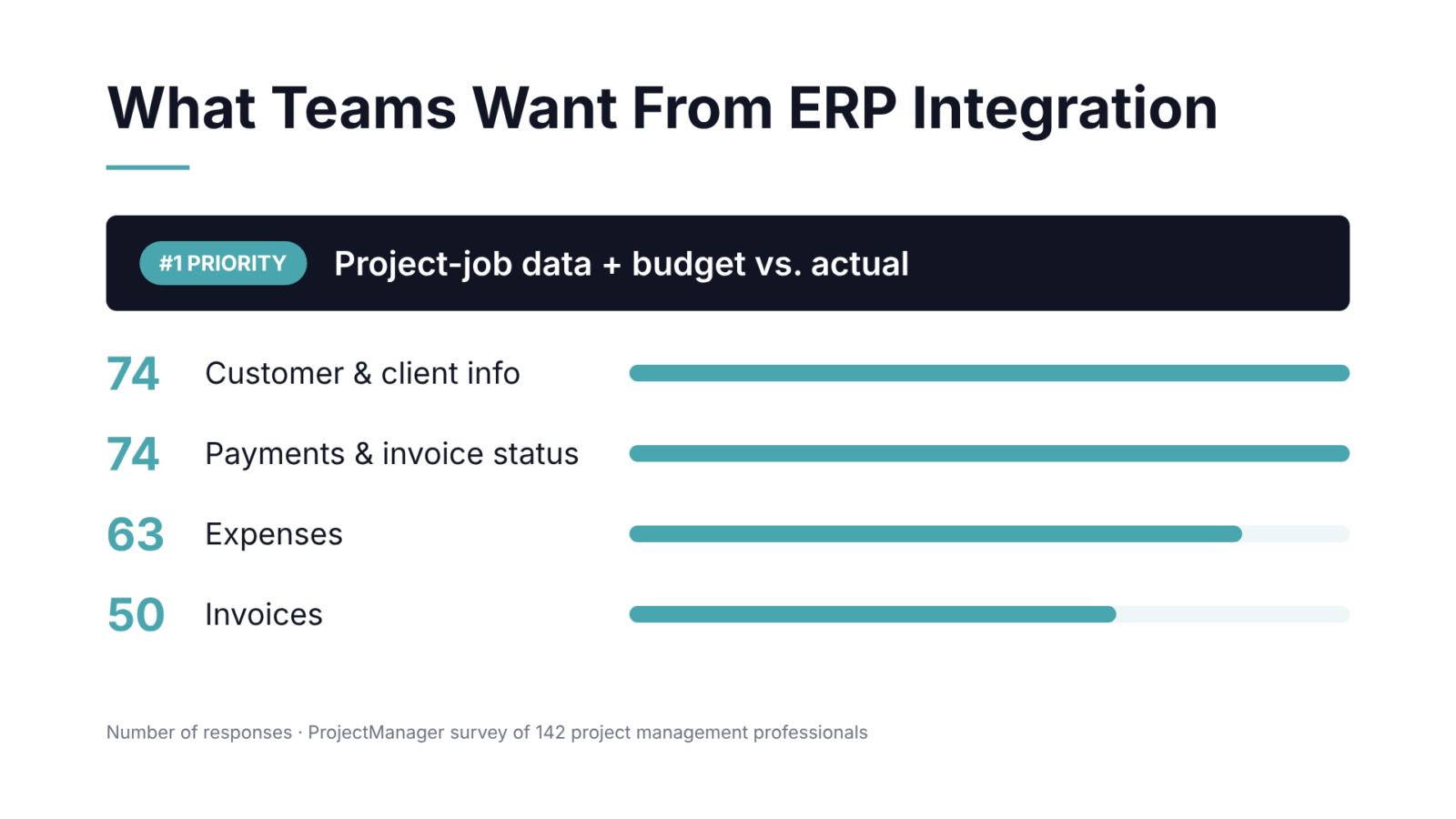
The most valuable connection was project-job data, alongside budget-versus-actual visibility.
That makes sense. Project managers don’t just need to know that an expense exists. They need to know how that expense relates to the project plan. Is the project still on budget? How much has actually been spent? Which projects are generating the strongest margins? Where are cost overruns occurring? What happens to profitability if a project falls behind schedule? Those questions require project and financial data to work together.
Customers Are Another Important Connection
Customer and client information was also among the most valuable integrations, receiving 74 responses. Connecting customer data to project information can give organizations a more complete picture of the relationship between the work they perform and the revenue it generates.
For example, teams can connect projects to customers, understand what work is underway for a particular client and evaluate customer profitability across projects. Again, the goal isn’t simply moving records between applications. It’s creating the context necessary to make better decisions.
Financial Visibility Goes Beyond Invoicing
The survey also found that respondents placed a higher value on payments and invoice status (74 responses) and expenses (63 responses) than on invoices themselves, which received 50 responses. That’s an important distinction.
Creating an invoice is an accounting function. Knowing whether a customer has paid, how much revenue remains outstanding and whether project expenses are threatening profitability is a business visibility function.
The data suggests project professionals increasingly need to see financial information in the context of the project, not simply complete individual financial transactions.
Integration Can Close the Gap
The answer isn’t necessarily to make the ERP do everything or to replace it with project management software. For many organizations, the better option is to connect the two.
An integrated setup lets project teams manage schedules, tasks, resources and time in the project management platform they already use, while finance teams continue managing accounting, billing and financial reporting in the ERP. The important information can then move between the systems instead of being re-entered manually.
That means a project manager can see how actual costs are affecting a project without having to dig through accounting records, while the finance team can receive accurate project and time data without asking project managers to recreate it in the ERP.
The difference may seem simple, but it addresses one of the biggest problems identified in the survey: the amount of time teams spend manually reconciling information that already exists in their systems.
Integration isn’t about creating another place to manage data. It’s about making the systems a business already relies on to work together.
Acumatica + ProjectManager: Connecting the Two Sides of the Project
ProjectManager’s Acumatica integration provides a real-world example of this approach. Acumatica can manage the financial side of the business, while ProjectManager provides the project planning and execution environment. Rather than requiring project managers and finance teams to maintain duplicate information, the integration connects the operational and financial sides of the project.
Project teams can manage schedules, tasks, resources and project work in ProjectManager. Approved timesheets can then flow to Acumatica, connecting time worked to the organization’s financial processes.
The integration can also bring actual and committed project costs from Acumatica into ProjectManager, giving project managers more visibility into how actual costs compare with the work they’re managing.
That addresses several of the priorities identified in the survey: connecting project data to financial outcomes, improving budget-versus-actual visibility and reducing the manual reconciliation that 89% of respondents currently experience.
From Data Reconciliation to Project Visibility
The survey makes one thing clear: project professionals don’t simply need more financial data. They need connected financial data.
Nearly nine in 10 respondents are already spending time reconciling project and financial information. More than a quarter spend over 10 hours a month doing it. And when asked what would be most valuable from integration, respondents prioritized connections that would help them understand project costs, budgets, customers, payments and profitability. The opportunity is to move beyond systems that simply store information separately.
With an integrated ERP and project management environment, financial teams can continue managing the financial system while project teams manage the work. The data connecting those functions can move between systems without requiring people to manually recreate it.
Acumatica and ProjectManager demonstrate what that can look like in practice: one connected view of the project, from the work being planned to the money being spent.
That’s the real value of integration; not just fewer spreadsheets or fewer hours spent reconciling data, but better visibility into how project execution affects financial performance.
Are you interested in trying the integration yourself? Whether you’re an existing ProjectManager customer, or you’re looking for a platform that bridges the gap between your project and financial data, this integration is the right fit. Explore our homepage or read more about our Acumatica integration.