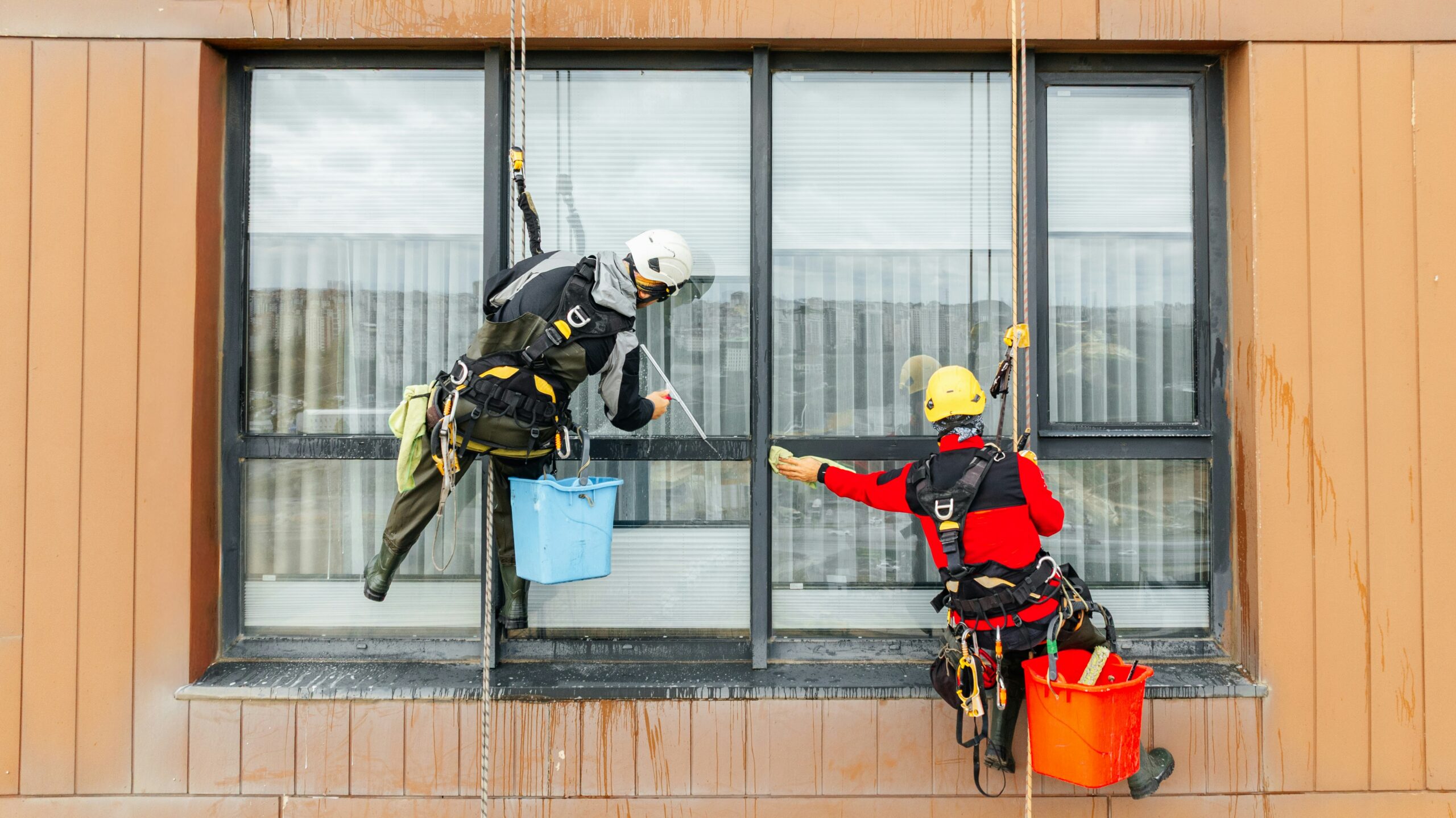
Across a handful of U.S. trades now, a similar bet is playing out: give a machine the most dangerous or hardest to staff part of a job, and hand the rest of the business, contract, customer relationship, and P&L to an independent worker.
In commercial cleaning, for one, that bet just got $5 million USD behind it in Dallas-Fort Worth. In manufacturing, meanwhile, a version of it has been running for several years in Ohio and both cases point to the same underlying question.
Does robotics in blue-collar work expand the number of people who own their labor or just change who profits from it?
That bet is being placed at a moment when capital floods the general robotics landscape. Venture investors put $47.4 billion USD into “physical AI” startups globally in just the first half of 2026, according to Crunchbase News, four times what the sector raised in the back half of 2025 and more than the entire 2022 to 2024 period combined.
Almost none of it is going toward anything like SkyPSI’s model, though. The money is chasing humanoid robots, robot foundation models, warehouse automation: big, centralized bets, not individual ownership.
While SkyPSI and Path Robotics sit outside that gravity center, their bet is the more interesting question isn’t which company builds the best robot at all, but who ends up owning the business on the other end of it.
The Case in Commercial Cleaning
By most accounts, the commercial exterior cleaning market is still barely touched by automation. Fortune Business Insights projects the global cleaning services market growing from roughly $482 billion USD in 2026 to $859 billion USD by 2034, but the segment has historically relied on rope-access crews and scaffolding, methods expensive and dangerous enough that many buildings get washed only once a year.
Drones currently serve only a small fraction of that market, roughly 1% by one company’s estimate, a figure that although hasn’t been verified independently, is consistent with how little of the rope-access segment has converted to drone based methods thus far.
Vic Pellicano’s new company, SkyPSI, launched this week with a model built around that gap. SkyPSI sells commercial cleaning contracts to property teams, hotels, offices, medical facilities, retail developments, then trains and certifies independent operators and books them directly onto those contracts.
Here, the operator runs their own company under their own name, and SkyPSI handles the sales pipeline, the FAA certification process, and the insurance and legal groundwork that typically keeps a solo operator from ever landing commercial accounts in the first place.
Pellicano’s case for the model is largely autobiographical, too. His father drove a truck and never finished sixth grade, and the now-founder grew up in a trailer park outside Chicago, washed dishes for his first paycheck, and taught himself to code at 13, according to his own account. He’d go on to earn degrees in computer science and math, then start law school at night, before both of his parents died and he ended up homeless, living out of a van.
He later built that experience into Verenia, a manufacturing software company whose NetSuite CPQ business Oracle acquired in 2022, then founded drone software startup Avianna, which Lucid Bots acquired in 2024. He stayed on at Lucid Bots’ president and chief platform officer before launching SkyPSI.
“Some think the robot economy belongs to people with the right badge and the right zip code. I think it belongs to the guy who shows up at 5 a.m. with calluses on his hands,” Pellicano said in a statement.
The safety clause behind that pitch holds up against U.S. federal data as well. The Bureau of Labor Statistics’ 2024 Census of Fatal Occupational Injuries, released in February 2026 due to government shutdown-related delays, recorded 844 fatal falls, slips and trips that year, about a sixth of all workplace deaths. Fatalities among building and grounds cleaning and maintenance workers rose to 356, up from 337 the year before.
The Same Bet, a Different Trade
The pattern isn’t confined to Dallas or to cleaning, for that matter. Path Robotics, an Ohio-based welding-robot maker was founded by Andy Lonsberry after his own family’s manufacturing startup failed years earlier for a reason that had nothing to do with automation: they couldn’t find enough welders to keep up with orders.
Path’s robots now do everything from finishing motorcycle chassis to welding ship hulls, sold not to eliminate welding jobs but to let small manufacturers take on work they’d otherwise have to turn away for lack of staff.
“The democratization of technology should be able to help small businesses and small manufacturers,” Lonsberry told Sherwood News in June 2026. “Manufacturing in the United States is notoriously done in very disparate settings.”
That labor shortage behind that pitch isn’t unique to cleaning; welding alone is short more than 300,000 workers, according to American Welding Society projections, and even that number understates the problem. One Missouri trade school told local news this month that enrollment is actually falling, even as demand for welders keeps climbing.
The broader manufacturing sector shows the same strain, and manufacturers are feeling it too. More than 4% of manufacturing jobs sat unfilled in the first quarter of 2026, per the National Association of Manufacturers, and for one in four manufacturers, that vacancy rate topped 5%.
Openings kept climbing anyway. Manufacturing job postings hit 462,000 in March 2026, the third straight monthly increase, Bureau of Labor Statistics data shows. Quits stayed high too, a sign that workers with the right skills still have somewhere else to go.
In a labor market this tight, a robot that lets an existing shop absorb more orders isn’t competing with a worker who wants the job. It’s competing with an empty workstation. And that’s the actual bet embedded in all this automation: robots don’t replace workers who want the job. Rather, there aren’t enough workers to replace, and whoever fills that gap decides whether the person running the machine ends up being an employee or an owner.
What the Numbers Suggest
This doesn’t mean the outcome is guaranteed. The most rigorous evidence on the subject, albeit outdated, still points the other way, in fact.
Between 1990 and 2007, every additional robot per thousand workers cut the employment-to-population ratio by roughly 0.2 percentage points and wages by about 0.42%, economists Daron Acemoglu and Pascual Restrepo found. And the jobs that took the hit are the same ones now being targeted: machinists, assemblers, material handlers, welders.
Such is the tension for the ownership thesis, not a footnote to wave away. Available data comes from an earlier generation of automation, large manufacturers installing robots that directly displaced workers on their own payroll – all around a different structure from an independent operator who owns both the contract and the customer relationship.
Whether that distinction actually protects operators, or simply delays the same displacement by a few years, is the open question. But it’s also the riddle capital is now answering with real money.
If the labor gap in trades like welding and commercial cleaning closes even partially over the next several years, and if operators genuinely keep the ownership stake these companies are promising instead of ending up as contractors in name only, the job math points toward growth; certainly not displacement.
Featured image: Ahmet Kurt via Unsplash+