


I’ve been a big fan of both Gelato and Fourthwall for quite some time now, but I still don’t recommend them automatically to the same people. Gelato is brilliant if you want a global, sustainable print on demand provider with genuinely excellent products, and a huge range of tools to make your designs look incredible.
Fourthwall also gives you retail-grade customizable products, but it’s also giving you a custom website, multiple ways to sell other products (like digital downloads or memberships), plus a range of tools to help scale a brand.
If fulfillment is what’s missing from your strategy, Gelato is still a great pick, if you’re looking to build something a lot bigger, without the extra admin headaches, Fourthwall is better.
Fourthwall vs Gelato: My Quick Verdict
If you already have a store on something like Shopify or Etsy, and you need a brilliant POD partner to help create and ship your products, Gelato is fantastic. It’s got a huge production network, a great sustainability story, all the high-quality products you can want, plus great tools, like the Personalization Studio to improve your margins.
If you don’t have a store yet, Fourthwall is the better choice. It gives you your home on the web, along with a curated POD catalog, and options to sell other physical products, memberships, or digital products. It also acts as your Merchant of Record and handles customer support for catalog items, so you end up with less work on your plate.
What Are Fourthwall and Gelato?
Fourthwall is an ecommerce platform with print on demand built in. You get a website with your own domain where you can sell anything you want, from customizable products to items you source yourself, subscriptions, or memberships. There’s even an option to accept donations, and you can also connect your store to social selling platforms, or marketplaces like Etsy.
Gelato is a print on demand provider that connects to the platforms you already sell on, like Wix, Squarespace, or TikTok shop. You choose products from the catalog, add your designs, or let customers apply their own with the Personalization studio, and wait for purchases to come in. When they do, Gelato creates and ships the product, and you just pay for the base cost of the item.
| Comparison Factor | Fourthwall | Gelato |
|---|---|---|
| What is it? | A brand-building platform with POD included | A print on demand and fulfillment partner |
| What can you sell? | POD products, custom sourced products, digital downloads or memberships | Customized print on demand products |
| How much does it cost to start with? | Free to sign up | Free to sign up |
| What type of support is available? | Fulfillment, Merchant of Record, and customer support for catalog items | Fulfillment, basic back-end support |
| Sustainability | Not a huge differentiator, but sustainable products are available | Very big part of the platform |
| Integrations | Social media channels, email marketing tools, and marketplaces like Etsy | Ecommerce and marketplace channels |
| Fulfillment | Worldwide shipping | Worldwide shipping with 140+ production hubs |
Fourthwall vs Gelato Pricing: Which One Costs Less in Practice?
Both Fourthwall and Gelato have free plans, so you’ll have no problem getting started with a limited budget, although there is a big difference in what you actually get for free.
Gelato Free gives you the full print on demand catalog, free mockups, connections to any ecommerce channels you want, plus the basic design tools. Upgrading to the $29.99 per month Gelato+ plan is actually pretty worthwhile when you start to grow, because you get discounts up to 33%, the Personalization Studio, Magic mockups, the price navigator, plus product migration tools.
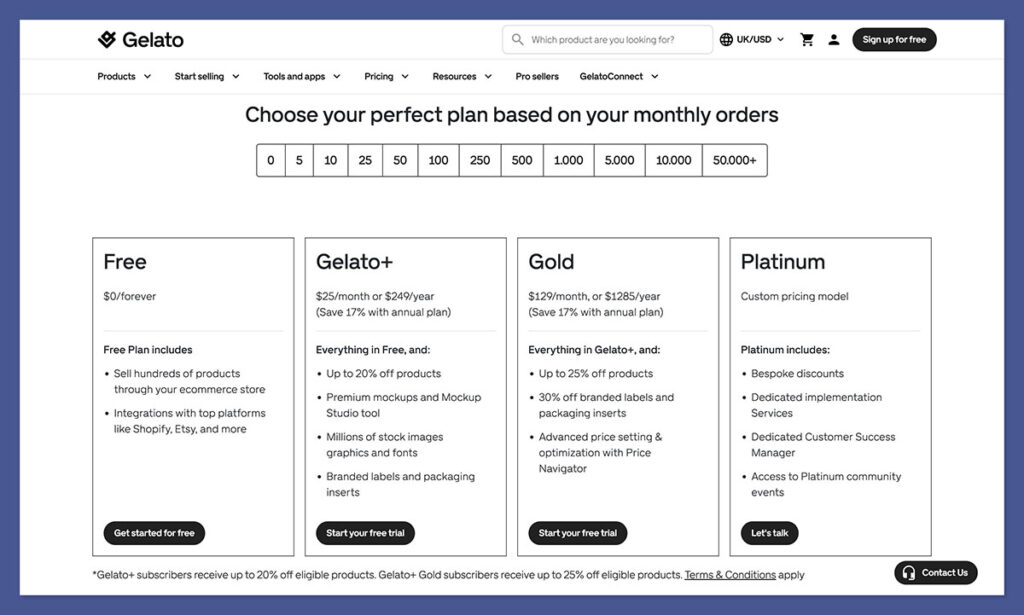
The downside is that you do need to pay for other things alongside Gelato, like your ecommerce platform, and any marketing tools you’re going to be using.
Fourthwall ends up being a little cheaper overall, because the free plan already comes with a storefront you can fully customize, as well as options to sell digital and other products alongside your print on demand catalog. You do have to pay a 5% fee on digital downloads and memberships on that plan though, though the digital download fee disappears on the Pro plan for $19 per month.
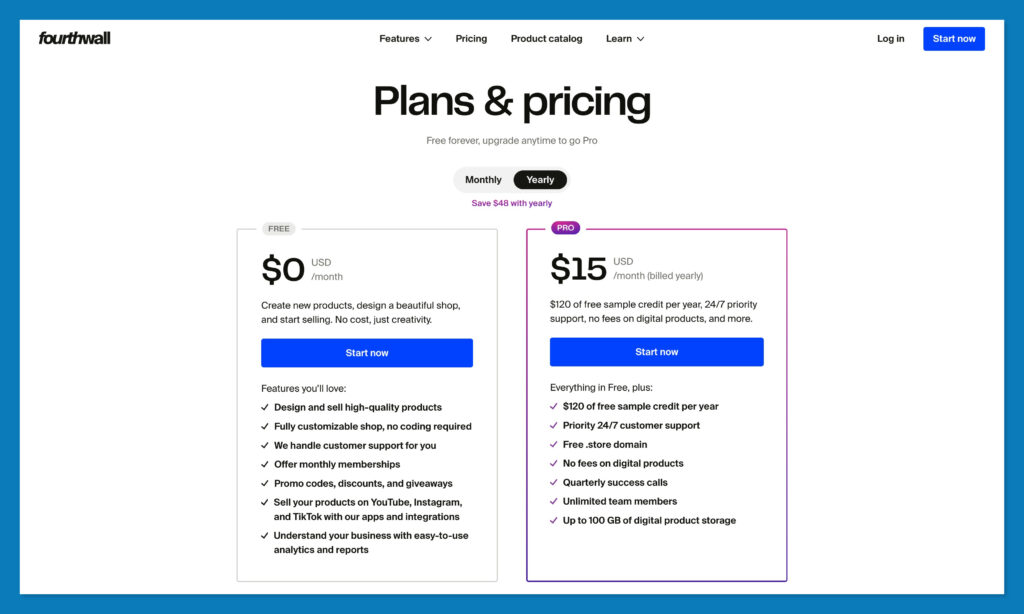
That paid plan also comes with unlimited team members, advanced analytics, sample credits worth up to $10 per month, and priority support. Honestly, both platforms are great value for money in their own way, but Fourthwall ends up being the cheaper option if you don’t already have a store.
Fourthwall vs Gelato: Product Range and Quality
This is a very close call. I’ve always said that Gelato’s product range and quality are both great. The catalog covers all the standard apparel and accessories you’d probably expect, and the wall art or paper products are better than most of the alternatives I’ve seen from other suppliers.
I also think Gelato’s design tools are excellent, which makes it a lot easier to end up with a brilliant print. Plus, there’s the Personalization Studio which lets customers add their own tweaks to any item they want to buy from you (great for helping justify a higher price).

Plus, you don’t necessarily need to spend too much extra for quality with Gelato. When I’ve compared the base cost of its products to similar options from Printful or Printify, Gelato was rarely the most expensive.
Fourthwall’s print-on-demand catalog isn’t huge, but the quality is truly phenomenal. Everything in the catalog is retail-quality, and there are even plenty of eco-friendly options. You also get to print on certain products in places you wouldn’t expect, like on the sleeves.

What really makes Fourthwall different to Gelato though, is that it doesn’t just lock you into print on demand. You can start with POD products, then add items you source yourself to your catalog too, and even send those products to Fourthwall for fulfillment. You also get to sell digital products and memberships without another app, or you can accept donations.
So both companies do well in POD range and quality, Fourthwall just gives you more monetization opportunities to explore.
Fourthwall vs Gelato: International Shipping and Sustainability
Gelato edges ahead a little in this category. Fourthwall’s fulfillment strategy is excellent, with worldwide fulfillment partners across the UK, US, EU, Canada, Mexico, Japan, and Australia. Most products take around 5-8 days to arrive, although it’s worth saying that your location will have an impact on which products you can order.
Plus, Fourthwall isn’t an “unsustainable” company, it still offers eco-friendly products, it just doesn’t focus on the sustainable angle as much as Gelato.
With Gelato, you’re getting a partner that’s completely committed to reducing its footprint with non-toxic inks, eco-conscious product collections, and local production and delivery to help reduce the amount of time a product spends in transit. About 90% of orders are produced locally, and the same percentage tend to arrive in five days.
With it’s huge provider and partner network, Gelato’s fulfillment strategy is definitely one of the best things about it.
Fourthwall vs Gelato: Who Offers the Most Support?
First, I should say that both of these companies have a pretty good reputation for general customer support. They both answer emails as quickly as possible, and publish plenty of self-help resources. They also both, obviously, work as your print on demand partner, so they handle all of the creation, packaging and shipping process for you.
However, with Gelato, you’re still responsible for a lot more. You need to build and run your store, make sure tax rules and shipping rules are set up properly, and handle refunds or emails from unhappy customers. There are tools on other platforms like Shopify that can help you, but you’re still the one responsible for making sure everything works.
Fourthwall is a bit more helpful. First, it acts as the Merchant of Record for its customers, so it can handle the sales tax responsibilities you have for transactions that happen through the platform. Plus, although Fourthwall doesn’t handle customer service (with your customers) for every product you sell, it will manage it if someone buys an item from its catalog.
So if you’re using Fourthwall for print on demand and someone orders a custom t-shirt that has a problem, Fourthwall’s team will take over to fix the issue.
Fourthwall vs Gelato: Integrations and Storefronts
This might be the area where Gelato and Fourthwall diverge the most, because as I said before, Gelato is a production and fulfillment partner, not an ecommerce platform. It connects brilliantly with a lot of different selling solutions from Shopify and WooCommerce to TikTok Shop and Etsy, but you still need to bring the store into the mix.
Still, as I said, the integrations are fantastic, the Shopify app for instance can sync product availability details from the production partner into your store every two hours for certain products.
Fourthwall gives you the store to begin with, complete with your own domain and checkout. You’re free to customize that store however you like with the drag-and-drop editor, and you can create custom pages or a blog for content marketing. You can also pull other channels into the mix, like TikTok Shop or YouTube Shopping, even Etsy as of 2026.
The rest of the integrations available from Fourthwall are there to help you improve your relationship with customers. You can connect to email marketing tools like Klaviyo, for instance, or use something like Kit to improve membership experiences.
Again, both companies are doing some brilliant work with upgrades. Gelato is mostly focused on making the whole print on demand selling process better. The Personalization Studio is fantastic if you want to give customers an opportunity to make everything they buy unique. There’s also a great range of extra tools in the “premium” plan to help you with setting the right prices, designing better mockups, or producing instant collections.
GelatoCreate also has an AI mockup tool now, and there’s an enhanced analytics dashboard to help increase your sales, plus the “creator insights widget” to track achievements.
Fourthwall obviously focuses on more than just Print on Demand. There’s the Eli AI assistant that can answer questions about sales or orders, and create promotions, change product details, adjust prices, or make other changes to your store.
There’s also an RSS.com integration for podcast hosting, digital product security updates for when you’re selling downloads, plus a ChatGPT workflow that can help you get an idea and turn it into a product people can actually order. I also like that, from a print on demand perspective, Fourthwall now has a designer marketplace you can use to find artists if you’re having trouble coming up with new ideas for your next range of products.
Fourthwall or Gelato: Which One Should You Use?
I recommend both platforms, just to people in different stages of their selling strategy. Gelato is an incredible pick if you already have your ecommerce platform, like Shopify or Etsy, and all you need is a production partner you can trust to create great items and get them to customers fast. It’s also fantastic if you want to promote yourself as being an “eco-conscious” seller.
The design tools are great as well, particularly on the paid plan, and the Personalization Studio gives you an excellent way to separate yourself from other print on demand merchants.
Fourthwall is the better option if you don’t already have a store in place, and you want to set everything up at once. You get your storefront, your domain, the full print on demand catalog (plus the fulfillment that comes with it), as well as tools for selling other physical products, digital downloads, or memberships.
It’s also fantastic for reducing the amount of work you’d typically do when setting up something similar with a platform like Shopify. You don’t need extra tools to sell other kinds of products, and you get merchant of record support.
So that’s the final split, use Gelato if all you need is fulfillment excellence and great products. Use Fourthwall if you want to build an entire brand.