


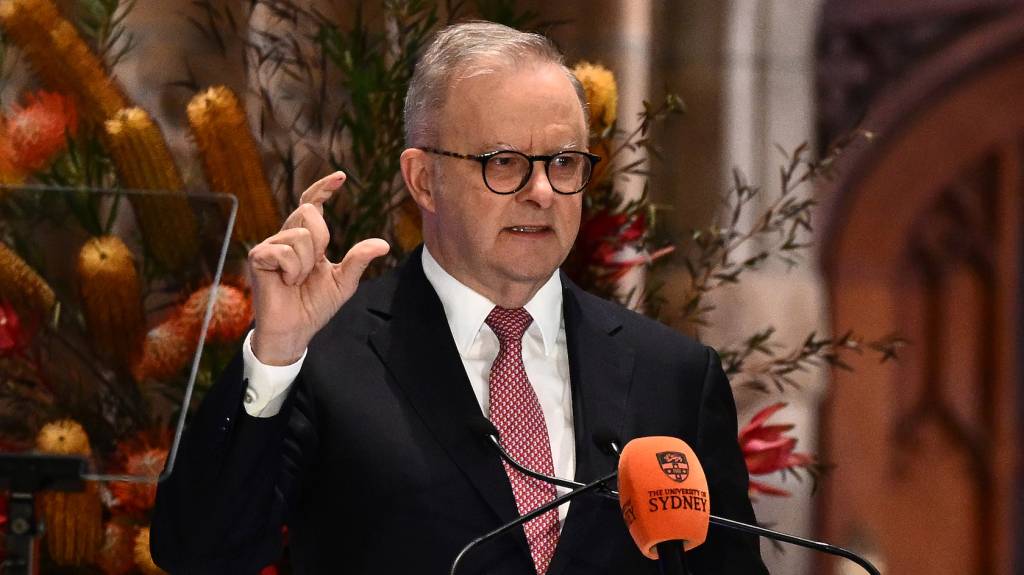
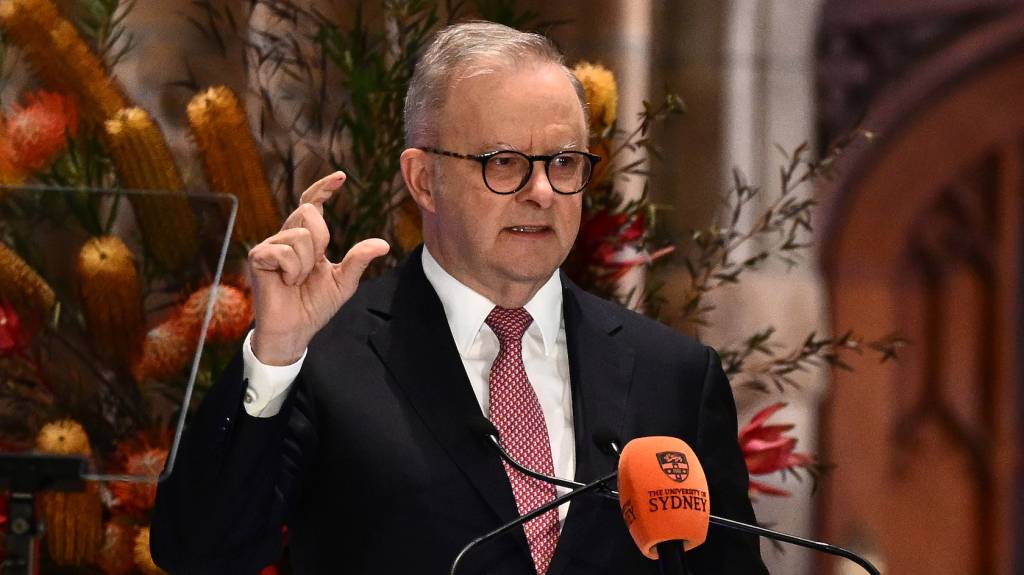
Today, prime minister Anthony Albanese laid out how his government plans to manage artificial intelligence (AI) and ensure the rapidly advancing technology works in Australia’s interest.
In a major speech at the University of Sydney, Albanese declared that AI “is a bigger challenge and a bigger opportunity than social media”, and that Australia must move now to determine its “social licence” and capture the opportunities it presents.
Key to the government’s plans is the immediate establishment of an Office of AI within the prime minister’s own department and the creation of new national standards for AI.
This news comes as a group of leading economists and AI researchers urge policymakers and tech companies around the world to prepare now for how the technology could reshape the global economy on a much bigger and faster scale than the Industrial Revolution did.
A new office and new standards
Albanese said the new Office of AI will coordinate AI policy across government, rather than leaving individual departments to develop their own approaches. This will be similar to how the government developed coordinated approaches for other significant technologies such as civil aviation and genetics.
The office will also help coordinate the design of new national standards for AI.
These standards, which Albanese said will be legislated early next year, will build on the government’s previously announced expectations for data centres. They will, for example, create a new legal obligation for large data centre operators to underwrite their own power supply, not increase household power prices, and minimise water usage.
Other countries are also grappling with how best to handle this issue. Indeed, hours before Albanese’s speech, New York enforced a one-year moratorium on the building of new data centres.
There are growing calls for Australia to do the same.
But Albanese suggested his government would not be heeding these calls. As he said:
No government can turn back the clock or press pause on all of this. Nor would we want to. That would only mean cutting ourselves off from the opportunities that are there to be seized.
Protection for artists and creative industries
Albanese also reiterated his government’s commitment to the “strongest possible protection” for artists, musicians and journalists, who should retain ownership and control of their works in the AI age.
Last year the Labor government rejected a copyright exemption that would allow AI companies to use protected content for free when developing AI models.
In contrast to other jurisdictions (such as the United States, European Union and Japan), Australian AI developers will still have to pay for creators’ content.
This approach is fair. But the government has since been grappling with how to ensure this policy does not disadvantage Australian AI developers and the payments reach actual creators.
In his speech today, Albanese promised laws to address this. But he did not provide any clarity on what they might look like.
Where does Australia sit internationally?
By establishing the AI Office and developing national standards for AI, Australia is trying to position itself as an international leader in AI policy.
But Albanese’s claim that Australia “will be the first country in the world to bring [AI] issues into a single, national framework” is overstated.
For example, the European Union adopted the AI Act back in 2024. This established strict regulation especially for high-risk AI. It also established the EU AI Office to coordinate the implementation of the AI Act and protect people against the risks of the technology.
This year, however, the EU Commission introduced amendments to weaken some of the requirements in the AI Act and postponed certain implementation deadlines.
This “watering down” of the AI Act is intended to boost AI innovation in the EU. It comes after AI developers have been complaining that strict EU regulation slows down AI development.
Other countries seem to also favour a pro-innovation approach, instead of strong regulation. South Korea, for example, has introduced an AI Basic Act for high impact AI systems, but its rules are much less strict than in the EU.
Japan has opted for voluntary guidance for the AI sector.
So Australia’s decision not to introduce hard regulation (such as mandatory AI guardrails) but rather rely on softer standards and national-level coordination appears to align with international trends.
A starting point
The new standards and office announced today are a good starting point for managing AI. So too is Albanese’s promise to protect creative industries whose content has been used by AI companies to train their large language models without consent.
However, we don’t yet know how, or how well, the government will do this.
Much more work and leadership from the government is needed – especially in relation to mitigating the wide array risks of AI, from misinformation and deceptive deep-fakes, anti-democratic propaganda, health AI apps causing health safety issues, and public security challenges.
And while the government hopes its new AI standards will allay community fears about data centres, the news out of New York is likely to only fuel the push in Australia to hit “pause” on them.
This article is republished from The Conversation under a Creative Commons license. Read the original article.