



Back in 2018, I wrote that households need to earn $300,000 a year to live a middle-class lifestyle in an expensive coastal city. The internet was not pleased. I was called out of touch, delusional, and a few other things I can’t print on a family finance blog. After having a second child in December 2019, I upped my estimate to $350,000, which went over about as well as you’d expect.
Well well well. The latest data is in, and it turns out a family of four now needs to earn $408,000 a year to live comfortably in San Francisco. We’re number one! Congrats to all who live here.
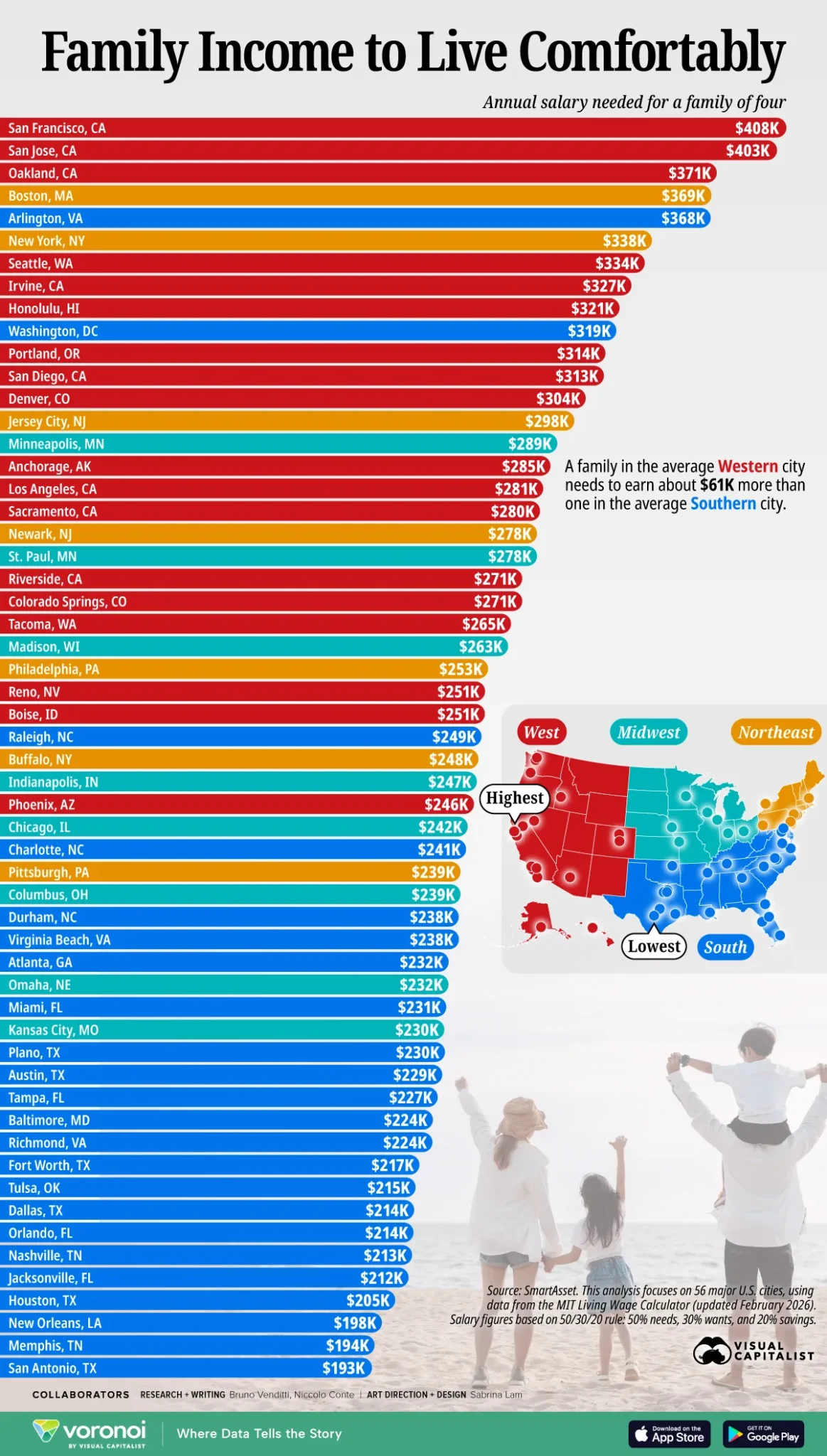
I’d like to say vindication feels great. But being right that the middle-class lifestyle now requires a top 5% income is a hollow victory. It means affordability got worse, exactly as predicted.
Let’s break down what these figures actually mean, whether they apply to you, and what you can do if your income falls short. I’d also love to hear from you whether you believe these figures are accurate based on where you live.
What $408,000 A Year Really Means After Taxes
For the record, going from $300,000 in 2017 to $408,000 in 2026 works out to a 36% increase, or roughly 3.5% compound annual cost-of-living inflation for a family.
That’s still higher than reported CPI, which is what happens when your personal inflation basket is stuffed with housing, tuition, childcare, and healthcare instead of flat-screen TVs. But it’s not far off, so please be aware of how sneaky inflation can be.
After a 32% effective federal plus state tax rate, $408,000 comes out to about $277,440 a year before any tax-advantaged retirement contributions. And you know what? That sounds about right coming from someone who lives in San Francisco with a family of four.
We currently budget about $280,000 a year after taxes, which is why I aim for about $380,000 a year in gross passive investment income to retain my FIRE membership card.
Why not $408,000? Because investment income is taxed at a lower rate than W2 income. We’re talking about a 26% effective tax rate versus 32%. Qualified dividends, long-term capital gains, and depreciation-sheltered rental income are more efficient income sources.
However, due to inflation, I need to keep growing my passive income by 3-5% a year to keep up, so surpassing $400,000 is only a matter of time.
Sample Household Budget
To illustrate how quickly $408,000 a year can get spent, here’s a realistic sample budget I’ve put together for a family of four living in a high cost of living city like San Francisco.

Notice how roughly $121,000 a year goes to taxes to support the community using a 32% total effective tax rate. Meanwhile, $30,000 goes to fund retirement and $16,000 goes to saving for college. Not a bad 11.4% saving rate, but not ideal if you want to FIRE.
Besides food ($3,042/month) and vacations ($9,000/year), there’s not that much to cut until life starts getting less comfortable. No single line item is outrageous. It’s the accumulation of reasonable expenses that gets you.
But of course, the big elephant in the budget is the $90,000 a year in private grade school tuition that’s only going to increase as the kids get older.
So if a family can control their children’s grade school spending by simply sending them to public school, then the family can live quite well. $49,000 a year can go to 401(k) contributions instead of just $30,000 for 2026. A healthy amount can be contributed to their taxable portfolios, which is necessary for FIRE. Or, they can buy a nicer car and house too. Plenty of money left to spare.
Given we highly value learning a second language, we are comfortable paying up. Looking back at my education, one regret is not mastering Spanish and Mandarin. I’d happily pay $500,000 to be fluent in Spanish and $1 million to be fluent in Mandarin today. With those figures in mind, the tuition becomes far more digestible.
What Is Considered Living Comfortably Is Subjective
Comfort is a moving target. Personally, I found working 60 hours a week under a tremendous amount of stress too uncomfortable to continue. So I left finance at age 34.
Before I left, I took six weeks of vacation during each of my last two years, to the dismay of my bosses. During my final two-week trip to Europe, I devised a way to get even more comfortable by figuring out how to negotiate a severance and break free. In retrospect, it was the best thing I could have ever done for lifestyle.
That said, if I had known COVID would happen and millions of knowledge workers would get to work from home while not really working, I probably would have worked for five more years.
It was eye-opening to play pickleball and tennis on weekday mornings for three years alongside all the work-from-home employees. The courts were packed at 10 am on a Tuesday. Productivity was clearly through the roof, making FIRE obsolete.
Beyond career comfort, all I want is a typical middle-class lifestyle:
- The ability to afford four economy class roundtrip tickets two to four times a year anywhere in the world
- A median-priced to 50%-above-median single-family home with at least three bedrooms and two bathrooms
- A safe and reliable car that costs less than $60,000 (the median price of a new car is about $50,000)
- Enough savings to pay 100% of both kids’ public university tuition
- Healthcare coverage plus the ability to afford the 20% co-insurance (not co-pay) when something goes wrong
- The ability to help my parents and in-laws when in need, including setting aside at least $250,000 for eldercare
- New shoes and clothes when needed. Our kids burn through their shoe soles within four months.
- Being able to afford some type of activity once per week for two kids
Notice what’s not on the list. No boat. No first class. No vacation home in Aspen. This is the middle-class dream, and in a big coastal city, it now requires a top 5% household income.
You Don’t Need To Save Much For Retirement Once You Retire
Because my wife and I FIREd in 2015 and 2012, respectively, we no longer have to save aggressively for retirement.
Not having to save for retirement is one of the budget surprises pre-FIRE folks don’t properly account for.
Conceptually, everyone understands it. But the habit of oversaving is so ingrained that most people keep doing it right up until the day they leave, and then feel shocked by how much extra cash flow they have.
If you’re saving 30% to 50% of your income today, your comfortable lifestyle number in retirement is 30% to 50% lower than your current gross income implies. The chart’s figures assume you’re still saving for the future. Retirees get a discount.
I was saving about 75% of my after-tax income during my last two years of work because I was hyper-focused on escaping. So losing roughly 80% of my total income after leaving didn’t feel like a big shock. The initial sting lasted one month, right after my WARN Act pay ended and the bi-weekly paychecks stopped. Then a severance check arrived, followed by unemployment benefits, which further softened the blow.
In other words, my lifestyle was exactly the same after leaving my job. I would argue it was better, given the freedom I gained. Freedom, it turns out, is the ultimate luxury good, and it doesn’t show up on any cost-of-living chart.
Note, if you quit your job, you don’t get a severance check and are not eligible for unemployment benefits. Hence, please don’t quit your job, get laid off instead. Quitting is leaving money on the table. Negotiating a severance is getting paid to leave a job you wanted to leave anyway.
How To Calculate Your Own Comfortable Income Number
Don’t just accept a headline figure from a study. Calculate your own number in four steps:
- Track your actual annual spending. Not what you think you spend. What you actually spend. Pull 12 months of statements or use a free tool like Empower to aggregate everything. Most people underestimate their spending by 10% to 20%.
- Add the middle-class checklist items you’re deferring. No kids yet but want two? Add childcare and education. Haven’t been to the dentist in three years? Add real healthcare costs. Deferred spending is still spending, just with worse timing.
- Gross it up for taxes. Divide your after-tax spending number by 0.70 if you’re a W2 employee in a high-tax state, or by 0.74 to 0.80 if your income comes mostly from investments. This is your required gross income.
- Subtract savings you no longer need to make. If you’re financially independent or close to it, remove the retirement savings line item. Your number just dropped meaningfully.
Run this exercise and you’ll know whether your city’s figure in the chart is your reality or someone else’s.
Can’t Hit The Number? Deploy The Proper Geoarbitrage Strategy
If your household income falls short of your city’s comfort figure, you have three levers: earn more, spend less, or move somewhere cheaper. Many people jump straight to fantasizing about moving to Portugal or Thailand. Slow down.
As I wrote in The Proper Geoarbitrage Strategy, the correct order of operations is to first relocate within a cheaper part of your own city, then a cheaper part of your state, then a cheaper state, and only then a cheaper country.
Moving to a developing country to save money sounds romantic until you realize you’ve abandoned your entire network, your kids’ friends, your favorite dim sum spot, and easy access to aging parents. Too disruptive for most households.
Instead, look three miles down the road. In 2014, I moved just three miles west within San Francisco and cut our housing expenses by roughly 40%. Same city. Same friends. Same doctors. An extra 8 minutes of driving to the tennis club. No big deal.
Every expensive city has a cheaper side of town that locals irrationally dismiss. That irrationality is your arbitrage opportunity. Only after you’ve exhausted the intra-city discount should you consider a bigger move.
Relocate To A Cheaper City With Better Weather
What’s exciting about living in the most expensive city in America is that I can look down the chart and choose literally any other city to save money.
Given I’m visiting my parents for a month in Honolulu, and did so for six weeks in 2025, the logical choice would be to relocate to Hawaii. According to the data, it only requires $321,000 a year in household income to live comfortably in Honolulu.
Coming here is like rewinding time five to ten years, back when it only cost $300,000 to $350,000 to live comfortably in San Francisco. Who needs a DeLorean?
$321,000 is $87,000 less than the $408,000 required in San Francisco. Meanwhile, housing is about 10% cheaper and private school tuition runs $10,000 to $25,000 a year less per student.
At a 4% return or withdrawal rate, needing $87,000 less per year means needing roughly $2.2 million less in capital. Significant! Moving one flight away from San Francisco is worth over $2 million in required net worth. That’s the power of geoarbitrage at the city level.
Other Cities Under Consideration
If I didn’t have family in Honolulu, I might consider San Diego ($313K), Los Angeles ($281K), Richmond, VA ($224K for my wife), or Orlando ($214K). Although after living in Virginia and New York City for 10 years, I’m not sure I could handle the summer humidity in Richmond or Orlando again. Some discomforts no amount of savings can offset.
So we’re back to determining what is comfortable.
To me, comfortable weather is a top three consideration. Other considerations include safety, cleanliness, natural beauty, quality food, entertainment, educational institutions, and diversity.
Perhaps these are some of the reasons why a family needs to earn $61,000 more on average in a western state than in a southern state. You’re paying a sunshine and lifestyle premium, whether you realize it or not.
If You Don’t Want To Move, Attack The Income Side
Relocating isn’t for everyone. Roots matter. If you’re staying put in an expensive city, which usually provides you with the most opportunities to make the most money, focus on these instead:
- Build passive income streams. Every $10,000 in annual passive income is $10,000 you don’t need to earn from a job, taxed at a friendlier rate to boot.
- Negotiate your compensation every single year. The difference between asking and not asking compounds into hundreds of thousands of dollars, if not millions, over a career.
- Cut your optional expenses honestly. A $90,000 private grade school tuition bill is a choice. You likely have your own version. Owning your choices beats resenting your city.
- Get on the right side of inflation. Own assets that benefit from rising prices, like your primary residence, rather than only renting them from someone else.
The chart tells you what comfort costs. It doesn’t tell you that you’re helpless. You always have more levers than you think.
Readers, what do you think? Do the figures in the chart properly represent what a family of four needs to live comfortably in each city? Where do you live and how much do you spend a year? Have you ever geoarbitraged within your own city before making a bigger move?
Build Wealth Faster No Matter Your City
If you want a step-by-step guide to building enough wealth so cost-of-living charts become trivia rather than terror, pick up a copy of my USA Today bestseller, Millionaire Milestones: Simple Steps To Seven Figures, published by Portfolio Penguin. It lays out exactly how to accumulate the capital needed to live comfortably anywhere, on your own terms.
For more nuanced personal finance content, join 60,000+ others and sign up for the free Financial Samurai newsletter. Financial Samurai began in 2009 and is one of the largest independently-owned personal finance sites today. Everything is written based on firsthand experience because money is too important to be left up to pontification.