


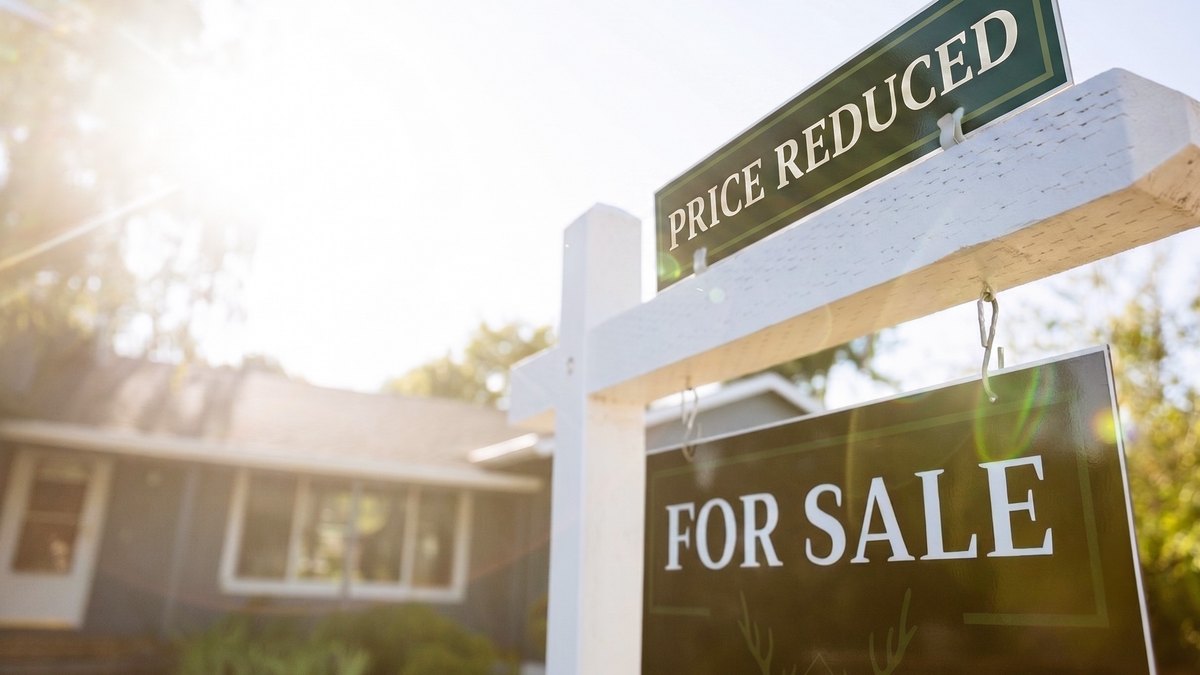
After a strong spring and promising early summer, July saw homebuying stagnate as a result of rising borrowing costs, forcing sellers to slash prices to revive demand.
The share of listings with a price cut reached 20% in July, nearly even with last year’s levels, after running close to 2 percentage points lower throughout spring, according to the latest Realtor.com® housing market trends report released on Monday.
For the first six months of the year, the dominant theme of the national housing market was sellers pricing realistically from the outset to meet buyers where they are to avoid listings going stale.
By the end of June, the share of for-sale homes across the U.S. with price cuts was 1.9 percentage points lower than the prior year.
However, as summer entered its peak, price cuts picked up as vacationing would-be buyers pulled back and aging listings piled up on the market.
“We are seeing the housing market run up against some headwinds, especially on the mortgage rate front, at the exact time when buyer demand starts to dip seasonally,” says Realtor.com senior economist Jake Krimmel. “So while the realistic pricing narrative is still there, the story has weakened a bit recently.”
On a month-over-month basis, the share of listings with price reductions rose from 18.8% to 20%.
“July might be hinting at even softer demand than sellers are anticipating,” notes Krimmel. “This will be something to watch as the summer progresses.”
At the regional level, price cuts were least common in the Northeast (13.7% of listings) and Midwest (18.7%), where inventory is tight and demand is robust. By contrast, buyers had better luck finding discounted properties in the more well-supplied West (21.9%) and South (21.3%).
Yet, housing data analysis points to early signs of market softening in the Northeast and Midwest, where the share of price-reduced listings ticked up by 1 and 0.3 percentage points, respectively, compared to July 2025.
Western metros lead in price cuts
A zoomed-in look at metro-level trends reveals that prices were slashed in July on more than a quarter of homes in 12 of the 50 largest U.S. metros, the vast majority of them located in the West or South.
Portland, OR, reclaimed the title of the metro with the highest share of discounted listings, at 31%, outpacing June’s leader, Denver, which slid to second place with 30.9%, followed by Dallas and Austin, TX, both with 28.3%.
Cory Culpepper, an agent with Douglas Elliman Austin, attributes price cuts to two main seller behaviors. First, some sellers opt to list above market value in anticipation of low offers, or in case they need to pay the buyer’s closing costs.
“Then there are sellers that see their competition selling and feel that their home should capture the same price, even though they haven’t prepared it properly for the [multiple listing service] and potential buyer showings,” Culpepper tells Realtor.com.
While some choose the strategy of listing higher at the outset, with the option of cutting the price down the line, the agent warns that this approach can be a “double-edged sword” and keep savvy buyers away, especially in a market with ample inventory.
“The cons outweigh the pros because sellers take a huge risk of ‘testing the market,’ only later to find their property with too many days on the market and now becoming the problem house,” says Culpepper.
According to the Austin agent, a buyer will always consider days on the market. And if the listing has remained unsold for an extended period of time, they will inevitably start thinking, “What’s wrong with this home and why doesn’t anyone else want it?”
Buyers are taking advantage of Austin’s widespread price cuts to secure better deals, often to the seller’s benefit as well.
“At the end of the day, a smart seller and buyer typically find a win-win,” says Culpepper. “We are able to negotiate a lower amount and/or closing costs for the buyer to achieve a lower interest rate, which is crucial right now, and the seller is happy, since they technically net the same they would with a much lower offer.”
Echoing the agent, Krimmel says that if price cuts lead to more sales and steady time on the market, they are less of a warning sign and more proof that a market is shifting toward buyers, as reflected in the Realtor.com 2026Q2 Market Clock report.
National housing market is cooling
Buyers are facing economic and geopolitical headwinds this summer, as the ongoing conflict in Iran, which ignited in February, continues to drive up oil prices and fuel inflation fears.
During the July meeting of the Federal Open Market Committee, policymakers voted 9-3 to hold the benchmark federal funds rate steady at a range of 3.50% to 3.75% while keeping the door open for potential hikes later this year to combat inflation.
The news pushed the 10-year Treasury yield higher, and a day later, the average rate on 30-year fixed home loans reached 6.66%, the highest level in a year.
Krimmel says that while the spring market showed impressive resilience in the face of accelerating inflation and a mortgage rate roller coaster, these conditions may hit differently in the summer—a time when demand typically slumps.
“Our revised midyear forecast penciled in mortgage rates around 6.3% for the rest of the year, but that view was predicated on easing Middle East tensions,” points out the economist. “With the Iran conflict heating back up and oil prices at their highest level since May, that rate outlook may prove too optimistic.”
Taken together, the monthly housing data paints a picture of a plateauing market, but not one that’s outright losing steam.
Asking prices fell for a ninth consecutive month at a near-record pace, settling at $428,950, down 2.4% compared to July 2025.
The typical listing spent 57 days on the market, one day less than a year ago, marking the first real annual decline in more than two years.
While active listings edged up slightly, new listings flatlined year over year after tracking above 2025 levels through the spring.
“When the weather gets hot, market activity cools,” concludes Krimmel.
Get real estate news in your inbox