

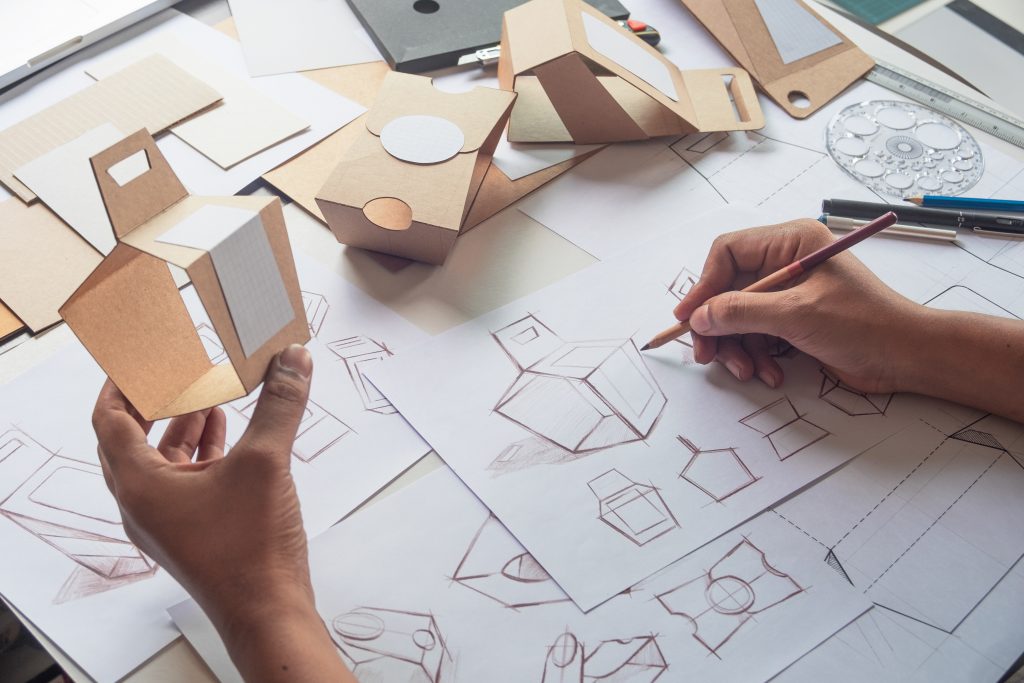
The main value of prototyping (see more here) is the ability to turn ideas into concrete, testable items. You can’t hold a drawing. A prototype reveals properties like size, weight, shape, and feel that a file on a designer’s or engineer’s computer can’t. Prototypes let teams learn about and refine design and manufacturing decisions early in the development process and before significant time or money has been invested.
Physical Models Reveal Hidden Problems
A simple physical model of the product shows issues like a button that’s difficult to reach, a lid that sticks, or a confusing feature set before the problem is embedded so deeply that it’s difficult and expensive to correct during production. Having a physical model in hand means that discussions about how the product feels and looks don’t rely on people’s “likes” and instead reflect observable behavior and reactions. When everyone has a clear understanding of what’s not working, it’s much easier to decide the next steps and implement a solution.
Choosing the Right Prototype
Prototypes come in a variety of shapes and types and are often made in a series from simple to more elaborate and complex. The type of prototype a project needs varies by discipline and stage:
- Form models focus on size, proportion, shape, and balance.
- Functional models explore connections, fit, movement, and basic usage.
- Testing products are used to surface ergonomics and other issues.
- Pre-production models explore the behavior of materials and manufacturing approaches, as well as assembly challenges.
The ultimate goal is to build products that look beautiful, work effectively, and can be made reliably. When teams spend time polishing a prototype’s appearance before fully understanding how it works, it leads to wasted effort and lost time.
Iteration Keeps Development Moving
Successful products are the result of an iterative process: make, test, learn, and then make a new prototype; the practical side of rapid prototyping starts there. Teams learn about what works, what doesn’t, and where there may be challenges. Building around one major design assumption, testing the prototype against real-world requirements and uses, gathering data, and documenting the process allow the design team to make changes and fixes before the next build.
Early and often is the mantra that keeps the process moving. Problems are opportunities to learn and adjust a design, and when a team makes and tests prototypes on a regular basis, changes to the design are simply part of the process and don’t lead to large batches of manufactured goods being thrown away. Making a prototype to understand the most challenging assumption of a project takes precedence over polishing a finish that is already well understood. Once the product and manufacturing processes are well understood and the remaining changes are surface-level, it’s not necessary to go through another prototyping cycle.
What Should Product Testing Cover?
Testing a product prototype reveals many issues, including a weak joint, a poor fit between pieces, an inaccessible control, an overly time-consuming assembly process, and a lack of durability or consistency from product to product. Product teams test for setup and operation, as well as storage, maintenance, transportation, and the inevitable errors in use that occur.
Once a team has an idea of what they want to learn, it’s helpful to test the prototype in a realistic way and to document results using photos, measurements, notes, and other information. This process helps prevent the recurrence of known issues and provides information to the project team and decision-makers as the project continues to move along. A product that works well in a controlled environment may reveal challenges in mass production, and vice versa. It’s important to test thoroughly and to repeat tests as necessary to make sure problems have been solved for all scenarios.
From Validated Design to Manufacturing
Once a design has been thoroughly tested with prototypes and the details worked out, it’s not automatically ready for manufacturing. At that point, teams focus on other variables such as production processes and tooling, materials availability and specifications, production speed, quality control, acceptable limits for errors and costs – more info at https://www.sciencedirect.com/science/article/pii/S2214860424006092. Building a product requires compromises, and accounting for manufacturing considerations early on can make it easier to make decisions about thickness, construction techniques, and product features.
When a team builds a new prototype, they should be able to define the purpose of the model and describe the design questions it will answer. The goal is to build to the level of fidelity necessary to answer those questions and determine if the answers are acceptable. Each successive prototype should refine the design and move the project forward.
The process starts with a list of assumptions, the ideas that the team believes to be true but are not completely certain of. Teams rank their assumptions and build a prototype based on the three that, if incorrect, would take the longest to resolve or have the greatest impact on costs.