


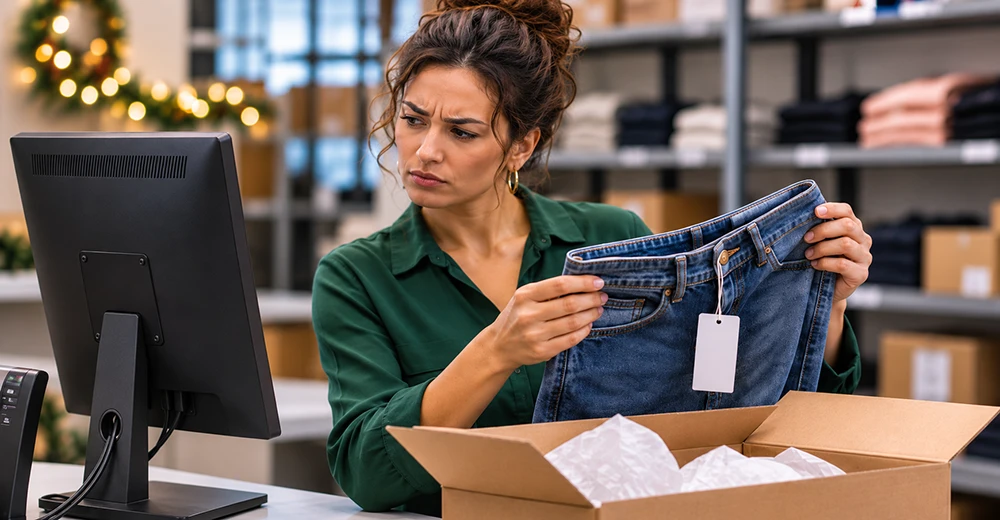
While merchants look forward to a revenue boost from holiday sales, they don’t look forward to the rise in returns during the period, especially fraudulent ones.
“Return fraud is a major problem for retailers, and it’s getting more attention every year,” noted Laura Perdomo, vice president of location operations and partnerships at Happy Returns, a UPS-owned company that manages returns for online retailers.
“When we surveyed retailers this year, 94% told us return fraud is a significant issue for their business,” she told the E-Commerce Times. “That’s the highest we’ve seen in three years.”
“And with the holidays here,” she continued, “most retailers expect it to get worse before it gets better.”
Chad Brinton, general manager of strategic accounts at Atomic, a Boston-based AI supply chain planning platform, added that return fraud has become an organized operation.
“Fake shoppers will trade fraud playbooks in online forums, learn return policies inside and out, and then Photoshop labels and tracking pages to claim refunds on products they never sent back,” he told the E-Commerce Times.
He recalled one scheme that cost a company US$100,000 in one month before anyone connected the dots across the customer service team.
“This holiday season, the brands that can spot fraud patterns across scattered data in real time will be the ones that can afford to keep free returns,” he said.
“But everyone else risks swinging to punitive policies that punish their honest customers.”
Punitive Policies Risk Customer Wrath
Punitive return policies can backfire on retailers as well as their customers.
A recent Blue Yonder survey of more than 5,000 consumers across the U.S., Australia, France, Germany, and the U.K., including 2,000 Americans, found that 63% of U.S. consumers would not pay a fee to return a product. Another 82% would shop less often or stop shopping entirely at a retailer that restricted their returns because they returned items too frequently.
It also found that more than half of U.S. respondents (51%) said that they have decided to buy from one retailer over another purely because it had a better returns policy, while nearly one-third (29%) have gone further and stopped shopping altogether at a retailer that implemented a stricter return policy in the last year.
“The instinct when returns go up is to tighten the rules,” Blue Yonder CEO Duncan Angove said in a statement. “But the data tells you how that ends.”
“Flag shoppers as frequent returners and limit their returns, and eight in 10 say they’d cut back or walk away,” he continued. “And some of your most frequent returners are your best customers.”
“The challenge is telling the difference between a shopper who abuses returns and a loyal customer who simply returns a lot,” he added.
$75 Billion Problem
Return fraud is one of the biggest and least visible profit leaks in retail, observed Gaurav Saran, CEO of ReverseLogix, a returns management company in Burlingame, Calif.
He said that U.S. shoppers sent back roughly $850 billion in merchandise last year, and retailers estimate about 9% of those returns were fraudulent. “That’s a $75-billion-plus problem,” he told the E-Commerce Times.
“And the refund is only the start,” he added. “A very bad return also carries shipping, labor, inspection, and inventory that often can’t be resold.”
Across the brands, he continued, the pattern is consistent. “The companies that lose the most to fraud are the ones still treating returns as a customer-service function instead of a core operational and loss-prevention discipline,” he asserted.
Rustam Bagautdinov, a payment infrastructure expert based in London, agreed that return fraud and refund abuse cost retailers significant losses — roughly 9% to 15% of e-commerce returns.
“Lost inventory is only part of the hit,” he told the E-Commerce Times. “Merchants lose non-recoverable interchange and processing fees on the initial authorization, pay another gateway fee to push the refund and risk breaching Visa and Mastercard dispute-to-sales thresholds when refund abuse overlaps with chargebacks.”
‘Not as Described’ Fraud
Return fraud is a serious threat to retailers, especially when their own product information makes fraudulent claims harder to spot, maintained Romain Fouache, CEO of Akeneo, a global product information and experience management company.
“Return fraud hides in a ‘gray zone’ that’s made possible by bad product data,” he told the E-Commerce Times.
“If your product listing is vague or missing key elements like images, descriptions, or materials, the easiest return claim to make is ‘item not as described,'” he explained.
He cited research showing that 59% of consumers have returned a product because its online description was inaccurate or misleading.

“This is a great cover for fraudsters to hide their returns among a sea of legitimate ones,” he said. “This also means retailers now pay twice for the return. Once when they process it and then again when they have to restock that inventory.”
“For retailers, this is also the hardest claim to verify, which is why fraudsters use it so often,” he continued. “Complete product data makes this claim verifiable against what the page actually says, so retailers can determine if the return is legitimate or not.”
Case of the Mishandled Delivery
Jonathan Solis runs Whisker Bark, an online seller of mobility and wellness gear for dogs in Miami, Fla. He said he’s experienced return fraud, but in very few cases.
He recalled a case where UPS mishandled a shipment. “The customer said the package was broken and wanted a full refund,” he told the E-Commerce Times. “I offered a free exchange and asked them to open the package and send photos, because I needed proof to open a claim with UPS, who was at fault.”
“The customer declined to open it or send photos,” he continued. “Then they filed a chargeback, saying the product was not as advertised, which was very odd.”
“If you want to send something back, I will send you a completely free return label,” he explained, “but when you file a chargeback, there’s nothing I can do. Most of the time, the bank won’t even listen to the seller. They just try to please the buyer.”
Nordic Lifting, in Woodville, Texas, designs and sells weightlifting accessories and fitness equipment. Founder Henrik Andersson said he analyzed some 7,400 customer conversations since the company set up shop in 2013. “Delivered But Never Received came up in about 25 to 30 conversations, and in at least five, the package turned up later,” he told the E-Commerce Times.
“Empty-box claims came up about 15 times, and we have had real packing mistakes, so I can’t assume any of them was a scam,” he continued.
“My rule on small orders is to ask for a photo or a short video and nothing more,” he said. “I look harder only when the same customer keeps making claims. Accusing an honest customer costs us more than the occasional bad claim does.”
Reinforcing Long-Term Customer Value
Beyond the immediate cost of a fraudulent return, retailers must consider how fraud checks can affect customer loyalty and long-term value, explained Fernando Pedraz, CEO and founder of Reveni, a multinational returns management company headquartered in London.
He cited Reveni data showing that 79.9% of shoppers choose an instant refund or exchange when offered, and those who receive an instant refund repurchase at 7.8% within three days, compared to 4.3% for those who wait for a standard refund. After 30 days, the gap remains: 19.2% versus 16.4%.
“A fraud check that delays every return process can impact the long-term value of that customer,” he told the E-Commerce Times. “We believe brands should seek ways to make the customer experience optimal without the risk.”
Dinoop Dayanand, a user experience designer based in Cupertino, Calif., pointed out that detecting a suspicious return is only one part of the problem. “The next challenge is giving the customer care team enough evidence and flexibility to resolve it fairly,” he told the E-Commerce Times.
“When deciding whether a fraud check is worthwhile, retailers should consider the potential loss alongside the time required to investigate, the additional support contacts it may generate and the impact on a legitimate customer,” he advised.

“Resolution speed should be evaluated alongside decision accuracy, overturned decisions and customer trust,” he said. “A quick resolution that wrongly denies a legitimate return can create more support work and cost the retailer a customer.”
He explained that when information is scattered across systems, time spent searching for evidence leaves less time to understand the customer’s situation. “Linking order history, delivery evidence, return reviews and past support gives the agent a quick way to investigate the issue without the customer having to repeat what happened,” he noted.
“Using AI can help summarize that and bring attention to any discrepancies,” he continued. “However, the agent must understand why the case has been flagged and have guidelines on how to escalate if there isn’t enough evidence.”
Rich Pleeth, co-founder of Finmile, an AI logistics SaaS company in London, agreed that AI can help flag inconsistencies for review, but warned, “An unusual pattern is a reason to investigate, not proof that a customer is dishonest.”
“Keep the underlying evidence available and give genuine customers a route to challenge mistakes,” he told the E-Commerce Times.
AI Works Both Sides of Return Fraud
AI can be used to detect fraudulent returns mainly because return fraud comes down to pattern recognition, maintained Aimee Simpson, director of product marketing at Huntress, a cybersecurity platform provider in Columbia, Md.
“AI is great, because it can spot things that a person reviewing returns one at a time might miss, like the same address being used for several accounts or a customer who has a higher-than-usual return rate,” she told the E-Commerce Times.
“It is also helpful with image comparison,” she continued. “AI tools can quickly check the photo of a returned good against the original product listing and catch things like swapped items and ‘damaged’ claims that don’t add up behind the scenes.”
On the other hand, fraudsters can use AI, too. “We’ve seen people use AI to generate fake videos and use them to make claims against us, like my phone caught fire, my phone suddenly stopped working, so you need to refund me,” said Steven Athwal, CEO and founder of The Big Phone Store, a refurbished phone seller in Wolverhampton, England.
“Luckily, AI is pretty good at detecting itself, so we can ask AI detectors to check the videos that we receive and tell us if they seem AI-generated,” he told the E-Commerce Times.
“AI has become a weapon on both sides,” added ReverseLogix’s Saran.
“Heading into January’s returns peak, the retailers that treat returns as a data and supply-chain discipline will protect their margins,” he said. “Those that treat returns as a back-office cost center will keep paying for it.”