


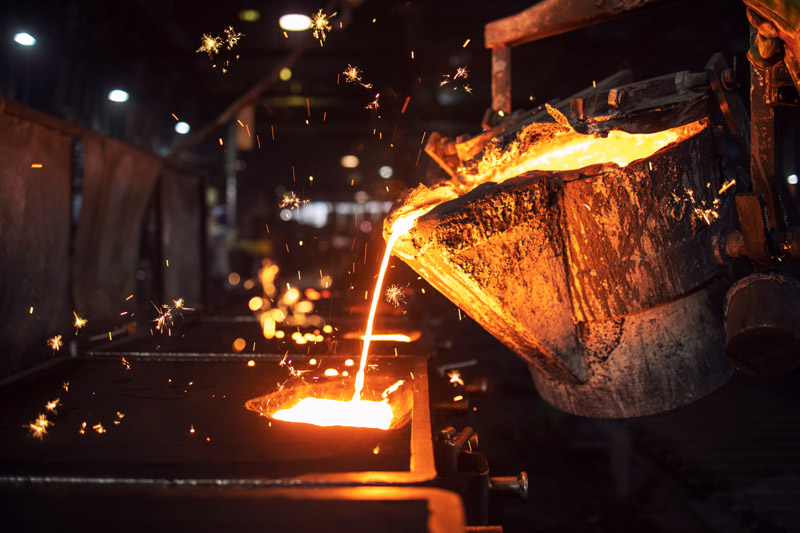
America hasn’t built a primary aluminum smelter since 1980. That’s about to change — in Oklahoma, with a $4 billion commitment from a sovereign wealth-backed company out of Abu Dhabi. In Episode 13, we use that deal as a lens on a bigger question: what does it actually take to rebuild American industrial capacity right now?
Three stories. First, Oklahoma Department of Commerce CEO John Budd on how the state won the Emirates Global Aluminum deal — and why the incentive structure mattered as much as the dollar amount. Then, a look at “active infrastructure”: the Sacramento utility rethinking reserve grid capacity, the city manager building a semiconductor corridor on existing strengths, the engineer who saved a client $300 million by putting sensors on storm drains, and the Johnson Controls VP whose buildings adjust their setpoints every 15 minutes. Finally, Stephen Tucker at Buffalo’s Northland Workforce Training Center about a workforce gap that’s hiding in plain sight — not in solar or wind, but in the building technicians that every facility in the country needs and can’t find.
Guests: John Budd (Oklahoma Dept. of Commerce), Lora Anguay (SMUD), Micah Runner (City of Rancho Cordova), Raja Kadiyala (Sidara), Jamie Cameron (Johnson Controls), Stephen Tucker (Northern Workforce Training Center).
The last primary aluminum smelter built in the United States broke ground in 1980. Ronald Reagan hadn’t been inaugurated yet. The personal computer wasn’t a thing. That’s the benchmark — and Oklahoma just blew past it.
Last spring, the state signed a memorandum of understanding with Emirates Global Aluminum, a sovereign wealth-backed company out of Abu Dhabi, for a $4 billion facility that would be the first new primary aluminum smelter in the country in nearly half a century. A thousand permanent jobs. A project that, if the downstream thesis holds, could pull aerospace suppliers, drone manufacturers, defense contractors, and critical mineral producers into its orbit.
Episode 13 of the Site Selection and Facility Planning podcast uses the Oklahoma deal as a starting point for a bigger question: what does it actually take to bring industrial production back to America in 2026? The answer, across three stories, turns out to be less about subsidies and more about systems.
Oklahoma’s pitch was simple — and structural
John Budd, CEO of the Oklahoma Department of Commerce, explains that the EGA deal came down to two things: power and logistics. Oklahoma has cheap, abundant electricity and the deepest inland ice-free ports in the United States — a river system that connects to global shipping, plus 3,500 miles of railroad and three major interstate highways.
On incentives, Oklahoma made a choice worth understanding. Instead of a large upfront payment, they structured the deal as payments over time — letting the state monitor performance while giving EGA a way to offset ongoing operating costs rather than sit on a lump sum. Budd’s biggest worry between now and groundbreaking? Business certainty. “If I can kick my groundbreaking back ninety days and save ten percentage points in tariffs, that is an issue,” he says.
1980
First production is expected as early as 2030.
The fastest infrastructure to build is the kind you don’t have to build
The second story is about a different kind of constraint. Demand for power — from data centers, advanced manufacturing, reshoring — is moving faster than new grid capacity can follow. Permitting timelines are long. Build costs are up. So what do you do when your infrastructure is stuck but you need it to work better?
Lora Anguay at SMUD has an answer. Instead of building new capacity, SMUD is rethinking how it uses the reserve capacity that already exists — and exploring partnerships with data centers that can temporarily shift to backup generation during grid constraints, freeing capacity for other customers in real time.
Micah Runner, city manager of Rancho Cordova — the hub of Sacramento’s semiconductor push — puts it this way: start from a position of strength. Build on what’s already there. His model for the city’s power needs isn’t one giant campus; it’s 20 to 50 megawatts spread across multiple research and development locations.
Raja Kadiyala at Sidara calls the broader concept “active infrastructure.” Traditional infrastructure is designed for a singular purpose; when that purpose changes, you rebuild. Active infrastructure is designed to adapt. He cites a client that avoided $300 million in new construction by putting sensors on existing storm drain storage and managing it more intelligently. “The fastest infrastructure to build,” Kadiyala says, “is infrastructure you don’t have to build.”
At the building level, Jamie Cameron at Johnson Controls describes the same principle playing out every 15 minutes — buildings that pull in weather data and internal system data and adjust setpoints continuously, extending equipment life, cutting energy costs, and freeing facilities staff for higher-value work.
The workforce gap is hiding in plain sight
The third story is about people. Stephen Tucker runs the Northland Workforce Training Center in Buffalo, New York. This July, they open a clean tech lab training building maintenance technicians and clean energy workers, alongside a Western New York Experience Center — a public-facing facility designed to make the energy transition legible to people who aren’t in the industry. (Inside, among other things: a scale model of a Westinghouse small nuclear reactor.)
Every 15 Minutes
Tucker’s core argument is that the real shortage isn’t in solar or wind. It’s in building engineers and facilities technicians — the people responsible for keeping every hospital, school, and office building running. “Every building in the country has a building engineer,” Tucker says. “And we don’t have enough technicians to fill those roles.”
His center is already training workers for Edwards Vacuum, which is building a new facility between Rochester and Syracuse. Current enrollment is 60 percent people of color and 10–15 percent female — meaningfully different from an industry where those numbers are typically below 20 percent and 5 percent, respectively.
The thread
Oklahoma betting on aluminum. Sacramento rethinking its grid. Buildings and infrastructure that optimize themselves in real time. A workforce center training for jobs that are still being invented. The throughline: communities and companies getting ahead of something that’s arriving faster than our infrastructure, our policy, and our workforce were built to handle.