The Trump administration’s recent decision to block foreign access to advanced artificial intelligence (AI) models has reignited AI sovereignty debates – where nations strive to build and maintain their own AI, rather than using models developed elsewhere.
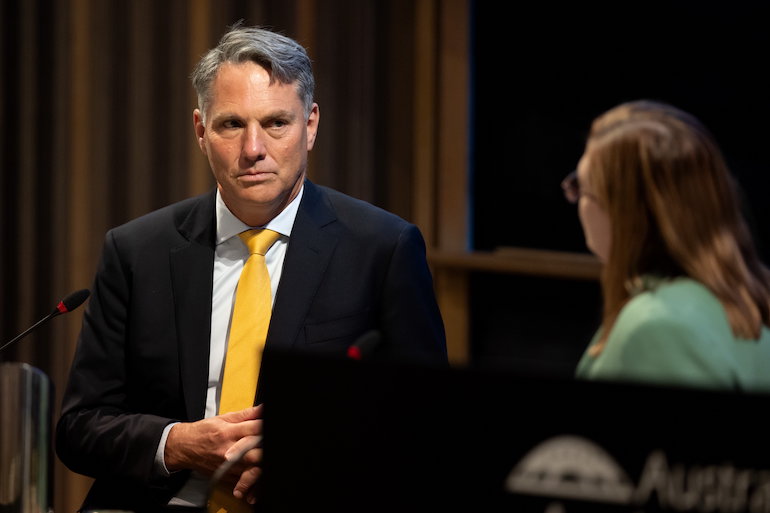
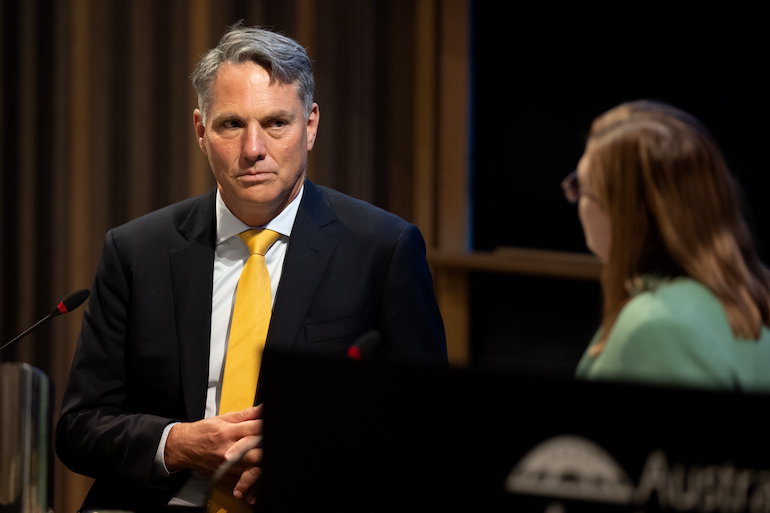
Recently, Defence Minister Richard Marles weighed in, telling a defence conference that Australia should “build some agency” in relation to AI.
But what does such “agency” look like? Australia can’t brute force its way to frontier AI capability. The costs are prohibitive and Australia has few natural advantages.
Instead, the immediate priority should be influencing how the United States shares AI models with allies for collective benefit.
What’s frontier AI?
Frontier AI refers to large-scale models that have cutting edge performance across a range of tasks. Earlier this month, the US government slapped export controls on Anthropic’s latest frontier models – Mythos and Fable – over concerns that their safety guardrails could be bypassed or “jailbroken”.
Anthropic insists its guardrails are robust compared to other widely available models. The White House claimed they’re too dangerous to release to non-US citizens.
Whatever the claims and counterclaims, the ban sent governments and businesses scrambling for workarounds. Even though the export controls have now been lifted, the episode raises troubling questions about the future of frontier AI access for everyday consumers.
Not just ‘teething problems’
The stakes are high because models like Mythos are especially good at finding software vulnerabilities. Cyber security leaders urged the US government to lift the export controls so as to not take the best models away from coders and other security professionals who uphold cyber security.
Marles described the export controls as “teething problems”. AI policy expert Dean Ball, who previously advised Trump’s AI strategy and will soon join OpenAI, has been less reassuring.
Ball expects that a US licensing regime for AI models is inevitable but it will be “informal, with no consistent rules or firm boundaries on state power or public transparency”.
That is perhaps the worst possible scenario for countries like Australia that rely heavily on American technologies. Australia may find itself in a long queue for the latest models, or navigating an opaque licensing regime where access can be abruptly revoked.
Australia already faced a two-month delay to access Mythos Preview, Anthropic’s restricted model for trusted cyber organisations. The White House is also now controlling access to OpenAI’s latest GPT-5.6 model, starting with a small number of approved US organisations.
As concerning as these events are, Australia should not see it as a signal to pursue frontier AI. That would be an inefficient – and probably unsuccessful – use of Australia’s limited resources.
Why Australia shouldn’t make its own frontier AI
First, consider the price tag. The eye-watering cost of training a frontier model is forecast to exceed a billion US dollars by 2027.
Then consider the experience of countries such as France, the United Arab Emirates, Japan, South Korea, India and Switzerland, who have all invested billions into domestic AI capability.
These investments help to improve technological choice, redundancy and national AI skills – all worthwhile goals. Yet none of these countries have so far produced an AI model with comparable performance to leading American or Chinese ones.
And performance does matter. Crucially, it matters when AI is used for national security, such as finding malware or providing battlefield support. In these use cases, accessing the best models with the least delay enhances defence and deterrence.
Instead of competing at the frontier, Australia should make pragmatic investments where we have greater maturity and agency, for example in critical minerals, data centre infrastructure and specialised data sets for AI training.
In frontier model development, Australia has few advantages and is unlikely to catch up to American firms.
We need to shape our own access
In the near term, a degree of reliance on American frontier AI is inevitable. Nevertheless, Australia can shape what access to such models will look like. We should argue for trusted US allies and partners to have priority access to the most powerful models.
The United Kingdom is reportedly already lobbying for access to future models through a list of whitelisted countries. The matter was also raised by leaders in the sidelines of the latest Group of Seven (G7) Summit.
Alternatively, a system of tiered access could be established: more powerful models could only be available to national security agencies or vetted organisations for defensive purposes. This is similar to how OpenAI already provides differentiated levels of access to its GPT-5.5-Cyber model depending on the user and use case.
Where there are concerns about jailbreaking, independent experts should evaluate AI models and recommend additional safeguards. This creates a more transparent system where models are blocked surgically and only when backed by verifiable evidence.
Australia’s new AI Safety Institute, together with safety institutes in like-minded countries, could contribute to this technical work.
Lastly, Australia should remind Washington that frontier AI provides a powerful tool for allies and partners to contribute to collective security – from securing critical infrastructure to driving the economic growth that funds defence spending.
Hoarding the technologies, on the other hand, sows doubt about the United States’ reliability as a technology supplier and a security partner. The recent events with Mythos have certainly done that.
The next Mythos is just around the corner. Australia can either be proactive with shaping the rules of access now or accept a future where the rules lock us out.
This article is republished from The Conversation under a Creative Commons license. Read the original article.