


While commercial and foreign direct investment has cooled considerably heading into 2026, one sector of the U.S. economy is experiencing a renaissance unlike anything seen in decades: defense aerospace. For site selectors and industrial developers paying attention, the implications are profound — and the window for smart positioning is now.
A Changing Investment Landscape
On the commercial side, the story is one of caution. Foreign direct investment outside of defense-related activity has slowed markedly, with international firms deterred by shifting U.S. policy and the kind of tariff unpredictability that makes it difficult to build a business model that will survive a boardroom. The reality is straightforward: if tariffs are to be used as a policy tool, stability is essential. Uncertainty, by contrast, freezes capital.
Domestically, higher interest rates — a world away from the near-zero cost of money during the Obama era — have tightened the filter on which projects move forward. That’s not entirely a bad thing. Higher borrowing costs force better project screening, weeding out marginal ventures and focusing capital on genuinely viable opportunities.
The window for smart positioning is almost closing.
Defense: From $500 Billion to $1.5 Trillion
The contrast with the defense sector could not be sharper. When Obama-era budgets hovered around $500 billion per year for defense and NASA combined, the trajectory was modest. Today, the defense budget has nearly doubled to just under $1.0 trillion, with the executive office requesting $1.5 trillion for the current fiscal period. Layer on top of that an additional $150 billion in supplemental legislation, and the pending Ships Act — which would offer a 25% federal tax credit for shipyard investments and a 33% credit for building U.S.-flagged commercial vessels — and you have a capital formation environment without modern precedent.
The Maritime Opportunity
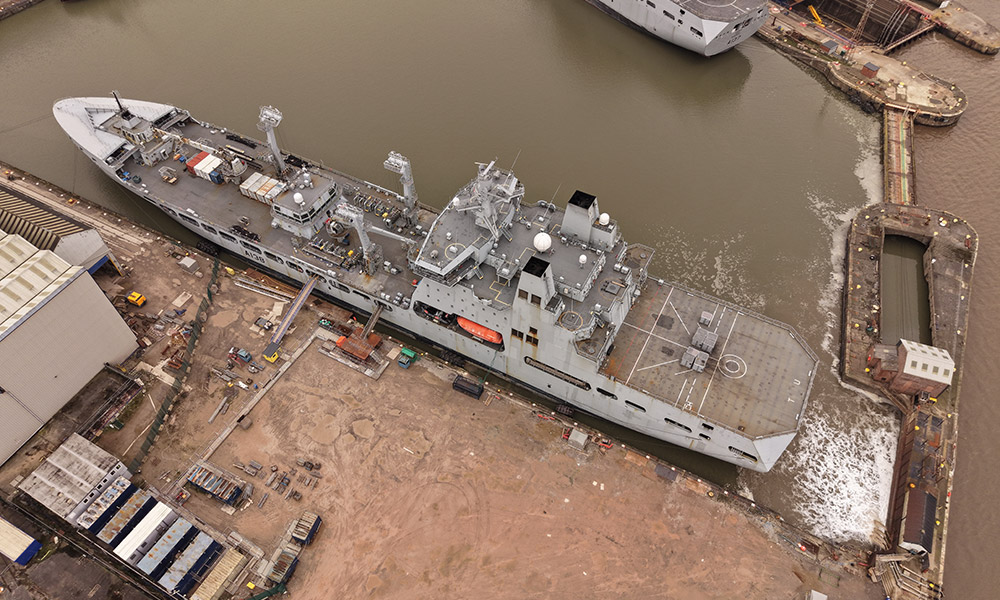
Nowhere is this more visible than in maritime. The U.S. Navy is undertaking a sweeping recapitalization: replacing the entire Ohio-class ballistic missile submarine fleet with Columbia-class boats, sharply expanding Virginia-class attack submarine production, and adding new missile destroyers, frigates, and the proposed Trump-class battleship. The goal is to grow the fleet from roughly 300 ships to 350 or more — enough to address a Pacific threat while maintaining an Atlantic deterrent.
$1.5T
This naval buildup is catalyzing a broader rebirth of U.S. commercial shipbuilding. The country’s largest shipyards — historically military yards that took on commercial work to fill capacity gaps — are now positioned to anchor an entirely new commercial shipping industry. The recently completed shiplift-based shipyard in Jacksonville, Florida, is one example; at least two additional Florida facilities are in the approval process. And the growth is not limited to coastal yards. Significant shipbuilding activity continues along the Great Lakes and inland river systems — a reminder that, as the industry says, it’s the systems inside the ship, not just the hull, that represent the bulk of the investment.
Air, Ground, and the New Drone Frontier
The aerospace story extends well beyond the waterline. The Air Force is extending the service lives of legacy platforms — F-18s, B-52s, C-130s — while simultaneously accepting steady deliveries of new F-35s and F-16s from Lockheed Martin and advancing Boeing’s next-generation F-47. Capacity at the three Air Logistics Centers (Tinker, Hill, and Warner Robins) is already strained, forcing more maintenance work into the private contracting community — creating durable demand for qualified MRO vendors.
A capital formation environment without modern precedent.
On the ground, Army contractors are being asked to double and triple weapons system production within two to three years to replenish depleted stockpiles. And across every domain, the Russo-Ukrainian conflict has validated an entirely new category: autonomous systems. Drone fighters, drone submarines capable of lying dormant for months, battlefield surveillance platforms — companies like Shield AI, Anduril, and Saronic are leading a new generation of defense innovators who require more software talent than traditional capital investment.
Infrastructure Investment and State Incentives Align
For the first time in decades, the Pentagon appears committed to paying for the infrastructure upgrades the defense industrial base needs. Many facilities date to the World War II era and are at or beyond the end of their useful lives. The Defense Production Act Office has seen its budget bolstered, Initial Production Facilitation funds are embedded in major contract structures, and facility-specific grants are available at the federal level. Meanwhile, states and localities — well aware that aerospace jobs routinely pay in excess of $100,000 annually — are competing aggressively to attract and retain this workforce.
350
The international market adds another layer of demand. The demonstrated failure of Russian and Chinese military hardware in Ukraine, Iran, and Venezuela has refocused allied nations on the value of American-built systems. Having the second-best military technology, as events have made clear, is not a strategic advantage — it is a liability. Despite some turbulence in F-35 international sales, global appetite for U.S. defense products remains strong.
The bottom line: every military contractor in this space is being pushed to expand production significantly — driving demand for new facilities, new tooling, and new talent pipelines. And history tells us that the technologies developed under these conditions rarely stay inside the fence line. Microwave ovens, cell phones, GPS, the internet itself — all are the commercialized descendants of military research. The next wave is already in motion.