


Home Depot made its name as a DIY retailer. Now it wants more pros.
The US home improvement giant is spending billions of dollars to attract new business from professional contractors and builders beyond its traditional retail customer base. A series of deals has tacked on wholesale distributors of roofing shingles, drywall and ductwork whose warehouses lack the stencilled brand name or distinctive orange awnings of Home Depot stores.
“Win the pro” has become a mantra inside Home Depot’s Atlanta headquarters as an affordability crunch saps the US housing market. Higher interest rates are throttling the sales turnover that sparks fix-up spending. The cost of a typical remodelling project has soared by 45 per cent since 2019, according to John Burns Research and Consulting.
Even if the market is not expanding, Home Depot executives believe they can command a larger piece of it by gaining more spending from professionals.

Ted Decker, chief executive, told the FT: “With housing turnover as low as it is, totally flat with no growth in new construction, our growth has to come from share capture right now.”
The slow market has weighed on the stock price of Home Depot, which at an equity value of $350bn is the third-biggest US brick-and-mortar retailer by market capitalisation. Executives forecast total sales will increase by 2.5 per cent to 4.5 per cent this year, significantly less than average growth in the years before the pandemic.
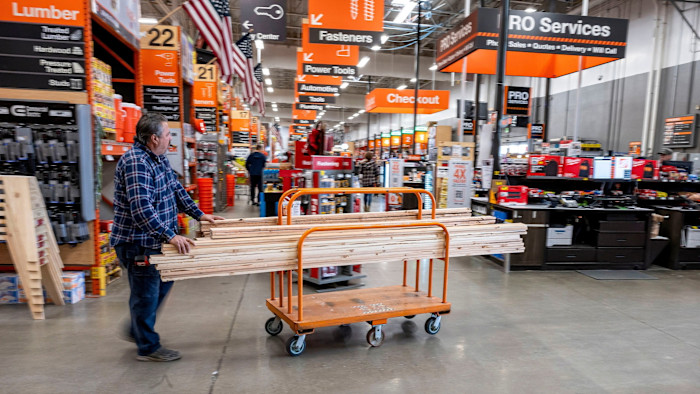
Pros have long made up a substantial chunk of Home Depot’s business. Stores stock high-end power tools and feature “pro desks” to help with large orders. Car parks reserve spots for pros’ trucks. With tall ceilings and floor areas of about 100,000 sq ft, the chain’s stores are designed like commercial warehouses that happen to be open to the public.

But serving novices eager to install their own sink or stain a deck has defined Home Depot’s brand since founders Arthur Blank and Bernie Marcus opened their first locations in 1979. “At the heart of it was the belief in the concept of do-it-yourself,” Marcus wrote in his memoirs.
The company has more than 2,350 retail stores across the US, Canada and Mexico. Lowe’s, Home Depot’s biggest competitor, has more than 1,750 locations. Opportunities to win more DIY customers are limited.
Michael Lasser, an analyst at UBS, said: “If there is any problem that Home Depot has, it’s that in certain categories and in certain segments of the market, it has very high market share. It’s looking to address more segments of the market.”
Some 9mn professional customers account for $90bn in annual sales at the chain, more than half of its $165bn in total sales last year. But executives say this is only a fraction of the total pro market of $700bn.
“We have the right to win all $700bn in the pro market,” Richard McPhail, chief financial officer, told an industry conference this month.
Contractors and builders mainly visit Home Depot stores to replenish supplies and make emergency purchases, executives said. A custom homebuilder getting all the necessary framing, drywall, sheathing and windows for a house would quickly empty a store.
To capture more of their business, Home Depot is expanding well beyond retail locations.
It is trucking specialised products directly to construction sites, opening 17 “flatbed distribution centres” around North America and financing contractors’ purchases.

Executives are also charging into wholesale through deals, acquiring roofing, landscaping and pool supply company SRS Distribution for $18.3bn in 2024, then drywall and steel framing specialist GMS for $5.5bn last year.
SRS, with 1,200 locations, intends to open 40 to 50 more a year and has itself been an aggressive acquirer of businesses large and small. In February it purchased a New York lumberyard that employs 18 people. In March it agreed to buy Mingledorff’s, an 87-year-old heating, ventilation and air-conditioning distributor that UBS estimates will cost $1bn to $2bn.
Rivals have joined the dealmaking. Lowe’s last year paid $8.8bn for Foundation Building Materials and $1.3bn for interior specialist Artisan Design Group as it chases pros.
QXO, a building products distributor formed by billionaire dealmaker Brad Jacobs, was outbid for GMS but on Sunday agreed the $17bn purchase of insulation company TopBuild, its latest in a series of acquisitions as it aims to roll up the sector. Jacobs argues consolidation in the industry, with 7,000 businesses across North America, is overdue.
Decker has more modest ambitions. “We’re not saying we’re the consolidator,” he said. Home Depot’s future deals are likely to be smaller “bolt-on” transactions that supplement the building products categories covered by SRS, GMS and Mingledorff’s, he added. “I wouldn’t expect us to do a big blockbuster vertical [category].”
Homebuilder Michael Barnish said he had taken notice of the merger wave among suppliers as he loaded his van with cement, paintbrushes and spackle outside a Home Depot in New Jersey. His cap carried the logo of Lansing Building Products, which he recalled had recently bought a fellow distributor.

“Over the years, you see it. You know, there’s just two or three companies that just keep buying and buying and buying. I don’t know if it’s helping or hurting me,” Barnish said.
Inflation in building products has led to “sticker shock” among customers, said Nishu Sood, principal of research at John Burns. Even so, “it’s really been somewhat of a surprise how weak remodelling has been in the post-pandemic period”.
Existing US home sales, a driver of remodelling demand, slid 3.6 per cent in March to the lowest level in nine months, according to the National Association of Realtors. The trade group recently cut its annual sales forecast after a rise in mortgage rates. New housing starts are far fewer than before the Federal Reserve began to lift borrowing costs in 2022.
Mike Rowe, Home Depot’s executive vice-president of pro, acknowledged contractors are as exposed as homeowners to a softer housing market.
“When you think about it, the pro often is an extension of the consumer. They’re simply choosing to have their work done in a do-it-for-me fashion as opposed to a DIY fashion,” he said.

Shares of Home Depot have declined about 9 per cent since the SRS purchase was agreed. Josh Cummings, a portfolio manager at Janus Henderson Investors, said the wholesaler deals have been weighing on profit growth. “You’re adding a lower-margin business,” he said.
But Cummings, whose firm is a Home Depot shareholder, said the new businesses would pay off. “You’re buying customers, you’re buying technology, you’re buying salespeople, you’re buying trucks, you’re buying service centres,” he said.
Catering to contractors does not mean abandoning DIYers. “That core business has to remain robust and relevant,” Decker said.