


Happy Labor Day weekend everyone. Perhaps some of you are in the market for a new car this weekend. I’m definitely not.
After almost a year of deliberating between replacing my 2015 Range Rover Sport or continuing to fix it, I’ve finally decided to keep fixing it indefinitely.
The main reason is that we may relocate to Honolulu in 2028 for my son’s 6th grade year and my daughter’s 3rd grade year. If we’re in Honolulu, I could take care of my parents, which would be an honor.
Buying a new car and then selling it in under two years would be a waste.
The Math On A New Car vs. Fixing The Old One
An exact replacement for my car runs about $110,000 before tax and fees. In San Francisco, the 8.625% sales tax adds roughly $9,500, and California registration on a vehicle that expensive runs over $1,000 in year one. Call it $120,000 out the door before I’ve driven a single mile.
Luxury SUVs typically shed 20% of their value in year one and another 10% to 15% in year two. On $110,000 that’s $33,000 to $38,500 gone by the time we’d be boxing up the house.
Add the sales tax, which I never get back, and I’m looking at $43,000 to $48,000 to drive a car for 24 months. That’s roughly $1,800 to $2,000 a month, and that’s before insurance and gas.
Now compare that to fixing an 11-year-old Range Rover. Even if I spend $3,000 a year keeping it alive, that’s $250 a month. I could have two catastrophically bad repair years back to back and still come out roughly $40,000 ahead.
The math isn’t close. And it gets worse when you factor in that shipping a car to Honolulu costs about $5,000, which is why I don’t plan to ship mine at all. Whatever I’m driving in 2028 gets sold before we go. So a new car purchased today would be a two-year rental at $2,000 a month that I also have to find a buyer for.
But the money wasn’t what finally decided it for me.
That took something that made me cringe, and then feel an enormous amount of relief.
The Hidden Cost Of Owning A New Car
Eight of us met at the pickleball courts at noon on Friday to play until 3pm. We’re all about a 4.0 to 4.75 level, so the games are intense and you sweat profusely.
I saw a spot to parallel park and did my usual maneuver. But something weird happened. I felt resistance going backward despite my right wheel not having touched the curb yet. So I pulled out and tried again. It was a busy street and I didn’t have much time.
Once again I felt resistance going into the spot. So I finally got out to check what was going on.
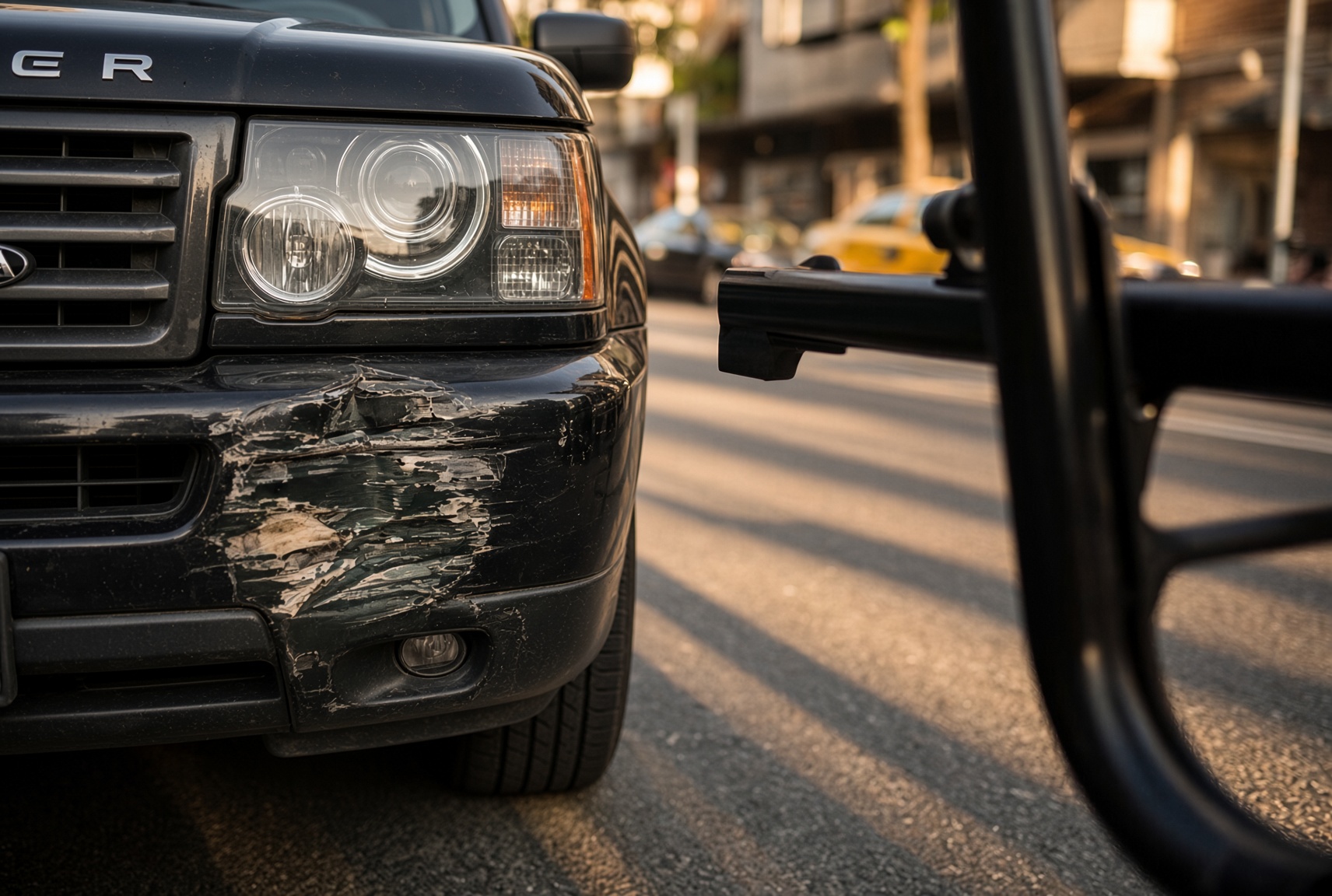
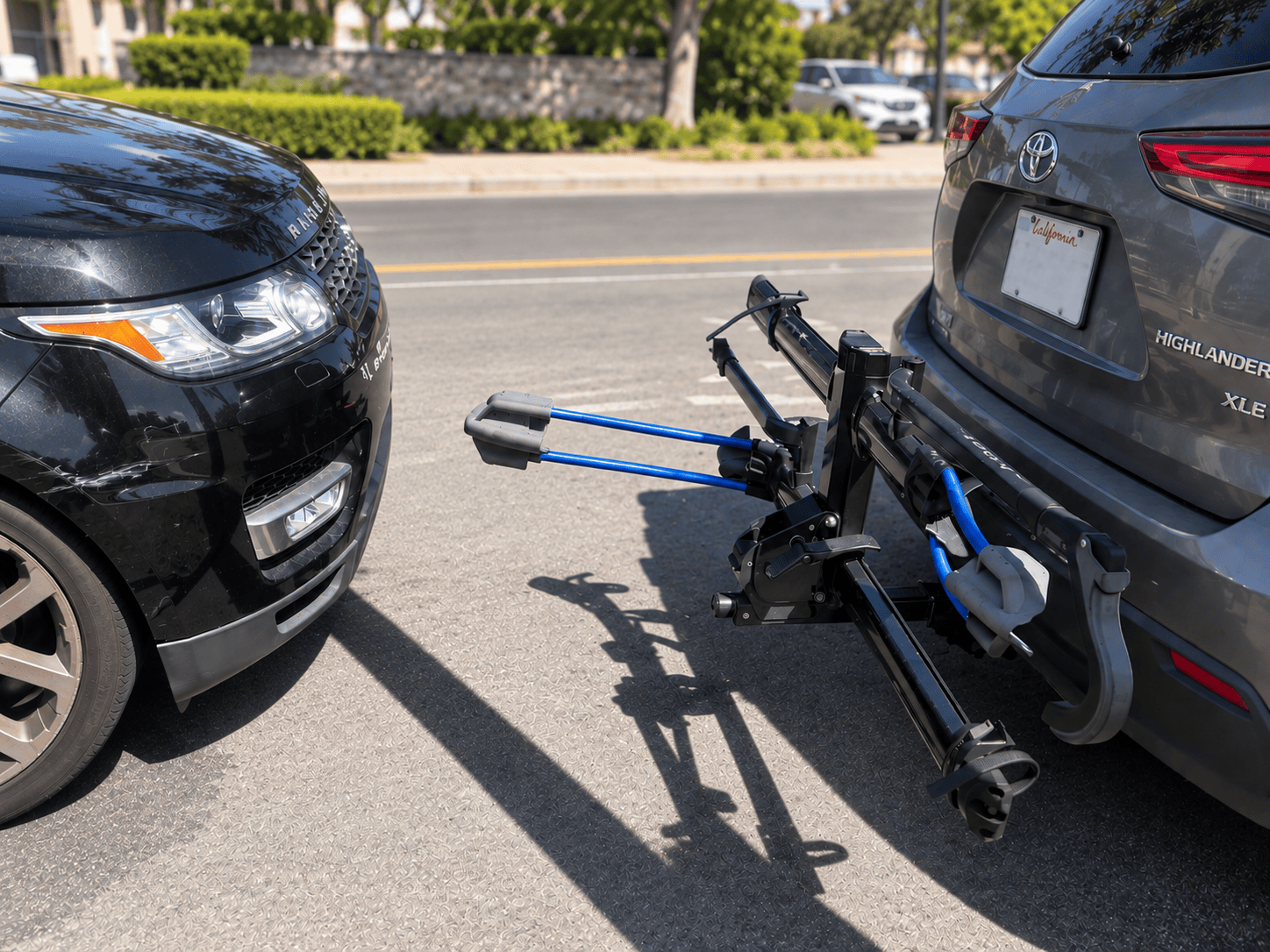
Lo and behold, the right side of my bumper was scraping along a protruding rod from the front car’s rear bike rack.
It was the type that attaches to a hitch down low, so I couldn’t see it from the driver’s seat. And it was sticking out from the back of the car by two to three feet. The driver had left the arm fully extended instead of folding it in.
Three sections of my bumper were indented and scraped. Fixing it properly would run $3,000 to $4,000. That’s an entire year of my Range Rover repair budget, gone to a bumper.
I was furious. Who leaves a bike rack fully extended when there are no bikes on it?
But it’s my fault for not spotting a three-foot metal arm, and I have nobody to blame but myself. Perhaps if I’d left for the courts five minutes earlier I wouldn’t have been rushing to park.
From Anger To Pure Relief
Then something surprising happened. Within about three minutes, the anger turned into relief.
Because I was this close to buying a new or lightly used car when I got back from the summer holiday. If I’d done the same damage to a $110,000 vehicle I’d owned for only a few weeks, I would have felt sick to my stomach.
I have never been happier driving an 11-year-old car already riddled with dings.
We all know the upfront costs of a new car. The taxes, the fees, the insurance, the sticker shock of a $50,000 average transaction price. Those are the numbers everybody runs.
Nobody runs the other one. The hidden cost of a new car is that you start caring what happens to it. Every parking garage or street spot becomes a calculation.
That cost never appears on the window sticker. But you pay it daily, for years, and there’s no way to negotiate it down.
Not Caring Is The Whole Point Of Owning An Old Car
One day, parking at my children’s school, a girl got into the car next to mine and swung her door open hard enough to dent my panel. I was sitting in the driver’s seat when it happened. The mom and daughter didn’t say a thing and drove off.
I was annoyed. Then I let it go, despite the obvious ding.
Same thing with the bike rack. Three minutes of agitation, then nothing. I’m going to gladly leave the bumper exactly as it is. In fact, I might get lucky and have someone hit me in that same spot, so I can get the whole thing fixed and repainted on their insurance.
With old cars, every ding lowers the stakes of the next one. The first scratch on a new car is a tragedy. The twelfth scratch on an 11-year-old car is camouflage.
With an old car, you’re king of the game of chicken. Nobody can take anything from you that you haven’t already given up.
I’ve come to value a car more the older it gets, purely for the peace of mind it provides.
Still Want To Buy A New Car? Know The Four Layers Of Car Pricing
Labor Day weekend kicks off the fall sell-off season. Demand tapers as families shift attention to the school year and holiday spending, and dealers need floor space for next year’s models arriving shortly. That combination produces real discounts.
But most buyers get confused by the definitions and end up paying more than they should. Here’s what you’re actually negotiating against.

Layer 1: MSRP
MSRP is the manufacturer’s suggested retail price. It appears on the Monroney label, the window sticker that’s been federally required since 1958. It includes the destination charge. The word “suggested” is doing a lot of work.
Watch for a second sticker next to it. That’s the dealer addendum, where paint protection, pinstriping, nitrogen-filled tires, and VIN etching appear. This is the highest margin junk on the lot and almost all of it is negotiable to zero.
Layer 2: Dealer Invoice
Dealer invoice is what the dealership supposedly paid the manufacturer. Most buyers treat invoice as the floor.
It isn’t. Here’s why.
Layer 3: Holdback
Manufacturers pay dealers back roughly 1% to 3% of MSRP after the car sells. On a $50,000 vehicle that’s $500 to $1,500 the dealer collects no matter what you paid. So a dealer can sell you a car “at invoice,” look like a hero, and still make money.
That doesn’t mean the holdback is yours to claim. It’s how dealers keep the lights on. What it tells you is that invoice is not a wall. There’s another 1% to 3% of room underneath it, and how much of that room you get depends entirely on how badly they want the car gone.
On a hot model with a waitlist, you’ll pay over MSRP and thank them for the privilege. On leftover inventory at the end of a model year, which is precisely what this weekend is, pushing below invoice is realistic.
Layer 4: Manufacturer-To-Dealer Cash
This is the layer almost nobody sees. These are unadvertised incentives paid to the dealer to move specific inventory.
Right now Honda is running Labor Day Closing Cash on the 2026 Accord, Odyssey, and Ridgeline. It comes as $100 certificates the dealer can stack up to $1,000, and dealers are prohibited from advertising it.
Read that again. There is money on the table this weekend that the dealer is contractually not allowed to tell you about. The only way to reach it is to ask for pricing directly and negotiate.
These programs change constantly, by model and by region. So train yourself to always ask what dealer cash is running on the exact car you want. The worst they can say is none.
Then Ask For The Out-The-Door Price
Once you’ve pushed the price toward invoice and below, ask for one number and one number only. The out-the-door price. Vehicle price plus tax, title, license, and documentation fee.
It’s the only figure that matters and the only one that can’t be quietly rearranged.
Doc fees are where states differ wildly. California caps it around $85. States with no cap routinely see $800 or more, and it is pure profit.
Get the out-the-door number in writing by email from three dealers before you set foot in a showroom. Most of the games require you to be sitting in a chair.
Treat It As Three Separate Transactions
The price of the car, your trade-in, and the financing are three different negotiations. Dealers make money by blending them so you can’t tell which one you lost.
Settle the purchase price in writing first. Don’t mention a trade-in. Don’t say how you’re paying. Only after the price is locked do you introduce the other two.
And be careful with financing. The average 60-month new car loan is running near 7%. Stretching to 72 or 84 months to hit a comfortable monthly payment can erase a 10% discount entirely. If you’re shopping by monthly payment, you’re not shopping by price, and the finance manager knows it.
Here’s a car price negotiation calculator I created to help you get the best deal possible. Once you have some price anchors, you can negotiate with conviction. Remember, the person who cares the least, usually wins the most in a negotiation.
Car Price Negotiation Calculator
Move the sliders to see how far below the window sticker you can realistically push, and what it costs out the door.
What they show you
MSRP plus the addendum sticker of junk fees
1
MSRP
The word “suggested” does a lot of work
2
Dealer invoice
What most buyers wrongly treat as the floor
3
Holdback
Paid to the dealer after the car sells
4
Manufacturer-to-dealer cash
Unadvertised by contract. You only get it if you ask
Your realistic target price
Not guaranteed. Depends on how badly they want it gone
Income needed under the 1/10th rule
The Easy Car Buying Test To Follow
Before any of this matters, run my 1/10th rule for car buying. Spend no more than one-tenth of your gross annual household income on the purchase price of a car.
At $50,000, the average new car requires a $500,000 gross household income. That should tell you something about why so many people feel broke while sitting in a nice vehicle.
The rule sounds harsh. It’s really just the anxiety tax written down in advance. Once a car represents a small enough fraction of your income, you stop caring what happens to it. And the older I get, the more I’d trade horsepower for not caring.
Readers, Over To You
Have you ever felt relief about damaging an old car instead of a new one? What’s the longest you’ve held onto a vehicle, and did it get easier to own the older it got? And for those buying this weekend, what’s the best negotiating tactic that actually worked for you?
If you’re weighing a big purchase like this, my book Buy This Not That goes deep on how to make optimal money decisions when the answer isn’t obvious. It’s a Wall Street Journal bestseller published by Portfolio Penguin, and it’s built for exactly these kinds of forks in the road.
Subscribe To Financial Samurai
If a friend forwarded you this post, join 60,000+ readers and subscribe to the free Financial Samurai newsletter here. To get notified of new posts, sign up here, where you’ll get every article ad-free for the first few hours.
Financial Samurai began in 2009 and is one of the largest independently-owned personal finance sites today. Everything is written based on firsthand experience, because money is too important to be left up to pontification.