



The Gist
- Most marketers are trained too narrowly. Early-career specialization, especially in promotion, limits exposure to product, pricing and go-to-market decisions that CMOs must ultimately own.
- Becoming a CMO requires letting go of tactical mastery. The role shifts from execution and platform expertise to enterprise-level judgment across strategy, finance, risk and long-term growth.
- The leadership gap is structural, not personal. Too little training, mentorship and rotational experience leaves many CMOs learning core business leadership skills only after they reach the role.
I was reflecting on this after a podcast interview I did recently about the pressures CMOs are under, and also my experience of attending a recent B2B marketing conference.
On the one hand, true CMO positions are tough. Not only do they require marketers to have a good grasp on all 4 P’s of marketing (product, pricing, place, as well as promotion), but also broader commercial acumen that can be difficult to pick up in traditional marketing roles.
Table of Contents
The Promotion Pigeonhole Starts Early
Earlier in marketing careers, it’s easy to get stuck in just one of the P’s. For most marketers that’s promotion. You’re the person that runs campaigns and communicates with audiences about all the ways your products are better, best or unique to solve their problems.
However, seldom do those marketers get a say in what that product should be or what it should do (except for a few dedicated product marketers). Fewer still get to set the pricing. Some may get to specialize in placement through distribution (for example in partner marketing or ecommerce roles), but usually one or the other. Not all distribution channels.
The point is for many early-career marketers they get quickly pigeonholed into specialist roles. And the advent of AI and ever more rigorous focus on marketing ROI, encourages even greater specialisation. As technology moves on, marketers need to know the details to get the most from their (promotional) investment.
The CMO Shift From Execution to Enterprise Thinking
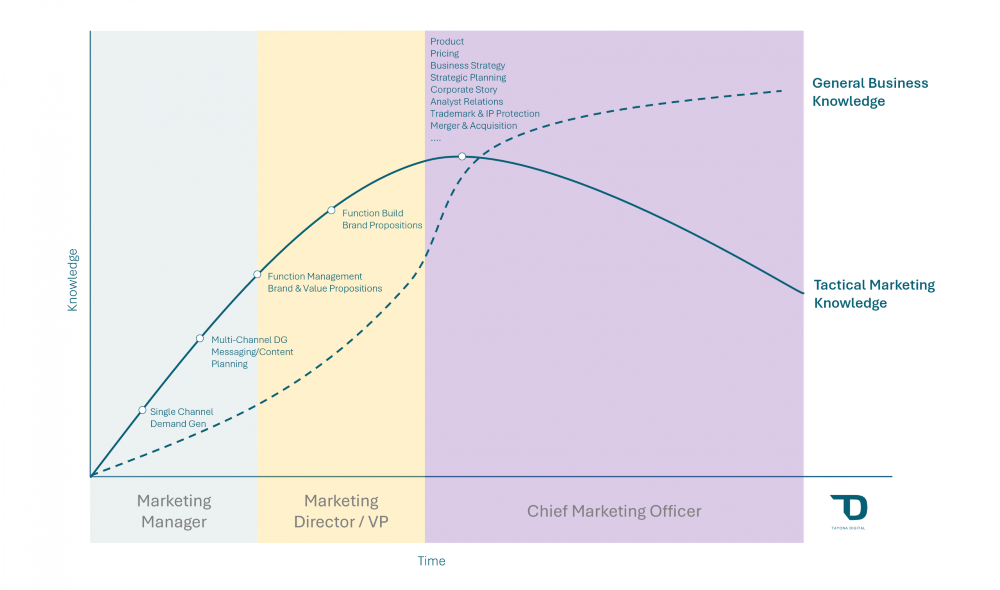
As a CMO, there comes a time where you don’t need to know the details of Google’s latest (unfathomable) Ad platform UI, or the intricacies of how LinkedIn’s 360Brew algorithm changes social reach. You have a team (or agencies) for that. So, it’s OK (and necessary) to relinquish some of that tactical, technical marketing expertise.
What you get in return is all the things you don’t typically get to experience as a less senior marketing director or VP. Like setting product direction or changing pricing. Like influencing analysts or protecting company trademarks and IP.
Like true strategic planning where you care about the company direction, funding mechanisms and the markets you participate in. Not just which campaigns or messages to run with.
Don’t misunderstand me. I think there are some amazing marketing directors out there that take to CMO roles like a duck to water. Fully capable of taking in it their stride. I don’t wish to belittle the critical role or impact of a great marketing manager or director.
For me, I don’t mind admitting the transition to CMO was a learning curve. There’s a big difference between reporting to a CEO on the latest campaign performance, and then sitting down with the board of directors and company lawyers about the implications of issuing a cease and desist to a well-funded competitor infringing on your copyright.
That’s exactly why I wanted to become a CMO. I love getting more involved working “on the business,” not just “in the business.” It’s also why I’ll admit I lost some of the sharpness on the latest, detailed marketing execution knowledge.
Related Article: CMOs: Be the Voice of the Market — Not Just Marketing
Why Full-Range Marketing Leadership Comes Too Late
At what point though do CMOs become true, full range marketers with the ability to set strategic direction and hold their own with the CEO and CFO? My fear is that not enough structured training or mentorship occurs for marketing managers and directors. Not enough opportunities to break the shackles of the promotion pigeonhole.
Company size and maturity will have a role to play here. The learning curve for a start-up CMO versus a large corporate will be markedly different. Yet the outcome is the same. Confidence to speak up about the entire way a company goes to market, not just what campaigns are run. Experience to know if fundamental changes in strategy are needed, or when the organizational model is not fit for purpose.
I believe marketers are incredibly well placed to be great business leaders. They are one of the few roles in the company that look beyond the month, quarter, or year. The very outlook that is needed to steer a business without getting stuck in the weeds.
They find ways to innovate with technology to drive efficiencies and savings. Managed multi-functional and highly-matrixed relationships between sales, finance, customer success and others. They know how competitors’ position and vie for the same business. The best will know what customers think and need, sometimes before they know themselves.
Yet there is a reason that marketers have the shortest tenure in the C-Suite. It’s a tough place to be. While they gain those commercial skills and experiences, they still need to be accountable and prove their worth today. Returns are expected to be immediate, although marketing (by design) should have the most impact on future revenues, not this quarter. All of this while the fundamentals of their discipline constantly changes under their feet.
I’m glad to say, after a year of running my own businesses (both consultancy and a SaaS business), and needing to get back into the tactical, it comes back! As a CMO it’s important to keep asking the questions of how, not just what and when. Go to those conferences, talk to peers, poke around in platforms and technologies. Not only will the marketing sharpness return, but fortunately the broader business leadership skills you picked up don’t change half as much.
 Learn how you can join our contributor community.