


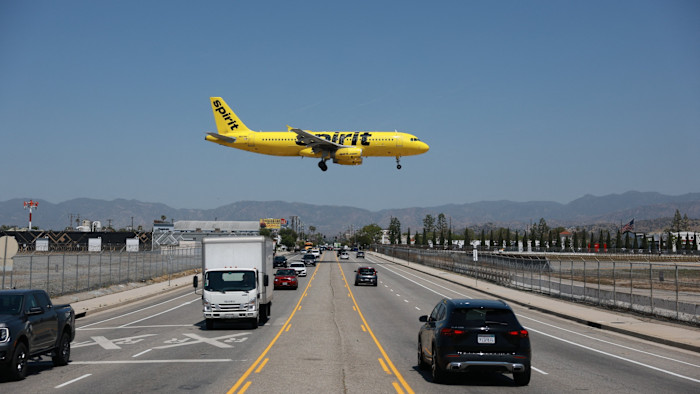
The Trump administration is looking to invest as much as $500mn in Spirit Airlines to fund the discount carrier’s exit from bankruptcy, the latest example of the US government taking a large stake in private enterprise, according to people familiar with the matter.
The government money would take the form of a senior loan with equity warrants that would come with it eventually owning a majority stake in Spirit, which has struggled with high operating costs, stiff competition and surging jet fuel costs amid the Iran war.
The airline’s share price more than tripled on Wednesday following reports of the talks.
Spirit filed for bankruptcy in August 2025 after emerging from a previous filing nine months earlier. The first bankruptcy eliminated nearly $1bn of financial debt. However, Spirit did not make any large operational changes. The current bankruptcy process has been used to slash jet leases and shrink its operations.
The Iran war has raised fuel prices and the carrier faces the prospect of being wound down and liquidated if it cannot secure a restructuring plan with its main bondholder creditors, which includes Citadel Americas, Cyrus Capital, Ares and Pimco.
According to people familiar with the situation, the bondholder group had not been briefed about the government rescue plan.
The people familiar with the situation cautioned there was no final deal in place yet and that negotiations could collapse.
During Donald Trump’s second term as president, the US government has taken stakes in a number of companies including a pair of rare-earth producers and chipmaker Intel.
But experts have questioned the Trump administration’s rationale for bailing out the struggling airline, which is headquartered in Trump’s adopted home state of Florida and employs more than 11,000 people.
“I can appreciate the government wanting to protect the consumer, but this would not help the industry,” said Savanthi Syth, an analyst with Raymond James. “It would actually hurt the industry and especially other low-cost and ultra-low-cost carriers, because you’re keeping inefficient capacity in the market that probably needs to go out.”
Spirit entered bankruptcy with nearly $3bn of financial debt and according to the US bankruptcy code holders of the debt will have a significant voice in any restructuring plan, which will also require approval by a federal bankruptcy judge.
In recent years, Spirit had looked to mergers with rivals Frontier and JetBlue, though a tie-up with the latter was terminated in 2024 under a legal challenge by then-president Joe Biden’s US justice department. A federal judge found the combination would be anti-competitive.
“We are operating our business as normal. Guests can continue to book, travel and use tickets, credits and loyalty points as usual,” a Spirit spokesperson said.
Spirit recorded a $2.76bn net loss in 2025 despite reducing departures by a quarter and its fleet by almost 40 per cent.
The airline has also struggled as a result of deep-pocketed network carriers with broader reach offering “basic economy” fare to lure price-sensitive passengers away from cheaper rivals.
It is attempting to move away from its previous “ultra-low-cost carrier” model by introducing more premium classes and seating, but has wrestled with managing fixed costs such as labour and aircraft rental and maintenance, furloughing pilots and flight attendants.
In March, the company said its initial restructuring objectives had been “largely accomplished” and have “dramatically improved earnings”, noting it was on track to reduce its operating margin loss to 5.6 per cent in the first quarter of 2026 from 27.1 per cent in the same period last year.
But analysts note that along with airlines around the world, Spirit will have been severely hit by a sharp rise in jet fuel resulting from the fallout from the unresolved Iran conflict.
The airline’s March Securities and Exchange Commission filing projected jet fuel to cost an average of $2.24 a gallon, falling to $2.14 a gallon in 2027. But following US and Israeli attacks on Iran at the end of February, the price of jet fuel soared to almost $5 a gallon, and is currently at about $4. According to JPMorgan analysts, the elevated cost of jet fuel could translate to $360mn in additional costs for Spirit this year.
In an interview with CNBC on Tuesday, President Donald Trump said he would “love” for somebody to buy Spirit Airlines, before suggesting: “Maybe the federal government should help that one out.”
Any government investment could prompt opposition from rival low-cost carriers in the US who are also struggling with higher jet fuel prices, given their passengers are likely to be more sensitive to ticket price rises.
Scott Kirby, chief executive of United Airlines, told investors on Wednesday that the fate of Spirit was not directly “relevant” to airlines like United with a loyal customer base more focused on premium and business travel.
But he added that “if I was working at one of the airlines that depended on more commoditised travel, I’d be irate, probably, about this”.
Aviation industry analyst Brett Snyder wrote in a recent commentary that other low-cost carriers affected by the economic fallout from Trump’s decision to launch strikes against Iran might also expect support.
“If the pitch is that fuel is expensive because of the government’s actions so the airline deserves a bailout, then who doesn’t deserve a bailout?” he wrote.
Additional reporting by Ray Douglas